
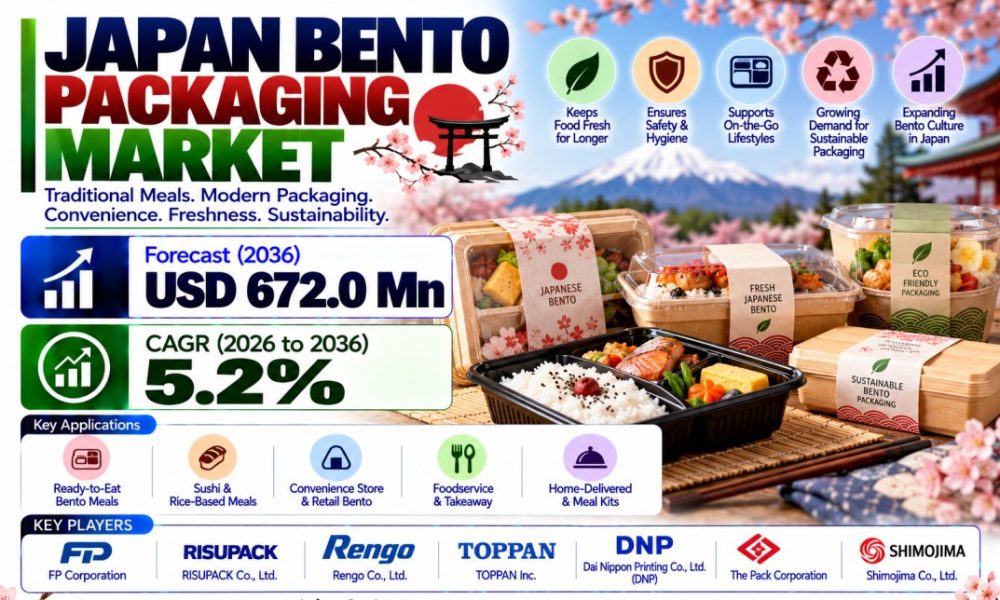
The Japan Bento Packaging Market is projected to grow from USD 404.8 million in 2026 to USD 672.0 million by 2036, registering a compound annual growth rate (CAGR) of 5.2%, according to Future Market Insights (FMI). The forecast represents an increase of USD 267.2 million over the ten-year period.
Bento packaging plays a functional role in Japan’s prepared-meal supply chain. Containers must keep separate food components intact during filling, stacking and transport while supporting efficient service at takeaway counters, retail delis and delivery operations. Packaging selection therefore depends on compartment design, closure performance and compatibility with the operator’s handling process.
Material selection is another consideration. Paperboard and other alternative structures can support packaging redesign, but they must meet grease-resistance, moisture-protection and heat-tolerance requirements for the intended meal. Food-contact compliance and the suitability of the final package also need to be established before a material change is approved.
👉 Get Detailed Market Forecasts, Competitive Benchmarking, and Pricing Trends: https://www.futuremarketinsights.com/reports/sample/rep-gb-35291
Standard Formats Lead Market Demand
Standard formats are projected to account for 37.0% of the market’s format-type segment in 2026, according to FMI. Repeatable dimensions can simplify filling, case packing and replenishment, particularly for operators managing multiple locations. Brands can adapt compartment layouts for different menus while retaining familiar container footprints.
The standard meal format is expected to represent 39.0% of format-size demand in 2026. Its compartment arrangement supports common meal configurations that combine a main item with separate side dishes. The design must preserve food separation while remaining practical for stacking, storage, transport and reheating where applicable.
Paperboard is estimated to hold 27.0% of material demand in 2026. Its printable surface and established converting processes make it relevant to prepared-food packaging. However, paperboard suitability depends on the complete construction, including barriers, coatings and closures. Fiber content alone does not establish that a container can protect wet or hot meals or be recovered through a particular recycling system.
Foodservice Operators Prioritize Speed and Reliability
Quick-service restaurant (QSR) chains are forecast to account for 31.0% of end-use demand in 2026. These operators require packaging that can be closed quickly, protect food during pickup or delivery and fit established kitchen routines.
Packaging changes can create operational challenges if a new container requires slower packing, different storage arrangements or additional staff handling. Buyers therefore need to evaluate pack-out speed, closure integrity and performance under realistic transport conditions before approving a new specification.
Broadline foodservice distributors are projected to lead the sales-channel segment with a 42.0% share in 2026. Their consolidated assortments can help operators replenish different container sizes and materials through established purchasing channels. Direct contracts remain relevant for custom programs and multi-site requirements.
Material Qualification and Recovery Remain Key Considerations
Japan’s food-contact framework affects which material structures operators can use. The Consumer Affairs Agency’s positive-list system applies to specified synthetic-resin materials used in food apparatus, containers and packaging. Buyers must verify the requirements that apply to their intended packaging construction and food-contact use.
Material conversion can also require additional testing. Grease resistance, moisture protection, sealing performance and heat tolerance need to be checked against the intended meal and service conditions. Recycling or reuse claims should likewise be supported by evidence for the actual package and its recovery route.
Nandini Roy Choudhury, Principal Consultant at Future Market Insights, said: “Bento packaging earns repeat orders when a tray protects separate meal components without slowing filling, stacking or delivery handoff. Material changes gain commercial value only after operators confirm the same line performance and a recovery route that works in the country of use.”
Suppliers Invest in Capacity and Packaging Development
FMI identifies FP Corporation, RISUPACK Co., Ltd., Rengo Co., Ltd., TOPPAN Inc., Dai Nippon Printing (DNP), The Pack Corporation, Shimojima, Koyo Pack Systems, Kureha and Mitsui Chemicals among the companies reviewed in the market.
Recent developments highlighted in the report include FP Corporation’s approval of a new plant and distribution-center investment in April 2026. In August 2026, RISUPACK began a Kansai plant expansion for biomass-plastic food-container capacity. These developments point to continued investment in production and supply capabilities for prepared-food packaging.
The companies operate across different parts of the packaging value chain, from rigid meal containers and paper conversion to barrier materials and specialty films. Buyers should assess suppliers according to the specific format, food-contact requirements, production volume and technical support needed for their application.
Access detailed market insights: https://www.futuremarketinsights.com/reports/brochure/rep-gb-35291
Outlook Through 2036
FMI forecasts the Japan Bento Packaging Market to reach USD 672.0 million by 2036, with growth at a 5.2% CAGR from 2026. Commercial opportunities will depend on packaging that protects food quality while meeting the speed and reliability requirements of prepared-meal operations.
For foodservice operators and packaging buyers, the priority is to validate container geometry, closure performance, material compliance and end-of-life arrangements together. These checks can help reduce the risk of material changes that fail during production, delivery or recovery.
To explore how FMI Custom Research can support your strategic priorities, connect with our team at – [email protected]



