
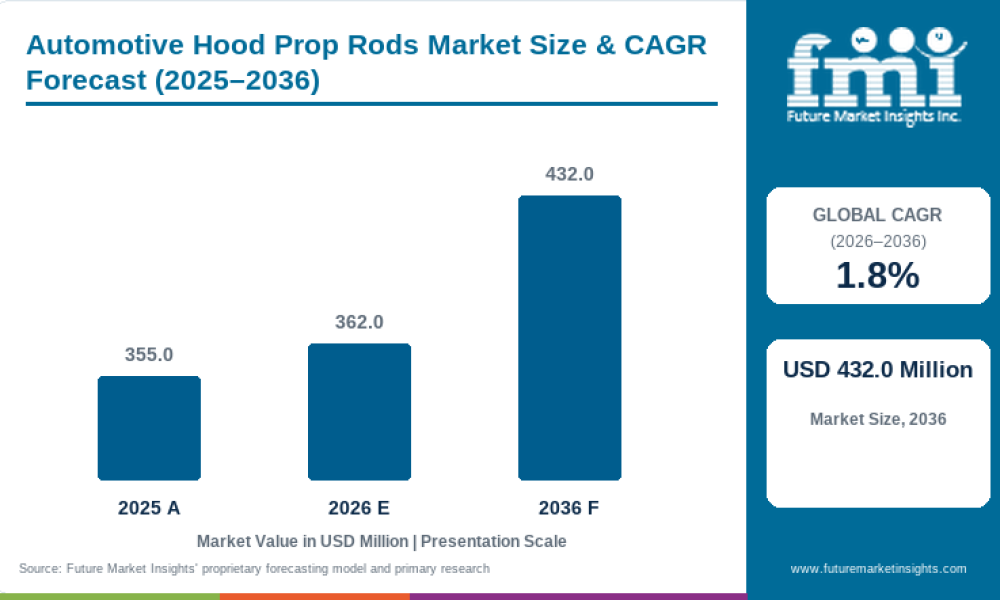
The global automotive hood prop rods market is estimated at USD 362.0 million in 2026 and is projected to reach USD 432.0 million by 2036, expanding at a 1.8% CAGR over the forecast period. The market was valued at USD 355.0 million in 2025. Demand is tied to vehicle production, manual hood-support fitment, and replacement of bent, missing, or corroded assemblies.
Automotive hood prop rods are rigid or telescopic components designed to manually hold an automotive hood or front access panel in the open position. The market includes integrated tips, clips, and retainers sold as part of the assembly. Gas springs, hood hinges, and powered actuators are excluded from the market estimate.
Prop rods operate within the broader hood-opening system, alongside components such as bonnet lock plates and latches. Their market performance depends on vehicle platform specifications, material selection, manufacturing costs, and the continued use of manual hood-support mechanisms.
What Are the Key Segments in the Automotive Hood Prop Rods Market?
Passenger cars are projected to account for 72.0% of market demand in 2026, reflecting their broad production base and established use of manual hood-support components across vehicle platforms.
Coated steel is expected to hold 74.0% of the rod-material segment in 2026. Its economical stiffness and compatibility with established coating processes support its use in conventional prop-rod assemblies.
Bent hook rod designs and ends are projected to represent 49.0% of segment demand in 2026. Their formed geometry enables engagement and load transfer with relatively few components, supporting straightforward manufacturing and assembly.
The market is segmented by vehicle type, rod material, rod design and end, hood material, sales channel, and region. Vehicle categories include passenger cars, light commercial vehicles, medium and heavy commercial vehicles, and buses and coaches. Material categories include coated steel, stainless steel, aluminum, composites, and other materials. Sales channels include OEM supply and the aftermarket.
Get detailed market forecasts, competitive benchmarking, and pricing trends:
https://www.futuremarketinsights.com/reports/sample/rep-gb-35596
Which Countries Are Showing the Strongest Growth in the Automotive Hood Prop Rods Market?
Indonesia is projected to lead the profiled countries with a 5.2% CAGR through 2036. Its outlook reflects potential demand associated with vehicle production and the continued specification of manual hood-support assemblies. The adoption of alternative hood-support technologies will influence the pace of conventional prop-rod demand.
India is expected to expand at a 5.0% CAGR. Demand opportunities are linked to vehicle manufacturing, OEM component sourcing, and replacement requirements for manual hood-support assemblies. Suppliers must balance cost, corrosion resistance, and reliable retention performance to meet vehicle program requirements.
Türkiye is projected to record a 3.0% CAGR, with demand influenced by vehicle manufacturing and component supply requirements. Rod durability, coating quality, and compatibility with hood designs remain relevant factors for manufacturers and suppliers.
Brazil is expected to grow at a 2.8% CAGR. Demand is associated with vehicle production and the continued use of conventional support mechanisms, alongside aftermarket replacement of damaged or corroded rods.
Mexico is projected to expand at a 2.7% CAGR. OEM sourcing and vehicle assembly requirements remain important factors in the country’s outlook, while platform-level decisions about manual or assisted hood opening affect the addressable market.
China is expected to record a 1.5% CAGR among the profiled countries. Market development will depend on vehicle output, prop-rod specifications, and the extent to which manufacturers continue using manual support systems alongside gas springs and powered alternatives.
How Is the Competitive Landscape Evolving?
The competitive landscape includes GM Genuine Parts, Ford Service Parts, Mopar, Nissan Genuine Parts, Dorman Products, NAPA, Stabilus, SUSPA, Lesjöfors, and Edscha. These participants operate across genuine replacement parts, aftermarket distribution, and hood-support component technologies.
Competition in conventional prop rods is influenced by manufacturing economics, fitment compatibility, corrosion resistance, retention reliability, and replacement-part availability. OEM suppliers must meet platform-specific requirements, while aftermarket providers serve vehicle owners and repair channels seeking compatible replacement assemblies.
The presence of companies involved in gas springs and other hood-support technologies also reflects competition between manual and assisted opening systems. As vehicle manufacturers evaluate convenience, packaging, and cost, the choice of hood-support mechanism affects demand for conventional prop rods.
What Does the Analyst Say About the Automotive Hood Prop Rods Market?
Future Market Insights Principal Consultant Nikhil Kaitwade observes:
“The hood prop rod survives because it solves a safety-critical holding task with one formed part. Its weakness is convenience, which is exactly where gas springs and powered systems compete.”
The assessment highlights the central trade-off shaping the market. Conventional prop rods offer a relatively simple mechanical solution for holding a hood open, but alternative mechanisms can provide easier operation and may be preferred in vehicle designs that emphasize convenience.
Drive Your Business Growth Strategy: Checkout the Report for Key Insights!
https://www.futuremarketinsights.com/checkout/35596
What Is Driving Demand for Automotive Hood Prop Rods?
Vehicle production and OEM fitment
New vehicle production remains a core source of demand. Where a vehicle platform uses a manual hood-support mechanism, the prop rod must be specified to suit the hood geometry, required support position, and relevant assembly interfaces. Passenger cars represent the largest vehicle-type segment, accounting for a projected 72.0% share in 2026.
Replacement of worn or damaged assemblies
The aftermarket supports demand when prop rods become bent, corroded, or missing. Replacement requirements depend on the condition of the component, vehicle age, repair practices, and the availability of compatible parts. Integrated tips, clips, and retainers can also affect replacement selection when the assembly is supplied as a complete unit.
Cost-effective materials and simple designs
Coated steel is projected to hold 74.0% of the rod-material segment in 2026. Its combination of stiffness, cost efficiency, and compatibility with established coating processes supports its use in conventional designs. Bent hook configurations also remain relevant because their formed ends provide engagement and load transfer without requiring an unnecessarily complex assembly.
What Are the Key Market Restraints?
The adoption of gas springs, spring-assist hinges, and powered hood mechanisms is a principal restraint on conventional prop-rod demand. These alternatives can improve opening convenience and reduce the need for a separate manually positioned support rod. Their use in higher-content vehicles can therefore limit prop-rod fitment on new platforms.
The market’s projected 1.8% CAGR also reflects its established component role. Demand depends substantially on vehicle production, platform specifications, and replacement activity rather than on a standalone technology transition. Suppliers must maintain cost competitiveness while meeting durability and corrosion-resistance expectations.
What Opportunities Exist for Automotive Hood Prop Rod Suppliers?
Suppliers can focus on reliable, cost-effective assemblies for vehicle platforms that retain manual hood supports. Opportunities include improving coating performance, maintaining consistent rod geometry, and supplying compatible tips, clips, and retainers as integrated assemblies.
Aftermarket availability is another relevant area. A broad range of compatible replacement parts can help distributors and repair channels address bent, missing, or corroded prop rods. Manufacturers that can provide dependable fitment and consistent quality may strengthen their position in both OEM and replacement channels.
What Is the Outlook for the Automotive Hood Prop Rods Market?
The automotive hood prop rods market is projected to increase from USD 362.0 million in 2026 to USD 432.0 million by 2036, at a 1.8% CAGR. Passenger cars, coated steel rods, and bent hook designs represent the leading segments based on the supplied 2026 estimates.
Indonesia and India are the fastest-growing profiled markets, at CAGRs of 5.2% and 5.0%, respectively. However, the growing use of gas springs and powered hood mechanisms remains an important competitive consideration for suppliers of conventional manual-support assemblies.
About Future Market Insights
Future Market Insights (FMI) provides market research and consulting services across industries, delivering market forecasts, competitive intelligence, and strategic analysis to support business decision-making.



