
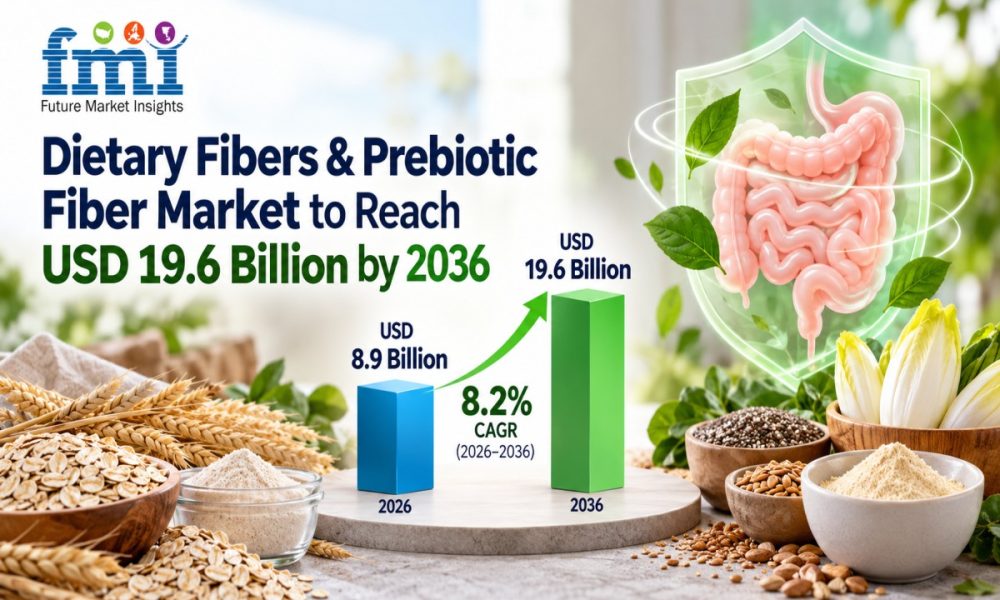
Summary: The global dietary fibers and prebiotic fiber market is projected to grow from USD 8.9 billion in 2026 to USD 19.6 billion by 2036, registering an 8.2% CAGR. Demand is supported by nutrition-focused reformulation, rising fiber targets, and multifunctional ingredients, while digestive tolerance, sensory performance, and claim substantiation remain critical adoption considerations.
The global dietary fibers and prebiotic fiber market is gaining momentum as food manufacturers incorporate fiber enrichment into everyday products without compromising taste, texture, or processing performance. Future Market Insights (FMI) estimates that the market will increase from USD 8.9 billion in 2026 to USD 19.6 billion by 2036, at an 8.2% CAGR. Commercial demand increasingly depends on whether ingredients deliver credible nutrition positioning at practical inclusion levels while maintaining finished-product quality.
Global Dietary Fibers & Prebiotic Fiber Market Snapshot
- 2026 market value: USD 8.9 billion
- 2036 forecast: USD 19.6 billion
- CAGR (2026–2036):2%
- Leading type: Inulin, with a projected 39.0% share in 2026
- Leading source: Plant-based fiber, with an estimated 50.4% share
- Leading application: Bakery, accounting for 37.9% of application demand
- Leading country: USA, projected to grow at an 8.7% CAGR
Get detailed market forecasts, competitive benchmarking, and pricing trends:
https://www.futuremarketinsights.com/reports/sample/rep-gb-34650
Why Is the Dietary Fibers & Prebiotic Fiber Market Growing?
Demand is expanding as nutrition guidance and product-label requirements encourage manufacturers to reconsider fiber content across frequently consumed food categories. However, ingredient suppliers must demonstrate that fiber enrichment can meet formulation targets without creating unacceptable changes in taste, texture, or digestive tolerance.
Tate & Lyle reported in May 2025 that new-product revenue increased 9% amid strong fiber demand within its food and beverage business. This illustrates the commercial importance of ingredients that support reformulation while preserving finished-product performance.
Inulin Leads the Type Segment
Inulin is projected to account for 39.0% of the market by type in 2026, supported by its role in soluble fiber enrichment and prebiotic positioning. Food formulators also use inulin in selected reduced-sugar and reduced-fat applications to contribute solids and body while adjusting nutritional profiles.
China’s State Administration for Market Regulation published an English version of its inulin quality requirement in September 2025, providing a common quality reference for domestic and imported ingredients.
Plant-Based Sources Maintain Their Lead
Plant-based fiber is estimated to hold a 50.4% share in 2026, reflecting the availability of diverse botanical feedstocks and established ingredient applications. Chicory and cereal inputs support familiar fortification approaches, while acacia and citrus fibers provide alternative sensory profiles and sourcing options.
Bakery Leads Application Demand
Bakery is expected to account for 37.9% of application demand in 2026. High-throughput production systems provide a practical route for incorporating dry fiber ingredients into doughs and batters during routine mixing.
Industrial bakers, however, must balance nutritional improvement with water binding, machinability, crumb structure, and flavor. The Netherlands Institute for Public Health and the Environment reported in June 2026 that Dutch supermarket brown bread contained 0.3 grams more fiber per 100 grams than products in 2020, documenting changes in a monitored bakery category.
Key Drivers, Restraints, and Opportunities
Driver — Nutrition guidance: Government dietary recommendations provide measurable reasons to increase fiber content across frequently consumed foods. The 2025–2030 Dietary Guidelines for Americans, released in January 2026, prioritize whole grains and nutrient-dense foods, supporting fiber-focused reformulation.
Restraint — Claim substantiation and tolerance: Prebiotic positioning requires evidence beyond a basic fiber declaration in markets with specific health-claim requirements. The European Food Safety Authority’s health-claims framework makes scientific substantiation an important consideration during commercial qualification. Higher inclusion levels can also create digestive-tolerance concerns or compromise sensory performance.
Opportunity — Multifunctional reformulation: Ingredients that improve nutritional profiles while protecting texture can attract additional development budgets. Tate & Lyle began operating with CP Kelco as one combined business in April 2025, bringing fiber fortification closer to a broader texture-focused ingredient portfolio.
Country-Level Growth Outlook
FMI projects the following CAGRs for the dietary fibers and prebiotic fiber market from 2026 to 2036:
- USA — 8.7%: Demand is supported by packaged-food reformulation, although label eligibility and sensory testing remain important commercial requirements.
- India — 8.4%: Familiar cereal and dairy formats provide opportunities, while price sensitivity influences inclusion levels in mass-market products.
- China — 8.0%: Nutrition targets support reformulation, while evolving dietary-fiber testing methods increase the value of locally reproducible results.
- Netherlands — 7.6%: Supermarket bakery reformulation creates opportunities for ingredients that preserve established dough handling and bread texture.
- Germany — 6.8%: Established fiber awareness supports demand across bakery and cereal categories, with processing stability and claim evidence remaining essential.
Competitive Landscape
The market includes specialized fiber producers and diversified ingredient companies competing through ingredient chemistry, application coverage, evidence, and regional supply capabilities.
Key companies profiled by FMI include BENEO, Roquette, Ingredion, Tate & Lyle, ADM, IFF, Cosun Ingredients, and Nexira.
BENEO and Cosun Ingredients focus on chicory-root inulin and fructan fibers. Roquette and ADM offer soluble starch- or dextrin-based fiber solutions, while Tate & Lyle combines fiber ingredients with broader formulation capabilities. Ingredion and Nexira participate in citrus and acacia fiber categories, and IFF supplies polydextrose-based ingredients for bakery and other applications.
Key developments include:
- February 2026: Roquette announced NutraStrong Prebiotic Verified certification from SGS Nutrasource for three specified NUTRIOSE soluble fiber references.
- September 2025: ADM announced Australian Therapeutic Goods Administration approval for Fibersol soluble prebiotic fiber as an active ingredient in regulated health products.
- September 2025: BENEO announced Thai FDA approval for an exclusive prebiotic claim covering Orafti Inulin following scientific evaluation by Thailand’s CNACT.
What Does the Market Mean for Industry Decision-Makers?
The dietary fibers and prebiotic fiber market offers growth opportunities for ingredient suppliers that connect nutrition objectives with reliable formulation performance. Inulin, plant-based sources, and bakery applications represent important demand areas, but segment leadership alone does not guarantee commercial adoption.
Manufacturers and suppliers need to validate inclusion levels, document relevant claims, manage digestive tolerance, and preserve taste and texture during scale-up. Companies that combine credible evidence with application expertise and consistent ingredient specifications are better positioned to convert reformulation projects into repeat orders.
For complete market forecasts, segment analysis, and competitive insights, access the full report:
https://www.futuremarketinsights.com/reports/dietary-fibers-and-prebiotic-fiber-market
About Future Market Insights (FMI)
Future Market Insights (FMI) provides market intelligence and consulting services to businesses across industries. Its research supports strategic planning through market sizing, forecasts, competitive analysis, and assessments of industry trends and growth opportunities.



