
Summary: Global pet food ingredients and sustainable protein market is set to reach USD 84.0 billion by 2036, driven by recurring pet-food production, established animal protein demand, and growing emphasis on sustainable sourcing and ingredient traceability.
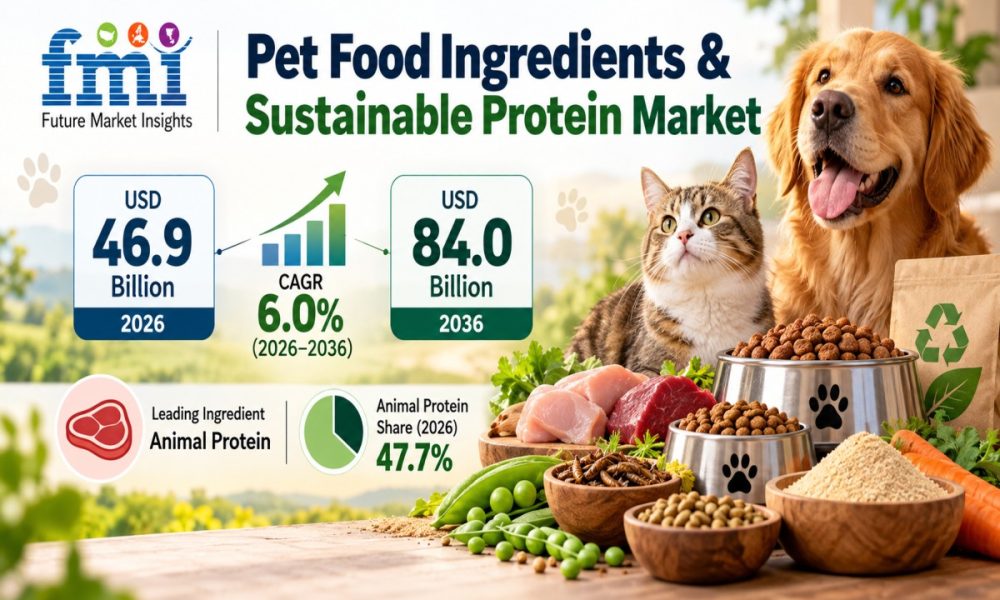
The global pet food ingredients & sustainable protein market is expanding as manufacturers balance nutritional requirements, palatability, supply continuity, and sustainability goals. The market is projected to grow from USD 46.9 billion in 2026 to USD 84.0 billion by 2036, registering a 6.0% CAGR during the forecast period, according to the latest insights by Future Market Insights (FMI).
Global Pet Food Ingredients & Sustainable Protein Market Snapshot
2026 market value: USD 46.9 billion
2036 forecast: USD 84.0 billion
CAGR, 2026–2036: 6.0%
Leading ingredient: Animal protein
Animal protein share, 2026: 47.7%
Leading product: Dry pet food
Dry product share, 2026: 46.3%
Leading claim category: Sustainable
Sustainable claim share, 2026: 64.3%
Leading profiled country: China
China CAGR: 6.7%
Get detailed market forecasts, competitive benchmarking, and pricing trends:
https://www.futuremarketinsights.com/reports/sample/rep-gb-34694
Why Is the Pet Food Ingredients & Sustainable Protein Market Growing?
Recurring pet-food production sustains demand for dependable protein and functional ingredients across dry food, wet food, and treats. FEDIAF reported European pet-food production of approximately 8.6 million tonnes in 2024, highlighting the scale of ingredient purchasing required by established manufacturing operations.
Manufacturers are also broadening protein sourcing as sustainability and traceability become more important in ingredient qualification. However, alternative ingredients must meet nutritional specifications, processing requirements, and regulatory expectations before they can secure repeat commercial orders.
Animal Protein Leads the Ingredient Category
Animal protein is estimated to account for 47.7% of ingredient demand in 2026, making it the leading ingredient category.
Its position reflects established sourcing networks, familiar nutritional specifications, and predictable palatability characteristics. Conventional meat ingredients are widely used in commercial recipes, allowing manufacturers to maintain consistent nutritional profiles across production runs.
Why Does Dry Pet Food Lead the Product Category?
Dry pet food is projected to represent 46.3% of product demand in 2026.
The category benefits from scalable extrusion processes and shelf-stable distribution. However, extrusion exposes ingredients to heat and mechanical shear, making consistent protein composition and processing performance important considerations for manufacturers.
Mars opened Royal Canin’s Lewisburg dry pet-food facility in May 2025, with annual output sufficient to feed four million pets. Manufacturing at this scale favors ingredients that maintain nutritional quality and processing consistency throughout commercial production.
Sustainable Claims Strengthen Ingredient Qualification
The sustainable claim category is forecast to account for 64.3% of claim demand in 2026.
Traceability is becoming an important consideration when manufacturers assess conventional and alternative protein sources. Plant-based and insect-derived proteins offer additional sourcing options, while novel proteins may help diversify ingredient supply.
Mars Petcare and Big Idea Ventures launched the Next Generation Pet Food Program in May 2026 to identify alternative proteins and novel ingredients. Nevertheless, unfamiliar ingredients must demonstrate safety, nutritional adequacy, and formulation compatibility before moving into recurring production.
Regulatory Review Creates Opportunities and Challenges
Novel proteins face qualification requirements that can extend commercialization timelines. Manufacturers must establish regulatory eligibility and complete formulation and feeding assessments before committing to larger purchasing volumes.
In July 2025, the U.S. Food and Drug Administration issued final guidance on its Animal Food Ingredient Consultation process, providing developers with a regulatory consultation route for animal-food ingredients.
A further development came in May 2026, when Hill’s Pet Nutrition and Bond Pet Foods reported receiving an FDA no-objection letter for Lamb Protein Yeast following a six-month dog feeding study. The milestone illustrates how evidence and regulatory review can help precision-fermentation proteins progress toward commercial applications.
China Leads the Profiled Country Growth
China is projected to register a 6.7% CAGR through 2036, supported by rising pet-feed production and demand for documented ingredients. The China Feed Industry Association reported in February 2026 that pet-feed output reached 1.884 million tonnes in 2025, increasing 17.9%.
Brazil follows with a 6.3% CAGR, supported by domestic ingredient availability and established processing. Manufacturers must still manage delivered costs and demonstrate that alternative proteins can maintain nutritional specifications and competitive finished-product pricing.
The United States is projected to grow at 5.9% CAGR, with established manufacturing capacity and regulatory review shaping the adoption of unfamiliar ingredients.
The United Kingdom is forecast to record a 5.5% CAGR, as traceable sourcing, retailer expectations, and dependable ingredient supply influence supplier selection.
Germany is projected to register a 5.1% CAGR, reflecting mature pet-food channels where recipe economics, consistent quality, and transparent ingredient origins remain important.
Competitive Landscape: Mars Petcare, Nestlé Purina and ADM Shape Market Development
The competitive environment spans branded pet-food manufacturers, ingredient suppliers, and alternative-protein specialists.
Mars Petcare, Nestlé Purina and Hill’s Pet Nutrition influence ingredient specifications through finished-product formulation and validation requirements. ADM, Cargill and Symrise Pet Food provide ingredient and formulation capabilities for commercial pet-food programs.
Protix and Bond Pet Foods focus on alternative proteins, including insect-based ingredients and precision-fermented proteins. Their commercial opportunities depend on regulatory progress, reliable production, and the ability to meet manufacturer specifications consistently.
Competition increasingly depends on nutritional performance, traceable sourcing, regulatory readiness, and production scale. Suppliers that demonstrate dependable quality and practical formulation compatibility are better positioned to secure repeat orders.
What Does the Market Mean for Industry Decision-Makers?
The 6.0% CAGR indicates sustained demand for pet-food ingredients as manufacturers expand production and evaluate additional protein sources.
For pet-food companies, the priority is balancing nutrition, palatability, processing performance, and ingredient costs. For alternative-protein developers, regulatory documentation, feeding evidence, and supply consistency are essential to converting trials into commercial contracts.
The strongest opportunities are likely to emerge where verified nutrition, traceable sourcing, and reliable manufacturing performance support sustainable ingredient adoption.
Get the Complete Story—Read More About Our Latest Report:
https://www.futuremarketinsights.com/reports/pet-food-ingredients-and-sustainable-protein-market
Related Food & Beverages Industry Reports
For companies tracking protein innovation and ingredient sourcing across animal nutrition, relevant FMI research areas include:
Animal Feed Market
Insect Protein Market
Plant-Based Protein Market
Pet Food Market
Alternative Protein Market
About Future Market Insights (FMI)
Future Market Insights, Inc. is an ESOMAR-certified, ISO 9001:2015 market research and consulting organization trusted by Fortune 500 companies. With a global presence across the U.S., UK, India and Dubai, FMI delivers data-driven insights across 30+ industries and 1,200 markets worldwide.



