
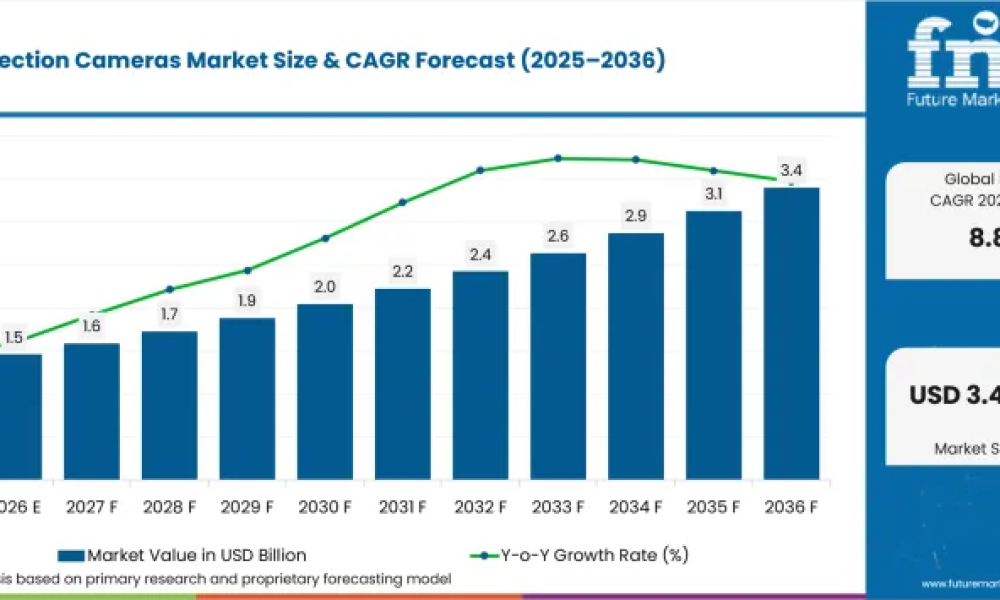
According to Future Market Insights (FMI), the global object detection cameras market is projected to reach USD 3.4 billion by 2036, rising from USD 1.5 billion in 2026 and expanding at an 8.8% CAGR during the forecast period. Increasing adoption of camera-based perception systems for hazard identification, supervised collision avoidance, and autonomous maritime operations is supporting market growth.
Object detection cameras are increasingly being considered as part of vessel perception systems rather than solely as passive recording equipment. Their ability to identify and classify objects can provide additional situational awareness for navigation and safety applications. However, low-visibility performance and compatibility with vessel systems remain important considerations for safety-relevant deployments.
Get Detailed Market Forecasts, Competitive Benchmarking, and Pricing Trends: https://www.futuremarketinsights.com/reports/sample/rep-gb-35319
Key Market Highlights
- The object detection cameras market is projected to reach USD 3.4 billion by 2036.
- Market value is expected to rise from USD 1.5 billion in 2026.
- The market is forecast to expand at an 8% CAGR from 2026 to 2036.
- Visible-light cameras are estimated to account for 0% of camera type demand in 2026.
- Floating objects represent approximately 0% of detection scope.
- Camera-only processing accounts for around 0% of demand by processing approach.
- Bridge-integrated object recognition is broadening the potential application of camera-based detection.
- Low-visibility performance and vessel-system compatibility remain important limitations for safety-relevant applications.
Analyst Viewpoint
Object detection cameras are moving beyond conventional video recording toward active perception applications in maritime environments. Shipowners and vessel operators are increasingly evaluating camera systems based on their ability to identify and classify potential hazards rather than simply capture visual information.
The evolution of maritime autonomy is also creating new requirements for perception technologies. The International Maritime Organization adopted the non-mandatory MASS Code in May 2026, incorporating navigation requirements for autonomous cargo ships. This regulatory development provides additional context for the need to integrate perception capabilities into vessel navigation architectures.
Why Is the Object Detection Cameras Market Growing?
The growing complexity of maritime navigation and the development of autonomous and semi-autonomous vessel technologies are increasing the importance of environmental perception.
Object detection cameras can provide visual information that supports the identification of floating objects, hazards, and other navigational elements. When integrated with bridge systems, these cameras can contribute to supervised collision-avoidance workflows and broader vessel situational awareness.
This is shifting investment from passive imaging toward systems capable of interpreting visual information and providing actionable detection outputs.
Key Growth Drivers
Shift Toward Active Maritime Perception
Shipowners are increasingly evaluating camera technologies based on their ability to detect and classify objects. This represents a shift from conventional recording systems toward perception technologies supporting navigation and safety functions.
Growth of Autonomous and Semi-Autonomous Shipping
The development of autonomous cargo ships is increasing the need for onboard technologies capable of observing and interpreting the surrounding environment. Camera-based object detection can form part of the perception layer required for such systems.
Bridge-Integrated Object Recognition
Integration with vessel bridge systems can expand the usefulness of object detection cameras by connecting visual recognition with navigation workflows. This can support operators in monitoring potential hazards and maintaining situational awareness.
Increasing Focus on Collision Avoidance
Object detection capabilities can help identify floating objects and other potential hazards within the vessel’s operating environment. Such capabilities are increasingly relevant to supervised collision-avoidance applications where human operators remain involved in navigation decisions.
Methodology: https://www.futuremarketinsights.com/methodology
Segment Analysis
Visible-Light Cameras Lead by Camera Type
Visible-light cameras are estimated to account for 28.0% of camera type demand in 2026. These systems provide visual information for object recognition and can serve as an important component of vessel perception architectures.
Floating Objects Represent a Leading Detection Scope
Floating objects account for approximately 26.0% of detection scope in 2026. Identifying objects on or near the water surface is relevant to navigation awareness and collision-avoidance applications.
Camera-Only Processing Holds a Significant Share
Camera-only processing represents approximately 25.0% of demand in 2026. These systems rely primarily on camera-derived information for object detection, while broader vessel architectures may combine multiple sources of perception data.
Market Dynamics
Drivers
- Growing demand for maritime perception systems.
- Increasing development of autonomous and semi-autonomous vessels.
- Expansion of bridge-integrated object recognition.
- Greater focus on supervised collision avoidance and hazard detection.
Restraints
- Reduced detection performance in low-visibility conditions.
- Vessel-system compatibility requirements can complicate integration.
- Safety-relevant applications require dependable detection performance.
- Integration with existing navigation systems can increase implementation complexity.
Trends
- Transition from passive video recording toward active object recognition.
- Increasing integration of cameras with vessel bridge systems.
- Growing interest in camera-based collision-avoidance support.
- Development of perception architectures for autonomous maritime operations.
Regional and Industry Outlook
The object detection cameras market is supported by developments across maritime navigation, vessel automation, and autonomous shipping. Demand is influenced by the need to improve situational awareness and provide additional perception capabilities for operators and autonomous systems.
The maritime industry’s gradual movement toward autonomous and semi-autonomous operations is increasing the relevance of object detection technologies. However, deployment in safety-relevant applications remains dependent on reliable performance across different visibility conditions and compatibility with existing vessel navigation architectures.
Competitive Landscape
Competition in the object detection cameras market is shaped by camera performance, detection capabilities, processing architecture, integration flexibility, and suitability for maritime operating environments.
Technology providers are increasingly focused on solutions that can connect visual recognition with vessel bridge and navigation systems. The ability to provide reliable detection while accommodating challenging maritime visibility conditions remains an important consideration for system adoption.
Key Players:
- Orca AI
- Teledyne FLIR
- Garmin Ltd.
- Furuno Electric Co., Ltd.
- Sea Machines Robotics
- Avikus (HD Hyundai)
- Axis Communications
- Hangzhou Hikvision Digital Technology Co., Ltd.
Future Outlook
The object detection cameras market is expected to maintain strong growth through 2036 as maritime operators increasingly invest in perception technologies for navigation awareness, hazard identification, and supervised collision avoidance.
The market is projected to expand from USD 1.5 billion in 2026 to USD 3.4 billion by 2036 at an 8.8% CAGR. Future demand will remain closely linked to autonomous vessel development, bridge-system integration, object-recognition capabilities, and the broader transition from passive recording toward active perception.
As maritime automation advances, camera systems will increasingly be evaluated not only on image quality but also on detection reliability, integration capability, and performance under challenging visibility conditions.
Frequently Asked Questions
- How big is the object detection cameras market in 2026?
The global object detection cameras market is estimated at USD 1.5 billion in 2026.
- What is the object detection cameras market forecast for 2036?
The market is projected to reach USD 3.4 billion by 2036.
- What is the CAGR of the object detection cameras market?
The market is expected to expand at an 8.8% CAGR between 2026 and 2036.
- Which camera type holds the leading share?
Visible-light cameras are estimated to account for 28.0% of camera type demand in 2026.
- What represents a leading detection scope?
Floating objects account for approximately 26.0% of detection scope in 2026.
About Future Market Insights (FMI)
Future Market Insights, Inc. (FMI) is an ESOMAR-certified, ISO 9001:2015 market research and consulting organization, trusted by Fortune 500 clients and global enterprises. With operations in the U.S., UK, India, and Dubai, FMI provides data-backed insights and strategic intelligence across 30+ industries and 1200 markets worldwide.
Contact Us:
Future Market Insights Inc.
Christiana Corporate, 200 Continental Drive,
Suite 401, Newark, Delaware – 19713, USA
T: +1-347-918-3531



