
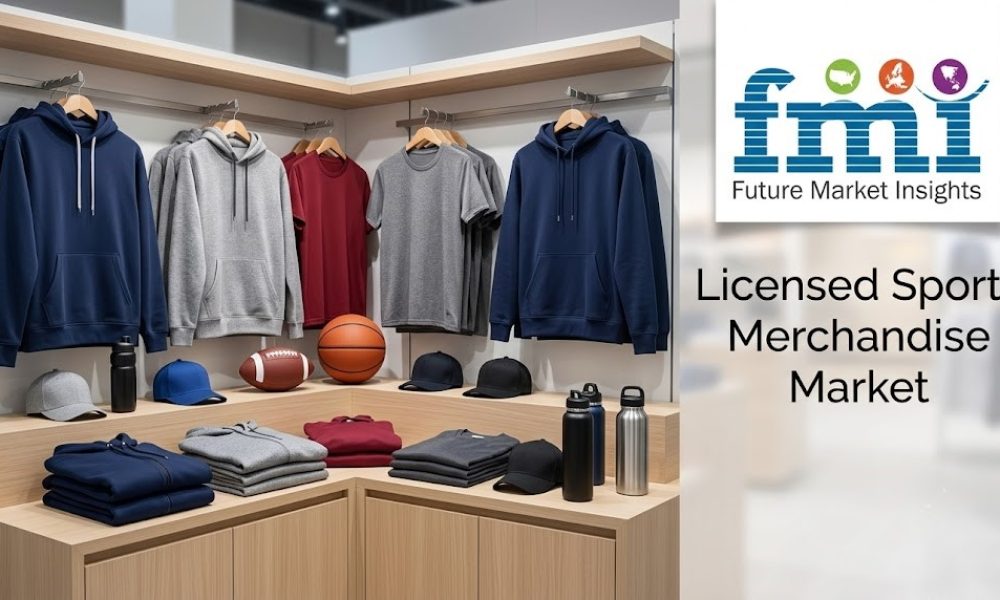
The global licensed sports merchandise market is projected to increase from USD 40.5 billion in 2026 to USD 64.6 billion by 2036, expanding at a 4.8% CAGR during the forecast period, according to a new report by Future Market Insights (FMI). The market was valued at USD 38.6 billion in 2025, with growing online access, recurring league merchandise releases, major sporting events, and demand for everyday fan apparel supporting continued expansion.
The market is increasingly shifting beyond match-day purchases. Fans are buying officially licensed jerseys, tops, hoodies, jackets, headwear, collectibles, and accessories as part of everyday clothing and lifestyle consumption. Official online storefronts are also giving rights owners and licensees greater control over product availability, authentication, pricing, and replenishment.
Sports Apparel Leads Product Demand
- Sports apparel is projected to account for 5% of product type sales in 2026, making it the largest category within the market. Jerseys and tops benefit from repeat buying tied to annual kits, club identity, athlete visibility, tournament cycles, and everyday wear.
- League and club licenses are expected to represent 0% of license type demand in 2026. Recurring season launches and team identity create repeated purchasing opportunities, while limited releases and event-linked collections add shorter demand peaks.
- Core season releases are forecast to account for 0% of release model demand in 2026. Annual team assortments provide a predictable sales base, while limited drops, event capsules, personalized products, and vintage merchandise create additional opportunities for retailers and licensees.
Get detailed market forecasts, competitive benchmarking, and pricing trends: https://www.futuremarketinsights.com/reports/sample/rep-gb-16642
Online Channels Reshape Fan Merchandise Distribution
Online channels are projected to represent 61.0% of distribution demand in 2026. Official e-commerce stores allow rights owners and retailers to reach fans beyond stadiums, club shops, and local retail networks.
Centralized online assortments also provide greater flexibility in testing new designs, tracking sell-through, managing inventory, and replenishing high-demand products. This becomes particularly relevant when athlete visibility, match results, playoff runs, or tournament events trigger sudden changes in buying activity.
Major sporting events are adding another layer of demand. In December 2025, Fanatics said it would operate official FIFA World Cup 2026 on-site retail for 104 matches across 16 host cities, demonstrating the growing importance of event-specific retail infrastructure and inventory planning.
Fan Identity Extends Beyond Match Day
Licensed merchandise is increasingly connected to everyday apparel consumption. Fans are purchasing team and league products for regular wear rather than treating merchandise solely as souvenirs.
Football is estimated to account for 31.0% of sport type demand in 2026, supported by overlapping club, national team, and international tournament buying cycles. League and club merchandise also benefits from annual kit releases and rivalry-related product launches.
Mid-price merchandise is expected to hold 44.0% of price-range demand in 2026, reflecting consumer consideration of authenticity, durability, design, and everyday wearability.
Counterfeit Products Remain a Market Challenge
Unauthorized and counterfeit merchandise remains a significant challenge for official licensees and rights owners. Lower-priced unlicensed products can compete with official merchandise across online marketplaces, increasing the need for authentication systems, marketplace monitoring, and stronger enforcement.
At the same time, faster replenishment presents an opportunity. Demand can shift rapidly following major sporting events, championship victories, athlete performances, or viral moments. Retailers with connected inventory and reliable online fulfillment can respond more quickly to these short purchasing windows.
Regional Markets Show Steady Growth
The United States is projected to grow at a 5.0% CAGR through 2036, supported by its large professional sports ecosystem, team e-commerce networks, and event retail infrastructure.
South Korea is forecast to record a 5.1% CAGR, the highest among the key countries covered, supported by online fan communities and mobile-led merchandise discovery. China and India are each projected to expand at 5.0% CAGR, while Japan is forecast at 4.9% and the United Kingdom at 4.8%. Germany is expected to register a 4.7% CAGR.
Analyst Perspective
Rahul Pandita, Principal Consultant for Consumer Product at Future Market Insights, said, “The licensed sports merchandise market is expected to favor rights owners and licensees with sharper release planning and reliable online fulfillment.”
Access the Complete Report in PDF Format: https://www.futuremarketinsights.com/reports/brochure/rep-gb-16642
Competitive Landscape
Competition is shaped by access to licensing rights, product design, event retail capabilities, online fulfillment, and geographic reach. Fanatics Inc., Nike, Inc., Adidas AG, Puma SE, Under Armour, Inc., New Era Cap, LLC, DICK’S Sporting Goods Inc., VF Corporation, Hanesbrands Inc., G-III Apparel Group, Ltd., Frasers Group, and Sports Direct International plc are among the companies profiled in the market study.
Recent industry developments include Fanatics’ multi-year global merchandise and trading-card partnership with Max Verstappen announced in December 2025, Nike’s 2026 federation kit launches, Adidas’ World Cup 2026 product programs, and Puma’s long-term agreement with the Portuguese Football Federation.
Report Scope
The Licensed Sports Merchandise Market report covers sports apparel, sweatshirts, jackets, bottom wear, headwear, and collectibles. Analysis is further segmented by sport type, license type, distribution channel, buyer group, price range, and release model.
The study covers North America, Latin America, Western Europe, Eastern Europe, East Asia, South Asia and Pacific, and the Middle East and Africa, with country-level analysis for the United States, China, India, Germany, Japan, South Korea, and the United Kingdom.
Business Impact
FMI helps organizations transform market complexity into strategic clarity, enabling leadership teams to identify growth opportunities faster, optimize resource allocation, strengthen competitive positioning, and make high-stakes business decisions with confidence.
To explore how FMI Custom Research can support your strategic priorities, please connect with our team at – [email protected]
About Future Market Insights (FMI)
Future Market Insights, Inc. (FMI) is an ESOMAR-certified, ISO 9001:2015 market research and consulting organization, trusted by Fortune 500 clients and global enterprises. With operations in the U.S., UK, India, and Dubai, FMI provides data-backed insights and strategic intelligence across 30+ industries and 1200 markets worldwide.



