
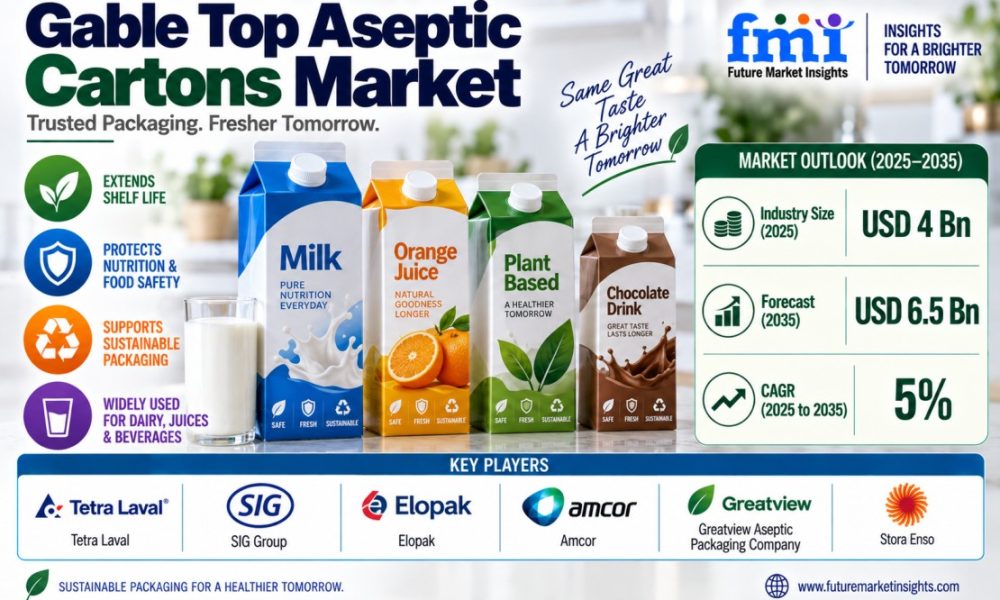
The global gable top aseptic cartons market is projected to grow from USD 4 billion in 2025 to approximately USD 6.5 billion by 2035, registering a 5% CAGR during the forecast period, according to Future Market Insights (FMI).
The market is expected to add approximately USD 2.53 billion in value over the decade, representing total growth of 62.9%. Rising demand for food safety, shelf-life extension, lightweight packaging, and efficient liquid food distribution is supporting adoption across dairy, juice, plant-based beverages, soups, broths, and other liquid food applications.
Advances in barrier coatings, sterilization systems, heat-sealing architectures, and automated filling technologies are also influencing packaging specifications. At the same time, food manufacturers are evaluating aluminum-free and bio-based carton formats as packaging requirements increasingly combine preservation performance with material and environmental considerations.
>> Get Detailed Market Forecasts, Competitive Benchmarking, and Pricing Trends: https://www.futuremarketinsights.com/reports/sample/rep-gb-27869
Dairy Products Remain the Largest Application
Dairy products are projected to remain the leading application segment, accounting for 58.7% of the market in 2025.
The segment benefits from demand for shelf-stable milk, cream products, and dairy-based beverages. Aseptic cartons enable manufacturers to support extended storage and distribution while reducing dependence on refrigerated supply chains for applicable products.
Juice beverages represent another important application, accounting for 23.8% share in 2025. Growth is supported by ready-to-drink beverage demand and the need to preserve product quality during distribution.
Plant-based beverages account for 11.4%, with aseptic cartons serving alternative dairy products, specialty nutrition products, and plant-protein beverages that require extended shelf stability.
Standard Aseptic Cartons Hold the Leading Type Position
Standard aseptic cartons are expected to account for 67.4% of the market in 2025, reflecting their established use across mainstream dairy and juice applications.
Their position is supported by a combination of cost performance, proven reliability, and compatibility with established production systems. Food manufacturers continue to use these formats where dependable barrier performance and integration with existing packaging operations are key purchasing requirements.
Aluminum-free aseptic cartons account for 18.2% share, with demand supported by sustainability-focused brands, recyclability requirements, and premium beverage applications.
Bio-based cartons represent another emerging opportunity as food and beverage manufacturers explore renewable material content and environmental positioning. However, material availability and cost remain considerations for broader adoption.
Food Manufacturers Dominate the Distribution Channel
Food manufacturers are expected to account for 74.2% of the distribution channel in 2025.
Direct supply relationships allow large-scale food processing companies to coordinate packaging specifications, technical support, filling operations, and production requirements. This structure also supports longer-term collaboration between carton manufacturers, food processors, and packaging equipment suppliers.
Beverage distributors, retail chains, and food service providers provide additional routes to market as aseptic carton applications expand across regional beverage producers, private-label products, institutional food service, and specialty applications.
Food Safety and Shelf-Life Extension Support Market Growth
Food safety requirements remain a fundamental driver of aseptic carton adoption.
Aseptic packaging provides a controlled packaging environment designed to reduce contamination risks and support extended shelf life. This is particularly relevant to dairy, juice, and other liquid food categories where preservation and product safety directly influence distribution requirements.
Ready-to-drink beverage consumption is another growth factor. Single-serve formats and portable packaging are increasing demand for convenient carton systems that can support retail distribution and on-the-go consumption.
Global food distribution is also creating opportunities. Longer transportation routes and international food trade increase the value of packaging systems that can support product stability across varied logistics conditions.
Barrier Technology Is Becoming More Important
Packaging manufacturers are investing in advanced barrier coatings, material layering, heat-sealing systems, and sterilization technologies to improve carton performance.
These developments are enabling manufacturers to target lower material consumption while maintaining the barrier characteristics needed for extended shelf life.
Aluminum-free barrier systems and bio-based coating technologies are also gaining attention as manufacturers explore alternatives that can address changing environmental packaging requirements.
At the same time, smart packaging integration, automated filling, real-time quality control, and production-line optimization are emerging as technology areas that can influence future carton development.
Asia Pacific Leads Growth Among Key Markets
China is projected to record the fastest growth among the countries covered, with a 6.8% CAGR from 2025 to 2035. Growth is supported by food processing expansion, dairy manufacturing development, urban consumption, and packaging infrastructure investment.
India follows with a 6.3% CAGR, driven by dairy industry development, food processing modernization, cold-chain infrastructure expansion, and investment in automated packaging systems.
Germany is projected to grow at 5.8%, reflecting its advanced food processing and packaging technology base.
Brazil is expected to register a 5.3% CAGR, while the United States is projected to grow at 4.8%. The United Kingdom and Japan are expected to record CAGRs of 4.3% and 3.8%, respectively.
India’s market is projected to reach USD 890.4 million by 2035, while Germany is forecast to reach USD 743.6 million. Brazil is expected to reach USD 612.7 million, and the United States is projected to reach USD 523.1 million.
Europe Remains an Important Technology and Manufacturing Base
European demand is increasingly shaped by engineering capabilities, food safety requirements, and specialized aseptic packaging applications.
Germany maintains an important position in high-performance aseptic packaging and food processing technology. British operators continue to contribute to packaging system innovation, while manufacturers in countries such as the Czech Republic and Poland are developing specialized production capabilities.
The region’s food safety framework supports stringent performance and quality requirements. These conditions favor suppliers with established certification capabilities, technical expertise, and experience integrating packaging with food processing systems.
Investment Is Shifting Toward Integrated Solutions
The competitive environment is moving beyond basic carton production toward integrated aseptic packaging systems.
Food manufacturers are increasingly seeking solutions that combine barrier performance, sterilization reliability, filling integration, and supply chain coordination. Strategic partnerships between food companies, packaging suppliers, and equipment manufacturers are supporting the development of application-specific platforms.
High capital requirements and processing complexity remain barriers, particularly for smaller food manufacturers. Material cost volatility, specialized coatings, equipment integration, maintenance requirements, and regulatory compliance costs can also affect adoption timelines.
These challenges are creating opportunities for suppliers that can provide integrated technical support and reliable packaging performance.
>> Exclusive Discounts on Full Report: https://www.futuremarketinsights.com/reports/gable-top-aseptic-cartons-market
Competitive Landscape
The gable top aseptic cartons market features established global packaging companies alongside regional and specialized manufacturers.
Tetra Laval leads the market with a reported 24% share, supported by integrated packaging solutions and aseptic processing capabilities serving dairy and beverage manufacturers.
Other leading companies profiled in the market include SIG Group, Elopak, Amcor, Greatview Aseptic Packaging Company, Stora Enso, Nippon Paper Group, International Paper, Ecolean, Pactiv Evergreen, GsPak, Qingdao Likang Food Packaging Technology, and Shandong Newjf Technology Packaging Co., Ltd.
Competition is increasingly shaped by barrier technology, food safety certification, production integration, manufacturing scale, and the ability to meet application-specific specifications.
Outlook for Aseptic Carton Packaging
The gable top aseptic cartons market is expected to continue expanding as food manufacturers balance food safety, shelf-life requirements, packaging weight, distribution efficiency, and evolving material expectations.
With the market forecast to reach USD 6.5 billion by 2035, opportunities are expected across dairy products, juice beverages, plant-based beverages, soups and broths, and other liquid food categories.
Advancements in barrier enhancement, aluminum-free structures, bio-based materials, automation, and circular economy integration are likely to remain important areas of development as manufacturers seek packaging solutions that meet both operational and evolving market requirements.
To explore how FMI Custom Research can support your strategic priorities, connect with our team at – [email protected]
About Future Market Insights (FMI)
Future Market Insights, Inc. is an ESOMAR-certified, ISO 9001:2015 market research and consulting organization trusted by Fortune 500 companies. With a global presence across the U.S., UK, India, and Dubai, FMI delivers data-driven insights across 30+ industries and 1200 markets worldwide.



