
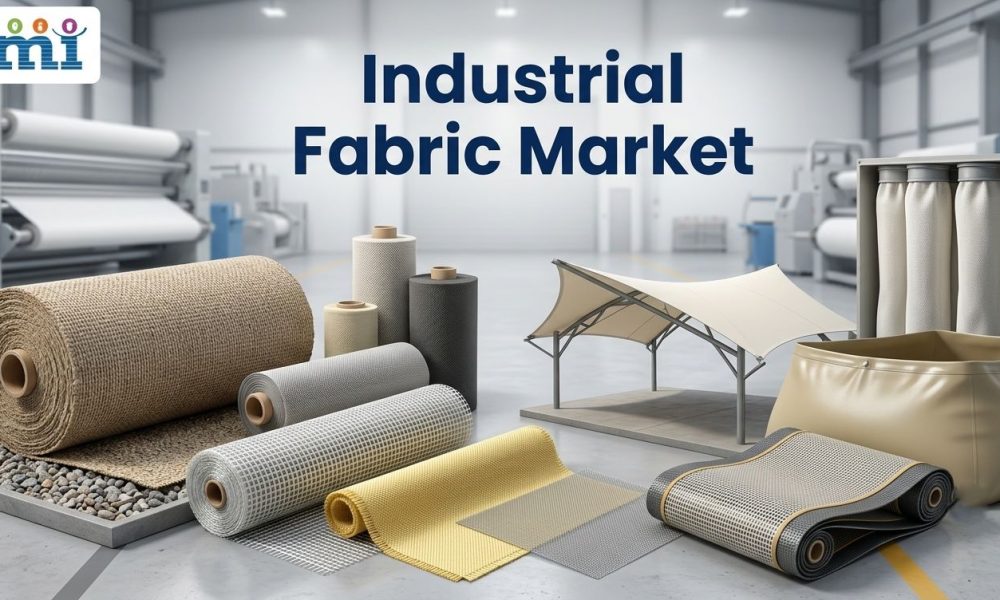
The global industrial fabric market is projected to grow from USD 23.2 billion in 2026 to USD 36.4 billion by 2036, advancing at a 4.6% CAGR during the forecast period. Market demand is being supported by industrial capacity expansion, facility modernization, regulatory compliance requirements, and investment in production infrastructure across manufacturing sectors.
Industrial fabric procurement is also being shaped by supply chain restructuring and nearshoring trends. As manufacturers expand or modernize facilities, demand is increasing for fabrics used across conveyor belts, transmission belts, protective apparel, automotive carpets, and flame resistance apparel. These applications require consistent specifications, reliable supply, and performance aligned with operating and safety requirements.
Industrial Fabric Market: Key Growth Drivers
Industrial capacity expansion and facility modernization programs across manufacturing sectors represent important demand drivers for industrial fabrics. Manufacturers are investing in infrastructure and production capabilities, supporting procurement across established and emerging industrial applications.
Tightening environmental and safety regulations are also creating compliance-driven procurement. Industrial buyers increasingly require fabric solutions that meet updated operational standards while maintaining performance and durability across demanding environments.
Get detailed market forecasts, competitive benchmarking, and pricing trends: https://www.futuremarketinsights.com/reports/sample/rep-gb-19101
Polyester Leads Fiber Type Demand
By fiber type, polyester is estimated to account for 34.5% of the segment in 2026. Its position is supported by established performance characteristics, broad compatibility with existing infrastructure, and demand from primary end-use applications.
By application, conveyor belts are forecast to account for 29.8% of the segment in 2026. Demand remains concentrated among industrial buyers requiring consistent product specifications and reliable supply for established operating environments.
Infrastructure Modernization Creates New Opportunities
Industrial modernization is creating opportunities for industrial fabric manufacturers that can supply products aligned with changing performance, safety, and compliance requirements. Facility upgrades and new production capacity can generate recurring procurement demand across multiple fabric applications.
However, raw material cost volatility and supply concentration risks remain important constraints. Changes in input costs can place pressure on manufacturer margins, while industrial buyers remain sensitive to pricing when evaluating premium fabric solutions.
Country Markets Show Different Growth Patterns
Country-level demand reflects differences in infrastructure investment, industrial activity, regulatory requirements, economic development, and adoption of specialized industrial fabric solutions.
Japan is projected to record the highest CAGR among the profiled countries at 5.9%, followed by South Korea at 5.5%, the UK at 5.1%, China at 5.0%, and the USA at 4.8% through 2036.
Japan’s growth is supported by infrastructure expansion, increasing industrial capacity, and adoption of industrial fabric products across key sectors. South Korea is benefiting from investment in operational infrastructure and modernization programs.
The UK maintains demand through its established industrial base, replacement requirements, and regulatory compliance needs. China presents opportunities through modernization programs, institutional procurement, and government investment in industrial infrastructure.
Access the Complete Report in PDF Format: https://www.futuremarketinsights.com/reports/brochure/rep-gb-19101
Competitive Landscape
The competitive landscape includes DuPont, Ahlstrom-Munksjö, Kimberly-Clark Corporation, Berry Global Group, Freudenberg Group, Johns Manville Corporation, Trelleborg AB, Low & Bonar, Asahi Kasei Corporation, and Saint-Gobain SA.
Market competition spans established global manufacturers with broad product portfolios and regional specialists serving application-specific requirements. Differentiation increasingly depends on product specifications, manufacturing scale, distribution coverage, application expertise, supply reliability, and geographic reach.
DuPont leads with an estimated 18.9% market share, supported by production scale, established distribution networks, and broad product coverage. Ahlstrom-Munksjö competes through product specifications, pricing, and regional supply coverage, while Kimberly-Clark Corporation and Berry Global Group serve specialized application segments and regional procurement channels.
“Industrial fabric procurement is increasingly shaped by the need for consistent performance, regulatory compliance, and dependable supply across established and emerging applications. Suppliers that can align product specifications with application requirements while maintaining cost and delivery reliability can strengthen their position as industrial buyers modernize infrastructure.”
— Nikhil Kaitwade, Principal Consultant, Future Market Insights
Industrial Fabric Market: Report Scope
The report covers the market by fiber type, applications, and region. Fiber types include polyester, aramid, polyamide, composite, and others, while applications include conveyor belts, transmission belts, protective apparel, automotive carpets, flame resistance apparel, and others.
The study covers North America, Latin America, Europe, East Asia, South Asia and Pacific, and the Middle East and Africa, with detailed analysis for Japan, South Korea, the UK, China, the USA, and more than 30 countries.
Business Impact
FMI helps organizations transform market complexity into strategic clarity, enabling leadership teams to identify growth opportunities faster, optimize resource allocation, strengthen competitive positioning, and make high-stakes business decisions with confidence.
To explore how FMI Custom Research can support your strategic priorities, please connect with our team at – [email protected]
About Future Market Insights (FMI)
Future Market Insights, Inc. (FMI) is an ESOMAR-certified, ISO 9001:2015 market research and consulting organization, trusted by Fortune 500 clients and global enterprises. With operations in the U.S., UK, India, and Dubai, FMI provides data-backed insights and strategic intelligence across 30+ industries and 1200 markets worldwide.



