
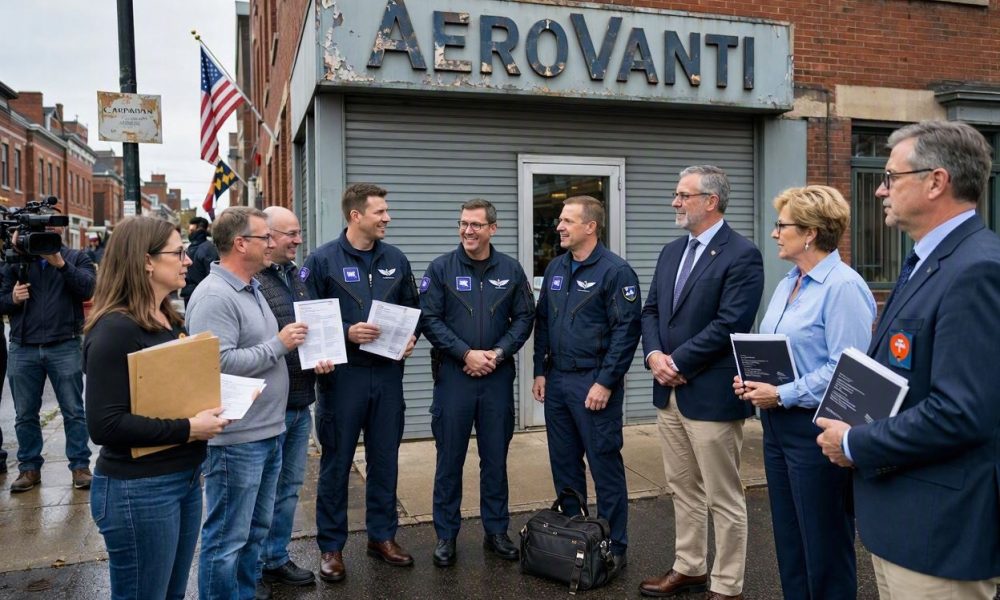
What began as a private jet startup connected to Annapolis and promoted through distinctive aircraft, premium memberships, sports alliances, and ambitious financing announcements has become a federal fraud case whose consequences now reach customers, creditors, workers, partners, and the reputation of its convicted founder.
ANNAPOLIS, Maryland, August 24, 2026 — AeroVanti arrived in private aviation with nearly every visual ingredient that a young luxury company could want, including unusual Italian aircraft, polished membership promises, prominent sports associations, aspirational travel imagery, and a founder who presented rapid expansion as evidence that the market had embraced his idea.
That carefully assembled identity now sits beneath a radically different public record, because a Baltimore federal jury convicted founder Patrick Britton-Harr on six wire-fraud counts after prosecutors proved that money solicited for aircraft purchases was diverted to personal spending while promised protections and assets did not materialize as represented.
The shift from a highly visible startup to an enterprise defined by its founder’s fraud conviction illustrates a harsh commercial reality for luxury businesses: reputation can accelerate customer acquisition when operations appear sound, but it can also magnify collapse when branding, financing, governance, and service delivery stop supporting one another.
For Annapolis business circles, the story is especially striking because Britton-Harr was identified with a city whose maritime culture, government connections, defense economy, and affluent regional clientele made it an understandable launching point for a venture selling convenience, exclusivity, and access to sophisticated travelers.
The criminal case was tried in Baltimore, yet its meaning extends well beyond the courthouse, since every luxury promise that once helped AeroVanti attract attention now provides a contrasting frame for lawsuits, grounded aircraft, unpaid obligations, customer losses, disputed sponsorships, and a founder awaiting further judicial proceedings.
A Brand Designed to Look Different
AeroVanti’s most recognizable branding asset was the Piaggio P.180 Avanti, a sleek, rear-propeller turboprop whose unconventional appearance immediately distinguished it from conventional business jets and helped the company present efficiency as a modern form of luxury rather than a compromise in status.
The aircraft supported a persuasive marketing equation because AeroVanti could emphasize cabin comfort, speed, range, and lower operating costs while arguing that private flying did not require customers to accept the pricing structures associated with larger jets or established fractional-ownership programs.
In 2022, TechCrunch described AeroVanti’s effort to disrupt private aviation as the company announced a targeted $9.75 million Series A round and promoted membership levels, lower hourly charges, no repositioning fees, an expanding fleet, and plans for maintenance and acquisition growth.
That coverage captured why the proposition initially appeared credible to sophisticated audiences: it paired a distinctive aircraft with a familiar startup narrative in which overlooked assets, operational discipline, and customer-friendly pricing supposedly combined to challenge an expensive, tradition-bound industry.
The model also benefited from post-pandemic interest in private aviation, when health concerns, airline disruptions, schedule control, and growing wealth encouraged more travelers to consider charter alternatives that had previously seemed inaccessible or impractical for routine personal and corporate trips.
AeroVanti therefore marketed more than flight hours, because the membership conveyed entry into a curated community whose customers could imagine bypassing crowded terminals, traveling on recognizable aircraft, attending elite events, and receiving individualized attention without paying the conventional premium attached to comparable access.
Prestige Borrowed From Public Partnerships
The company strengthened that identity through relationships and promotions tied to professional sports, motorsports, sailing, racing-season events, and other high-visibility settings, allowing AeroVanti’s name to appear alongside institutions whose established audiences already understood exclusivity, hospitality, competition, and premium experiences.
Associations reported over the company’s rise included the Tampa Bay Buccaneers, Chicago Cubs, Tampa Bay Rays, NASCAR-related activity, United States Sailing, Preakness-connected marketing, and an AeroVanti-branded yacht club, creating a public footprint much larger than an ordinary early-stage charter operator might command.
Such alliances can act as reputational shortcuts, because prospective customers may interpret a familiar team, league, venue, or event relationship as indirect evidence that an unfamiliar company has the financial capacity, contractual discipline, and operational permanence required to serve demanding partners.
That inference is not necessarily warranted, since sponsorship agreements generally purchase marketing rights rather than certify balance-sheet strength, yet the psychological transfer of credibility remains powerful when a premium brand appears repeatedly in settings associated with wealth, achievement, and trusted community institutions.
For AeroVanti, borrowed prestige increased both opportunity and exposure, because every major logo placement could attract new members while also expanding the number of organizations, fans, clients, vendors, and local executives who could notice when the company’s financial and operational performance began deteriorating.
Expansion Announcements Became Proof Points
Funding announcements further reinforced the image of momentum, including the proposed Series A raise and a later aircraft-financing vehicle described as capable of reaching as much as $100 million, figures that placed expansion, fleet capacity, and institutional-scale ambition at the center of the AeroVanti story.
In a capital-intensive industry, however, an announced financing target is not the same as unrestricted cash, completed aircraft ownership, available working capital, or durable profitability, and stakeholders must distinguish projected facilities from verified funding that can actually support maintenance, payroll, fuel, insurance, leasing, and customer flights.
Private aviation is particularly unforgiving because an operator’s luxury appearance rests on a complicated operational foundation involving regulated aircraft, qualified crews, continuous maintenance, scheduling systems, vendor credit, insurance, certificates, dispatch reliability, and enough liquidity to absorb interruptions without abandoning member commitments.
When that foundation weakens, marketing cannot indefinitely close the gap, since customers experience the business through completed trips, responsive service, accurate billing, safe equipment, and honored refunds rather than through sponsorship photographs, fleet projections, investor presentations, or statements about future scale.
The AeroVanti case shows how expansion language can become dangerous when audiences treat ambition as accomplishment, especially when rapid growth makes existing obligations harder to track and deposits collected for a specified purpose become essential to sustaining unrelated expenses or earlier promises.
Top Gun Turned Trust Into Capital
The sharpest collision between the luxury brand and the federal criminal case involved the limited-time Top Gun program, which invited selected members to pay $150,000 in advance so AeroVanti could acquire aircraft while the participants received discounted flight hours and what prosecutors described as promised financial protections.
Trial evidence showed that approximately one hundred members collectively provided nearly $15 million toward five aircraft after being told that their money would fund specified purchases, that titles would be placed in escrow, and that their interests would be secured against the aircraft.
Those details mattered because the arrangement was presented as more than an ordinary prepaid travel account, since the promised escrow and security structure offered a tangible explanation for why a customer should entrust a large sum to a young business undertaking expensive capital acquisitions.
According to the United States Justice Department’s account of the conviction, the aircraft were not acquired as promised, while Britton-Harr used members’ money for yachts, jewelry, living expenses, and a Tampa-area home rented for $10,000 each month.
The trial evidence also established that Britton-Harr later obtained a $1.5 million loan to buy one aircraft that members had already been led to believe was purchased, while withholding material information from the lender in what prosecutors characterized as an effort to conceal the fraud.
The jury’s six guilty verdicts converted the central Top Gun allegations from disputed prosecutorial claims into criminal findings beyond a reasonable doubt, although sentencing, post-trial litigation, restitution questions, and any eventual appellate proceedings remain separate stages that can materially affect the final legal outcome.
Luxury Spending Made the Contrast Unavoidable
The spending evidence proved especially damaging to the brand because yachts, jewelry, and an expensive rental residence belong to the same aspirational vocabulary that luxury aviation marketers frequently use, turning symbols of success into trial exhibits supporting the government’s account of diversion and personal enrichment.
That contrast gave jurors and the public an easily understood narrative, because money presented as protected capital for aircraft expansion was instead traced to purchases and expenses that appeared consistent with the founder’s high-end image rather than the members’ stated commercial purpose.
Luxury companies routinely require founders to embody confidence, access, and personal credibility, yet that founder-centered approach concentrates risk when the executive’s lifestyle becomes indistinguishable from the corporate promise or when customers cannot determine whether visible consumption reflects genuine profitability, borrowed money, or diverted funds.
Once the government placed Britton-Harr’s expenditures within a documented transaction trail, AeroVanti’s earlier imagery could no longer operate as neutral promotion, because the same symbols that had communicated prosperity now helped the prosecution explain motive, benefit, and the practical consequences of misleading customers.
This reputational reversal is difficult to contain through ordinary public relations, since a criminal verdict supported by bank records and witness testimony carries greater authority than promotional claims, favorable profiles, social-media content, testimonials, or assurances issued during a company’s growth period.
Operational Failure Broke the Illusion
Before the verdict, AeroVanti’s operational deterioration had already weakened the brand, as aircraft availability problems, cancellations, reported missed payroll, vendor disputes, repossessions or loss of access to equipment, and a June 2023 fleet grounding made the promised experience increasingly difficult to deliver.
Members who had purchased convenience encountered uncertainty, workers who had joined a growth company confronted delayed compensation, and counterparties that expected payment or contractual performance began using demand letters and litigation rather than private relationship management to pursue what they said was owed.
Leadership changes deepened the instability, with Scott Hopes taking over during the crisis, Todd Britton-Harr briefly occupying the chief executive role, and Patrick Britton-Harr returning, while later estimates placed liabilities to lessors, customers, vendors, sponsors, and other parties at roughly $50 million.
An estimate of liabilities is not a final audited loss calculation, and creditor claims may differ in validity, priority, security, and recoverability, but the scale demonstrates why the company’s failure cannot be understood solely as a customer-service breakdown or temporary scheduling disruption.
The business had depended on confidence across several interconnected markets, so flight failures harmed membership sales, weaker cash flow strained vendor relationships, public disputes discouraged new financing, and leadership uncertainty made every remaining promise harder for customers and partners to evaluate.
Litigation Replaced Advertising as the Public Record
By May 2023, customer and aircraft-related lawsuits were already challenging the company’s narrative, and later proceedings involving pilots, vendors, sports organizations, counterparties, and affiliates created a searchable legal archive that competed directly with every flattering feature, partnership announcement, and promotional campaign AeroVanti had produced.
Three pilots, Tyson Roser, Rick Hendrick, and Joshua Kraus, pursued a federal class action in Tampa over alleged unpaid compensation and overtime, claims that belong to a separate civil case and should not be presented as findings made by the Maryland criminal jury.
Sports-related litigation likewise included contract disputes associated with the Chicago Cubs and Tampa Bay Rays interests, while reporting described a multimillion-dollar judgment involving the Buccaneers, matters that illustrate commercial fallout but remain legally distinct from the six wire-fraud convictions.
That distinction matters because responsible reporting must separate proven criminal conduct from unresolved allegations, default judgments, negotiated claims, contractual disagreements, and estimates, even when all arise from the same company and collectively reveal a pattern of severe institutional distress.
For the brand, however, procedural distinctions do not eliminate cumulative damage, because customers searching the company’s name see a dense collection of court filings, creditor complaints, employment claims, adverse accounts, and criminal evidence that overwhelms the earlier promise of effortless premium travel.
The Founder and Company Became One Story
AeroVanti’s identity was closely tied to Britton-Harr’s personal entrepreneurship, making it hard to preserve enterprise value once his credibility became the central issue in a federal prosecution and the jury concluded that his representations induced customers to send money under false pretenses.
Founder-led branding can be highly efficient during expansion because one recognizable executive supplies a human story, answers questions, attracts media interest, reassures investors, and gives employees a shared vision, but the arrangement offers little reputational insulation when that person is convicted of fraud.
The verdict does not automatically adjudicate every statement AeroVanti ever made, nor does it prove that every employee, consultant, pilot, sponsor, or partner knew about criminal conduct, yet the organization’s dependence on Britton-Harr means outsiders are likely to interpret the entire enterprise through his conviction.
That consequence is especially severe in aviation, where customers must trust operators with large deposits, complicated scheduling, sensitive itineraries, personal safety, and expensive equipment, leaving little tolerance for uncertainty about who controls funds or whether corporate representations can be independently verified.
The Annapolis connection similarly shifts from an asset to a source of scrutiny, because local recognition once supported credibility while the founder’s residence and business identity now ensure that Maryland searches, networks, and professional conversations remain tied to the Baltimore prosecution.
Legal Ruin Is Broader Than a Prison Sentence
Britton-Harr faces a statutory maximum of twenty years on each wire-fraud count, but maximum penalties are not predictions, because the federal judge must consider sentencing guidelines, statutory factors, the offense record, victim losses, personal circumstances, and arguments from prosecutors and the defense.
The sentencing previously scheduled for August 26 has been postponed while the court considers a defense motion seeking a new trial based on alleged interactions involving jurors and a former courtroom deputy, and a hearing on that motion remains scheduled for the same date.
Those allegations require judicial examination, but the motion has not erased the verdict, established that improper conduct influenced deliberations, or restored the case to a presumption-of-innocence posture on the six counts that the jury decided after the May and June trial.
Britton-Harr also faces separate federal charges alleging health-care fraud and money laundering connected with Medicare respiratory-testing claims, with trial scheduled for October 2026, although those allegations were not decided in the AeroVanti proceeding and retain the full presumption of innocence.
Legal ruin therefore includes more than potential incarceration, encompassing restitution exposure, professional disqualification, depleted assets, defense costs, judgments, creditor collection, damaged relationships, reduced employability, persistent search visibility, and years of litigation that can continue even after a company ceases meaningful operations.
Reputation Cannot Be Rebuilt With Luxury Imagery Alone
When a premium company enters crisis, credible reputation and public-relations management begins with verified facts, precise distinctions between proven conduct and pending claims, consistent stakeholder communication, and documented corrective action rather than attempts to recreate the visual confidence that preceded the collapse.
Any legitimate social and professional rebranding strategy after a failure of this magnitude would also require lawful transparency, demonstrable governance changes, independent financial controls, repaired obligations where possible, and patience, because search results anchored in federal records cannot responsibly be displaced by cosmetic messaging.
For unaffiliated employees, pilots, suppliers, and partners, that process may involve separating their own records from AeroVanti’s conduct through accurate timelines, references, court outcomes, and evidence of individual responsibilities, particularly when their names remain attached online to a company they did not control.
For customers and investors evaluating future aviation clubs, the lesson is to verify aircraft ownership, escrow arrangements, secured interests, regulatory authority, audited financial capacity, refund terms, related-party payments, insurance coverage, and the precise legal entity receiving funds before transferring substantial advance payments.
For sponsors and community partners, diligence should extend beyond audience reach to financial health, litigation searches, payment history, ownership controls, compliance systems, and termination protections, since borrowed prestige can expose the established institution when a highly promoted counterparty later fails publicly.
A Maryland Cautionary Tale About Visibility
AeroVanti’s rise showed how quickly a visually distinctive product, persuasive founder, favorable economic moment, and public partnerships can create the appearance of institutional scale, even when the less visible disciplines of liquidity, governance, asset control, and contractual performance determine whether that scale is sustainable.
Its fall shows the reverse process operating with equal force, because every promotional claim becomes evidence for comparison, every partnership broadens the audience for failure, and every luxury symbol invites questions about whether customers funded the image rather than the service they expected.
The Baltimore verdict now supplies the most consequential answer in the company’s history, establishing that Britton-Harr committed six wire-fraud offenses through representations tied to approximately $15 million collected from Top Gun members for aircraft that were not purchased as promised.
The pending new-trial motion may change the procedural path, and sentencing will eventually determine punishment if the verdicts remain intact, but neither development can restore aircraft access, repay every claimant, resolve every civil dispute, or rebuild the commercial trust AeroVanti consumed.
What began as an Annapolis-linked luxury aviation proposition has therefore become a warning about the difference between visibility and durability, because branding can persuade customers to look upward while only transparent controls, reliable operations, and honest stewardship keep an enterprise from falling.




