
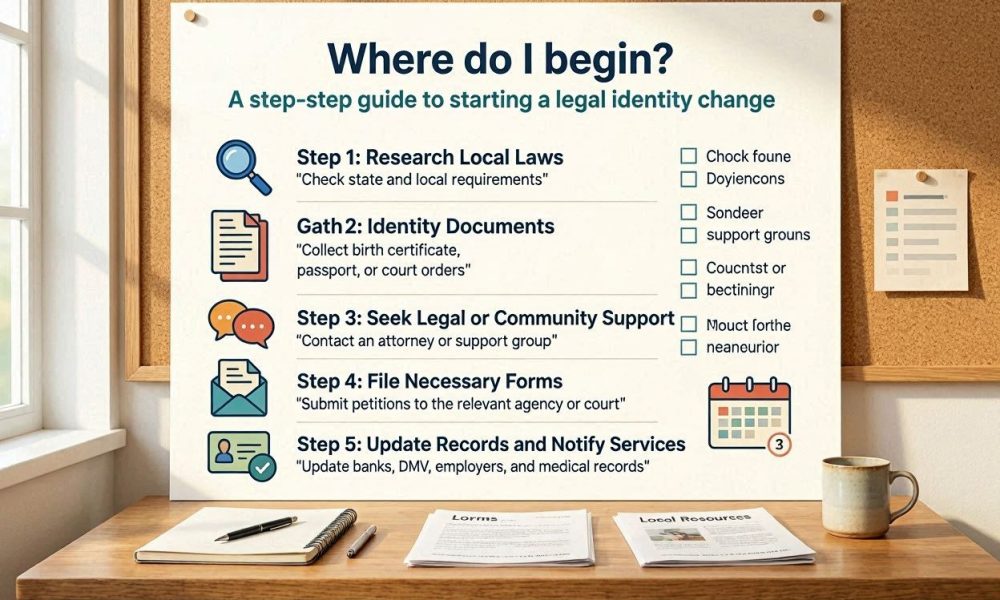
Legal experts outline the first steps for anyone considering a new identity, why lawful purpose matters, and how the process differs sharply from creating an illegal identity.
By Staff Reporter
WASHINGTON, DC, May 24, 2026, For anyone wondering where to begin creating a new identity, the answer starts not with a forged document, a private fixer, or a dramatic disappearance, but with a clear legal reason and a careful understanding of which records actually need to change.
The first step is identifying the legal purpose behind the request.
A lawful identity change usually begins with a simple but important question: Is the person seeking a name change, a protected identity update, a corrected document record, a confidential survivor-related filing, or a broader identity restructuring tied to citizenship, safety, or relocation?
Courts generally do not treat every identity-change request the same way, because a person changing a surname after divorce faces a very different legal review than a stalking survivor seeking sealed records and protected contact information.
Accepted reasons for identity changes often include marriage, divorce, adoption, personal preference, religious conversion, gender transition, documented safety concerns, domestic violence, stalking, identity theft, or participation in a formal witness protection process.
The key distinction is lawful recognition: a legal identity change is based on court orders, government records, and verifiable documents, whereas illegal identity creation relies on deception, forged records, or stolen personal information.
A person who begins with a vague desire to “start over” may quickly discover that courts and agencies require a specific legal basis, especially when the request involves sealed files, new identifying numbers, or changes to high-security documents.
A legal new identity is not the same thing as disappearing.
One of the most common misconceptions is that a new identity means a person can erase every connection to an old life, including debts, criminal records, taxes, immigration history, court orders, or family obligations.
In reality, lawful identity change usually creates a new public-facing record while preserving confidential continuity within courts, government agencies, tax systems, financial institutions, and regulated databases designed to prevent fraud.
That means someone may receive a court order for a new legal name, but the person’s old and new records may remain linked in official systems for payroll, taxes, benefits, licensing, court compliance, and identity verification.
For legitimate applicants, this continuity is not a failure of the process, because it allows a person to protect safety, privacy or dignity without creating a false identity that could collapse under verification.
The legal path works because it is recognized, durable, and defensible, whereas the illegal path may seem faster but often exposes the applicant to prosecution, blackmail, immigration issues, and permanent financial harm.
The second step is checking the law in the correct jurisdiction.
Name changes in the United States are usually handled through state courts, which means the required forms, filing fees, hearing rules, publication requirements, and sealing options can vary significantly by county and state.
Federal guidance on how to legally change your name explains that Americans often change names through marriage, divorce or court order, then update records with agencies such as Social Security and motor vehicle offices.
A person should begin by checking the court website for their county, because local rules often specify whether fingerprints, background checks, publication notices, notarized forms, or certified copies are required.
Many courts also provide separate procedures for adults, minors, parents filing for children, people seeking gender-marker updates, and applicants requesting confidentiality because of domestic violence, stalking, or safety threats.
The jurisdictional review matters because an early mistake can delay the entire process, especially when an applicant files in the wrong court, misses publication requirements, or fails to request confidentiality before documents become public.
The third step is deciding whether safety requires confidentiality.
For ordinary name changes, some jurisdictions still require public notice, which may involve publication in a newspaper or on a public docket, allowing others to view the petition before approval.
That rule can be dangerous for people escaping abuse, stalking, trafficking, or targeted harassment, because a public filing may expose the very information that the applicant is trying to protect from a dangerous person.
Safety-based applicants should consider consulting an attorney, legal aid program, or victim-services advocate before filing anything, because the timing of a sealing request can determine whether sensitive details remain protected.
Some states allow survivors or other vulnerable applicants to ask the court to waive publication, seal the case, restrict access to filings, or use address confidentiality programs connected to state agencies.
Public-record privacy has become a growing legal issue, especially as courts and lawmakers confront cases in which vulnerable people seek protection from harassment, as seen in recent news coverage of contested name-change cases.
The fourth step is gathering the documents before filing.
A person preparing for a legal identity change should usually gather a government-issued photo identification card, birth certificate, Social Security card, proof of residence, and any existing court orders connected to the request.
Depending on the reason for the change, additional records may include a marriage certificate, divorce decree, adoption decree, protective order, police report, medical documentation, immigration record, naturalization certificate, or prior identity-theft report.
Applicants seeking sealed records should collect evidence supporting the safety concern, such as restraining orders, stalking reports, threat documentation, shelter letters, affidavits, screenshots, criminal complaints, or victim-services records.
The purpose of gathering documents early is not simply administrative convenience, because a complete filing can help a judge understand why the request is legitimate and why any special protection may be justified.
Missing documents can create delays that affect every subsequent step, because the court order serves as the foundation for updating Social Security records, driver’s licenses, passports, bank accounts, and employment files.
The fifth step is filing the petition correctly.
In most cases, the applicant files a name-change petition in a county court, pays a filing fee or requests a fee waiver, submits required identification documents, and waits for a hearing date or administrative review.
Some courts require fingerprints or criminal-background checks, especially when applicants have criminal histories, are seeking changes for minors, or are subject to special registration or notification rules.
A judge may ask whether the applicant is changing identity to avoid creditors, commit fraud, evade law enforcement, conceal criminal history, interfere with parental rights, or mislead government agencies.
Those questions should not alarm legitimate applicants, because courts are required to preserve the integrity of public records while also allowing lawful identity changes for personal, family, safety, and dignity-based reasons.
The best filings address those concerns directly, with clear explanations, accurate disclosures, and supporting documents demonstrating that the change has a lawful purpose rather than a deceptive motive.
The sixth step is to attend the hearing and obtain the court order.
Many name-change hearings are brief, but the hearing remains an important legal moment because the judge’s order becomes the master document used to update nearly every other record.
The applicant may be asked to confirm residency, explain the reason for the change, verify that the petition is not fraudulent, and answer questions about criminal history, debts, child support, or pending legal matters.
If the judge approves the petition, the court issues an order that should be obtained in several certified copies, because many agencies, banks, schools, and licensing boards require official versions rather than photocopies.
A certified court order is especially important because it establishes the legal bridge between the old and new names, allowing institutions to update records without treating the applicant as an entirely unknown person.
For people seeking safety, the order may also include sealing language or confidentiality protections that determine how much of the case remains visible to the public.
The seventh step is updating Social Security records early.
After the court order is issued, many applicants update their Social Security records before changing other documents, because employment, tax records, and some state agencies rely on the Social Security Administration’s information.
The Social Security card may show the new legal name, but the underlying number usually remains the same unless the applicant qualifies under narrow rules involving abuse, harassment, life endangerment, identity theft, or similar serious circumstances.
A new Social Security number is not a general fresh-start tool, and applicants should not assume they can obtain one simply because they received a court-approved name change.
When a name change is legitimate, updating Social Security records helps prevent wage-reporting problems, tax delays, employer verification issues, and mismatches that can complicate employment or benefits.
For anyone considering a broader identity plan, this step demonstrates why lawful sequencing matters: a corrected record often determines whether later records can be updated smoothly.
The eighth step is updating state identification and driver’s license records.
Once Social Security records are updated, applicants typically move on to state identification, driver’s license records, voter registration, vehicle registration, and other state-managed systems that use legal-name data.
State motor vehicle agencies often require a certified court order, current identification, proof of residence, and sometimes evidence that Social Security records have already been updated.
Applicants who are also changing gender markers should confirm state rules in advance, because some jurisdictions allow administrative updates while others require specific forms, medical documentation, or additional court orders.
The goal is consistency, because mismatched records can create problems during traffic stops, job checks, airport screenings, banking reviews, school enrollment, or medical appointments.
A legal identity change works best when the applicant keeps a checklist and updates records in an organized sequence rather than changing one document while leaving others outdated for months.
The ninth step is updating passport records and travel documents.
For international travel, a person must update passport records using the required federal forms and proof of legal name change, which may include a certified court order, marriage certificate, or divorce decree.
The U.S. passport system treats name correction as a formal document update, not a casual administrative edit, because passports are identity and citizenship documents used at borders worldwide.
Applicants should avoid booking international travel until passport records, airline reservations, visa records, and trusted traveler profiles match, because inconsistent names can trigger delays or refusals at airports and border crossings.
A passport in a new legal name may improve privacy and consistency, but it does not erase prior travel history or eliminate government record continuity tied to citizenship, biometrics, or prior documentation.
This is why legitimate identity restructuring advisers, including Amicus International Consulting, often frame the issue in terms of lawful documentation, verifiable records, and compliance rather than secrecy or evasion.
The tenth step is updating the private-sector identity trail.
After government records are updated, the applicant still faces a second wave of private-sector changes involving banks, employers, insurers, doctors, schools, landlords, utilities, subscriptions, and professional licensing bodies.
Banks may require certified legal documents, updated government identification, and internal compliance review before changing account profiles, especially when accounts involve loans, business ownership, investment portfolios, or cross-border transfers.
Employers may need updated payroll forms, tax records, benefits information, and human resources files so that wages, health insurance, and retirement contributions continue under the correct legal name.
Professional license holders may need to notify state boards, credentialing organizations, malpractice insurers, industry regulators, and background-check vendors because inconsistent records can affect employment verification and client trust.
The cascade effect is often the most time-consuming part of the process because obtaining a court order may take one hearing, while updating every relevant record can take months of careful follow-through.
People seeking safety should also rebuild digital exposure.
A legal name change does not automatically remove old addresses, phone numbers, court records, social media profiles, data-broker listings, or archived search-engine results from the internet.
Survivors and high-risk applicants may need a separate privacy plan that includes new phone numbers, secure email accounts, changed passwords, two-factor authentication, data-broker opt-outs, mailing protections, and careful control of who receives the new name.
That privacy work should be done carefully, because careless announcements, reused accounts, shared family plans, or unchanged online profiles can reconnect the new identity to the old one almost immediately.
For victims of stalking or domestic violence, legal aid groups often recommend coordinating court filings, address confidentiality enrollment, device security, and relocation planning before updating public-facing records.
The safest approach treats identity change as both a legal process and a security process, because paperwork alone cannot protect someone whose digital life remains exposed.
International identity restructuring requires a different analysis.
Some people who ask how to legally obtain a new identity are not simply asking about a U.S. court name change, as they may be considering second citizenship, relocation, new residency rights, or lawful documentation in another jurisdiction.
International identity planning requires careful review of nationality law, immigration eligibility, tax obligations, banking rules, criminal-background checks, document issuance standards, and the applicant’s existing legal obligations.
No reputable adviser should promise that a second passport or foreign citizenship will erase a person’s past, because government databases, biometrics, and cross-border compliance systems are designed to preserve accountability.
However, lawful citizenship and residency planning can create legitimate privacy, mobility, and personal-security benefits when the process is transparent, properly documented, and compliant with the laws of the issuing jurisdiction.
Professionals explaining how to obtain a new legal identity generally distinguish between protected legal restructuring and illegal identity concealment, because the former is based on recognized law, whereas the latter relies on deception.
The illegal shortcut creates lasting legal risk.
The dark web and illegal document markets often advertise quick solutions for people searching for a new identity, but they commonly involve stolen data, forged passports, counterfeit licenses, and synthetic profiles created from real victims’ information.
Using those documents can lead to charges involving identity theft, passport fraud, bank fraud, immigration fraud, tax fraud, false statements, or conspiracy, depending on how the fraudulent identity is used.
The buyer may also become vulnerable to blackmail, because criminal sellers can retain payment records, communications, shipping details, and personal information that expose the buyer to future extortion.
A lawful path may involve attorneys, court fees, evidence, hearings, and waiting periods, but it gives the applicant something illegal markets cannot provide: a defensible record that can withstand verification.
For anyone serious about safety, dignity, or legitimate reinvention, the legal process is slower because it is designed to last.
The practical starting point is a written identity-change plan.
Before filing, applicants should write a simple plan that identifies the purpose, jurisdiction, documents needed, safety concerns, agencies to notify, estimated costs, and the sequence for updating records after approval.
That plan should separate urgent safety measures from ordinary administrative changes, because a domestic violence survivor may need confidentiality protections before a public filing, while a routine name-change applicant may not.
The plan should also include a record-update checklist covering Social Security, state identification, passport, employer records, bank accounts, insurance, taxes, schools, licensing boards, utilities, and digital accounts.
Applicants should store certified copies safely, scan non-sensitive copies for reference, and keep a private log of every institution notified, including dates, confirmation numbers, and pending follow-ups.
The beginning of a legal identity change is not dramatic but decisive, because the first decisions determine whether the process becomes orderly, protected, and lawful, or confused, exposed, and delayed.
A legal identity change starts with purpose, proof, and patience.
The safest answer for where to begin creating a new identity is to start with the legal reason, then proceed through the correct court, government agency, and document update process in the proper order.
For ordinary applicants, the first step may be a county court petition, while for survivors, it may be a confidential consultation before any public document is filed.
For people correcting records, the first move may be gathering proof, while for those considering international restructuring, it may be a compliance review before discussing citizenship, passports, or relocation.
Across all categories, the same principle applies: a legal identity change is not a disappearing act, but a documented transition from one recognized identity record to another.
The people who succeed are usually those who understand that the process is less about escaping the system and more about using the lawful system carefully enough to protect privacy, safety, and personal continuity.




