
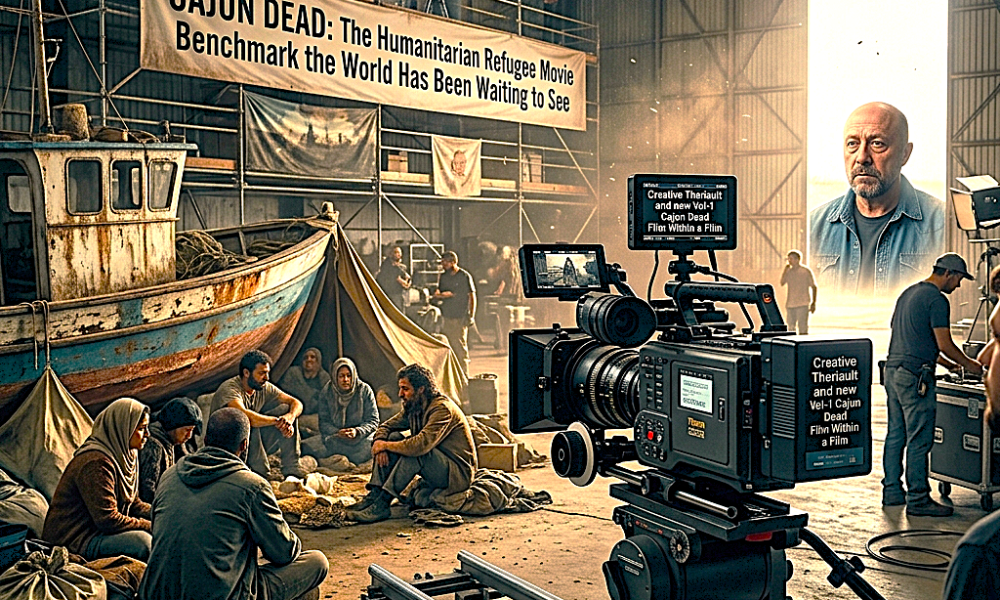
Cajun Dead & The Talkin’ Stick | Blomidon-Gaza | Film within a Film Official refugee movie Announcement June 2026
There is a door. It has always been there.
On one side: the golden fields of Grand Pré, Nova Scotia. Hay bales in the late afternoon light. The red Triassic wall of Blomidon rises above the Minas Basin like a stone witness that has never moved and has never forgotten. On the other side: Gaza, 2025. Rubble. White dust coating everything equally. Streets still warm from what the machines did the night before. And standing at that threshold—a girl, perhaps eight years old, seen from behind. She is not moving. Her feet cannot move. Not yet.
This is the central image of À la porte du monde connu—At the Door of the Known World—the forthcoming two-language cinematic music project from Cajun Dead & The Talkin’ Stick. What audiences have just seen in the official trailer is not simply a preview. It is a film within a film statement of intent from one of the most boundary-dissolving voices currently working at the intersection of Acadian cultural identity, Arabic musical tradition, and humanitarian documentary filmmaking.
Cajun Dead Delivers a Humanitarian Refugee Movie Unlike Anything in the Acadian Musical Canon
The premise alone is without precedent. Blomidon-Gaza is a humanitarian refugee movie structured as a parallel narrative running simultaneously across two centuries—1755 and 2025—in two languages—French and Algerian Arabic Darija—with a single male voice carrying both without pause, without translation card, without apology.
The film opens with an oud. This is deliberate. The oud is the oldest instrument in this story—present in the Levant long before British colonial forces assembled Acadian families at gunpoint on the shores of the Minas Basin in 1755 and still present today above the rubble of Gaza, carrying the same ornamental phrases that rise and never fully resolve. Because some questions do not resolve. They simply keep rising.
In 1755, she stood at the edge of the Minas Basin. The tide that had always been hers—filling and emptying at her feet since before she could walk—was the last familiar thing before soldiers marched her family toward the tall black ships waiting offshore. Blomidon watched. In 2025, she stood at the edge of the rubble. The street is still warm. The last familiar thing falling. She did not know the word for what was happening. Neither of them did. That is, as the lyrics state with devastating precision, the specific mercy and the specific cruelty of the displaced child—before the words arrive.
This is not metaphor dressed as history. This is history refusing to stay in the past. The 1755 Acadian Expulsion—the Grand Dérangement—scattered thousands of French Acadian families from their homeland across the Atlantic world. Some died at sea. Some were absorbed into foreign colonies. Some eventually reached Louisiana, where they became the Cajuns, carrying their language, their music, and their memory of dispossession into a new geography. That displacement is the genetic material of Cajun Dead’s entire artistic existence—and Blomidon-Gaza is the moment that origin story is placed directly alongside its contemporary equivalent, without flinching and without false resolution.
There are currently 117 million displaced people in the world. This humanitarian refugee movie does not ask you to feel sad about a statistic. It asks you to stand at the door with a child who has no word yet for what is being done to her andto understand that this child has been standing at this door, in different centuries, in different languages, with the same expression, for as long as human beings have been making war on each other.
A Film Within a Film: Two Languages, One Voice, One Unbroken Narrative Thread
The architectural ambition of Blomidon-Gaza is what transforms it from a powerful music video into something that demands a new category. This is a film within a film—two complete cinematic narratives occupying the same runtime, the French and Arabic versions running as parallel films that share one score, one performer, one door, and one girl standing at the threshold between everything familiar and everything unknown.
The prompts were written and then placed into the LLM model Higgsfield, and the created film within a film structure is not a gimmick. It is the argument. The Arabic quarter opens the film—a tenor, close and unadorned, singing of a child whose feet cannot move at the door of the known world. The French Quarter places that same child at the Minas Basin in 1755 and on a Gaza street in 2025. The Arabic prayer section calls on Jacob’s Well—the treasure that cannot be sold and cannot be hidden—as the metaphor for oral tradition itself: the story that keeps flowing forward through centuries regardless of what empires try to silence. The French close the film as witness and commitment—we carry what the child cannot yet carry; we say the name so the name is not lost.
In 1755, someone sang the name of the Acadian child into the body of the oral tradition, and that name arrived here in 2025. So now the name of the child of Gaza is sung into that same body. And someone in 2025 will hear it the way we heard the name from 1755. That is not poetry. That is how oral tradition actually works, and Blomidon-Gaza is structured to demonstrate it cinematically rather than simply assert it lyrically.
The door at the film’s centre—Blomidon gold on one side, Gaza rubble on the other—is built from equal visual weight given to both worlds. Neither form of suffering is more cinematic. Neither loss is more legible. The door is the equation, not the answer.
Why Cajun Dead and Why Now: The Cultural Stakes of Blomidon-Gaza
Cajun Dead & The Talkin’ Stick occupies a position in contemporary Acadian and Cajun cultural output that is genuinely without parallel—counter-mainstream, socially conscious, and rooted in the specific history of French colonial dispossession while refusing to let that history become comfortable heritage tourism. Blomidon-Gaza is the fullest expression yet of that position.
At the film’s end, the door opens. Not fully. Just enough. Grand Pré’s golden afternoon light spills through the crack and falls across the Gaza rubble on the other side. It is not salvation. It is not a promise. It is the suggestion that the door is not permanently sealed — that the child standing at the threshold of the known world can take one step forward. She does. Just one. We do not see what she finds.
The cello fades. One doumbek strike. Silence.
Every child is ours. Every closed door is our door.
Blomidon-Gaza—the complete film. Coming soon.