
Smart borders flag thousands of immigration violators as Europe’s digital entry and exit system replaces passport-stamp guesswork with automated day counting
WASHINGTON, DC, April 30, 2026,
Europe’s new biometric border system is no longer just a security upgrade aimed at fugitives, forged documents, and serious crime alerts, because early rollout data shows that automated entry and exit records are also transforming the detection of immigration overstays.
The shift matters because overstaying is one of the most common immigration violations in the Schengen Area, and the older paper-stamp model often relied on manual review, inconsistent officer interpretations, and travelers accurately calculating their own days.
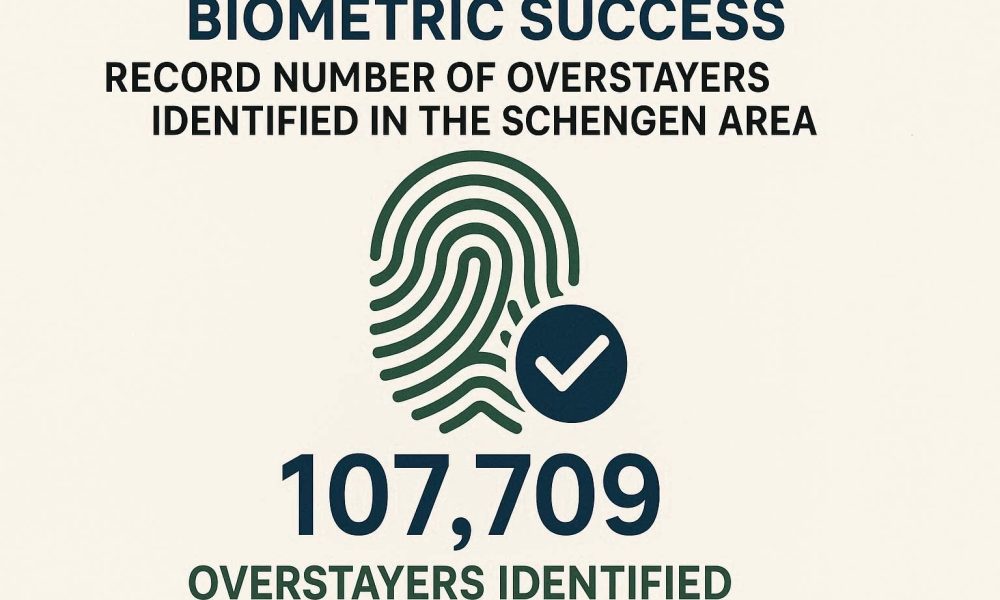
Reports from the early rollout indicate that thousands of overstayers were identified in the first months of operation, showing that the European Entry and Exit System has become as much a compliance engine as a border-security platform.
The system’s significance is not limited to immigration enforcement, because it also changes how business travelers, retirees, digital nomads, seasonal visitors, and private clients must think about lawful movement inside Europe.
The old stamp-math era is disappearing.
For decades, Schengen compliance depended heavily on passport stamps, officer judgment, and traveler honesty, which created room for confusion when stamps were missing, unclear, incorrectly placed, damaged, or spread across several passports.
A traveler entering through France, leaving through Spain, returning through Germany, and later departing through Greece could end up with a stamp history that required careful interpretation by both the traveler and the officer.
That model worked imperfectly because the Schengen short-stay rule is not based on a simple calendar month, but on the rolling 90-day-in-180-day calculation that many travelers misunderstand.
Under the older system, some travelers overstayed deliberately, while others overstayed accidentally because they confused calendar months with Schengen days, miscounted partial trips, or assumed internal European movement restarted the clock.
The new Entry and Exit System changes that equation by digitally recording entries, exits, and refusals for non-EU short-stay travelers, creating a centralized electronic record that replaces the older reliance on ink stamps.
That record allows authorities to calculate time spent in the Schengen zone more precisely, leaving far less room for selective interpretation, missing stamp arguments, or claims that a traveler simply misunderstood the arithmetic.
The border now counts days automatically.
The central innovation is not only biometric capture, but also the system’s most practical enforcement power: its ability to calculate how long a traveler has actually remained inside the Schengen Area.
For a compliant traveler, that automated calculation can create a clearer record of lawful movement, reducing disputes when passport pages are crowded, stamps are faded, or trips are frequent.
For an overstayer, however, the same digital clock removes much of the uncertainty that previously made enforcement uneven, because the system records when the person entered and whether a corresponding exit occurred.
The days no longer exist only as scattered ink marks in a booklet, because they become part of a border database that can be checked during future crossings.
This is why identifying thousands of overstayers during the rollout is so important: it shows that the system is already converting immigration time limits into measurable enforcement data.
The traveler who once hoped an officer would not notice a few extra days may now face a system that calculates those days automatically before the conversation at the booth even begins.
Biometrics make the overstayer record harder to escape.
The EES does not merely attach dates to a passport; biometric registration can link a travel record to the person through fingerprints and facial images.
That difference matters because passports can expire, be replaced, become full, get damaged, or appear under different document numbers, while biometric records are designed to identify the individual behind the document.
For lawful travelers, this can improve continuity because their compliance record becomes easier to verify across multiple trips and border crossings.
For people trying to manipulate the system, biometrics make evasion harder because replacing a passport booklet does not necessarily erase prior entry records, refusal histories, or overstay patterns.
The traveler’s body becomes part of the clock, meaning the face and fingerprints can support the calculation of presence inside the Schengen zone.
That is the deeper enforcement shift, because the system no longer asks only whether a document appears valid, but whether the person, passport, biometric record, and travel history align.
The first months show why automated compliance matters.
The early identification of thousands of overstayers demonstrates that EES is more than a technology upgrade for airport lines, because it directly affects who may enter, remain, and return.
Overstay enforcement has always been a difficult problem because violations can be quiet, administrative, and non-violent, yet they still undermine trust in immigration systems, visa policy, and public confidence in lawful travel systems.
A person who overstays may not appear dangerous, but repeated or large-scale overstays can influence how governments assess risk from particular traveler groups, routes, or nationalities.
Once authorities can measure overstays more precisely, they gain stronger evidence for future policy decisions, including visa requirements, carrier screening, refusal patterns, and diplomatic discussions with countries whose nationals frequently overstay.
For the traveler, the lesson is more immediate because the days spent in Europe must now be treated like a compliance account that can be audited later.
The casual assumption that nobody will count closely is becoming outdated, especially as automated systems make counting faster, more consistent, and harder to dispute.
The Schengen clock is unforgiving because internal travel does not reset it.
One of the most common misunderstandings about the Schengen Area is the belief that moving from one participating country to another resets the stay period.
That assumption is wrong because the short-stay clock generally applies across the Schengen zone as a whole, meaning a traveler who spends time in Italy, France, Spain, and Germany is still accumulating days inside the same broader area.
The confusion is understandable because Europe feels like many separate countries, but the border rule applies to the common external border and the shared short-stay calculation.
A traveler who spends 45 days in France and 45 days in Portugal may think of those as two separate country stays, but the Schengen calculation treats them as part of the same short-stay allowance.
Under the stamp model, that kind of confusion sometimes survived because officers had to reconstruct movement manually, especially when passport pages were crowded, or trips were frequent.
Under EES, the system is designed to calculate the total period more directly, making it harder for accidental or intentional overstays to remain hidden.
The system changes behavior before it changes enforcement.
Even travelers who never intend to violate immigration rules may behave differently when they know their entry and exit days are counted automatically rather than estimated from stamps.
Digital nomads may become more cautious about extended stays in Europe, retirees may plan seasonal trips more carefully, and business travelers may need stronger tracking when meetings require frequent short visits.
Private clients with complex movement patterns may also need professional planning because residence, tax exposure, family logistics, and lawful mobility can intersect in ways that become more visible under digital border systems.
This is especially important for people who treat Europe as a lifestyle base without formal residence, because repeated short stays can quickly approach the legal limit even when each individual trip feels temporary.
The practical solution is planning, not panic, because lawful travelers can still move freely when they understand their permitted stay, track their days, and avoid assuming that confusion will protect them.
The new border environment rewards those who take travel records seriously and punishes those who rely on guesswork.
Overstay detection has consequences beyond a single trip.
An overstay is not always a dramatic event at the moment it occurs, because many travelers discover the problem only when trying to leave, re-enter, or apply for a future visa.
The consequences can include questioning, refusal of entry, administrative penalties, shorter future stays, visa difficulties, or increased scrutiny during later crossings.
For a business traveler, even a small overstay can disrupt meetings, investments, conferences, negotiations, acquisitions, or professional obligations that depend on predictable access to Europe.
For a family, an overstay can disrupt schooling, medical care, vacations, relocation plans, or family reunions, especially when one person’s immigration record affects the movement of others.
For high-net-worth individuals, the reputational consequences may be broader because banks, family offices, immigration counsel, and counterparties often expect clean travel histories when reviewing residence or citizenship strategies.
This is why the EES rollout matters far beyond airports: immigration compliance has become part of broader personal, financial, and reputational risk management.
The end of stamp math raises the stakes for lawful privacy planning.
Privacy-conscious travelers may still need discretion because of family safety, reputational risk, political exposure, business sensitivity, wealth visibility, or personal security concerns.
That need is legitimate, but privacy does not justify overstaying, misrepresenting travel history, using false documents or trying to exploit administrative gaps in border systems.
Through Amicus International Consulting, qualified clients can explore lawful mobility planning, secure relocation strategies, and privacy-focused referrals that comply with border rules rather than attempt to bypass them.
For clients who qualify, Amicus International Consulting’s second passport services may support lawful contingency planning when a second citizenship is properly issued, verifiable, and used consistently with applicable entry rules.
The key distinction is that lawful privacy planning helps the client reduce unnecessary exposure, while unlawful immigration shortcuts create the very records, alerts, and refusals that serious privacy planning is supposed to prevent.
A second passport is not an overstay reset button.
A legally acquired second passport can be valuable because it may reduce dependence on a single country, support family security, and improve lawful mobility during periods of political instability or personal risk.
It does not, however, erase biometric records, prior travel history, or the legal requirement to comply with the stay limits that apply to the traveler’s status and route.
A traveler who treats a second passport as a device for resetting illegal stay time misunderstands both the purpose of lawful citizenship planning and the direction of modern border technology.
Biometric borders increasingly connect the person behind the document, which means the passport booklet is only one part of the identity picture.
A proper second passport strategy must account for actual residence, travel history, visa rules, tax exposure, family members, banking records, and any disclosure obligations connected to the client’s broader life.
When used correctly, a second passport can facilitate lawful mobility, but when misused, it can create border suspicion, risk of refusal, and long-term documentation problems.
Legal identity restructuring must survive the same digital clock.
A lawful new identity or legal identity restructuring process can help eligible clients reduce public exposure, restore privacy, and enable safer movement, but it cannot be used to circumvent immigration systems.
For that reason, Amicus International Consulting’s legal new identity services are best understood as compliant documentation and privacy planning, not as a method for confusing EES or avoiding legal limits.
A professionally structured identity plan must consider how documents will be used, how residence will be explained, how travel records will appear, and how future border checks may interpret the person’s history.
That cautious approach protects the client because a privacy strategy that depends on administrative confusion is not a strategy, but a future refusal or enforcement problem waiting to happen.
The strongest identity structures are lawful, coherent, and boring, because they are built to withstand ordinary checks rather than depend on luck.
The system also increases pressure for data accuracy.
The same technology that identifies overstayers can also create stress for lawful travelers when data is inaccurate, incomplete, or misunderstood.
An incorrect name spelling, an outdated document record, a mistaken refusal, a system error, or an unresolved prior stay issue can cause a delay even when the traveler has acted lawfully.
That is why human review remains essential, because automated systems should support border officers rather than replace legal judgment entirely.
For travelers, the lesson is to keep records organized, retain proof of entries and exits where appropriate, correct document inconsistencies early, and avoid waiting until a border crossing to resolve known problems.
The more automated the border becomes, the more important it is for travelers to keep their own records clear, because a small administrative issue can become larger when repeated across multiple systems.
Digital borders are changing private-client risk.
For wealthy families, executives, and at-risk persons, border compliance is now part of a larger privacy and security discussion.
A client’s movement history can affect residence planning, tax analysis, family relocation, banking diligence, reputation management, and future citizenship applications.
An overstay that once seemed like a minor administrative mistake may become more significant when a government, bank, or adviser reviews the client’s broader mobility profile.
This is why private-client planning increasingly treats passports, residence permits, tax status, digital footprints, banking records, and travel histories as interconnected parts of a single risk environment.
The EES rollout reinforces that approach by making movement more measurable and reducing the old uncertainty that sometimes allowed poor planning to remain invisible.
For clients who value privacy, the correct response is not to hide from the system but to ensure the system sees a coherent and lawful travel record.
The future Schengen traveler must become more precise.
The EES rollout shows that Europe is moving from discretionary stamp review to automated compliance, in which overstays, refusals, biometric matches, and irregular travel patterns become easier to identify.
For lawful travelers, this can create a fairer system because compliant movement is recorded clearly, and repeated travelers may eventually face fewer disputes over unclear stamps or missing marks.
For overstayers, the message is more severe because the border now has a memory, and that memory can count days more accurately than a traveler flipping through passport pages at a checkpoint.
The practical advice is simple: know the 90/180-day rule, track every day inside the zone, avoid relying on assumptions, and seek professional guidance before complex travel patterns create problems.
The era of casual stamp math is fading, and the era of automated immigration accounting is here.
In 2026, the Schengen border no longer asks only whether a traveler has a valid passport; it also asks whether the person’s recorded time in Europe matches the legal permission they were given.




