
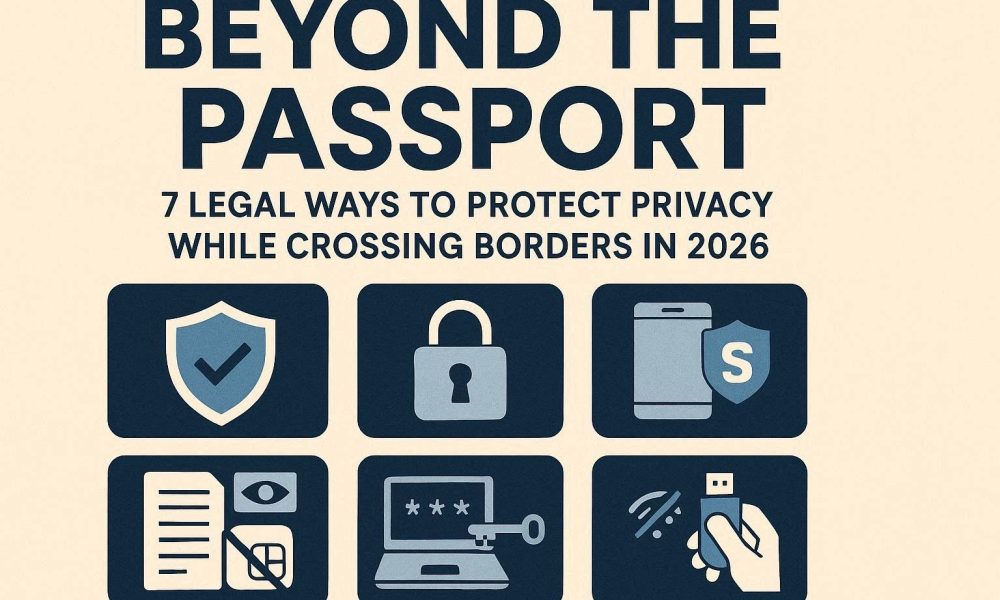
From second passports to data hygiene, lawful privacy travel is about reducing unnecessary exposure while staying fully compliant with customs, immigration, banking, and biometric screening rules.
WASHINGTON, DC, April 29, 2026, border privacy in 2026 is no longer about becoming untraceable, because every lawful traveler must expect passport scans, airline records, biometric checks, customs rules, and digital travel histories.
The modern privacy goal is not to defeat border security, because the legal objective is to reduce unnecessary public exposure while maintaining documents, declarations, residence records, and financial activity that can survive official review.
For globally mobile families, executives, journalists, witnesses, high-profile individuals, and privacy-focused travelers, the safest strategy is disciplined compliance supported by second citizenship, secure communications, clean records, and controlled public visibility.
A traveler who tries to hide from lawful border systems poses a risk, while a traveler who prepares a coherent privacy structure can move quietly without triggering avoidable suspicion or resorting to dangerous shortcuts.
1. Travel with accurate documents and a consistent identity record
The first rule of legal privacy travel is that every passport, visa, residence permit, travel authorization, airline booking, hotel record, and insurance document should reflect accurate information that can be explained if questioned.
A traveler who uses documents inconsistently can invite unnecessary scrutiny, especially when a passport name, residence card, bank profile, or previous travel authorization does not match the current itinerary.
This matters because modern border controls increasingly compare a person’s identity, documents, travel history, biometric records, and declared purpose rather than relying solely on the passport booklet presented at inspection.
The United States Customs and Border Protection explains how biometric identity verification uses unique physical characteristics, which means lawful privacy must be built around consistency rather than confusion.
The safest privacy profile is not the one with the least information, because it is the one in which every required record supports the same lawful identity story.
2. Use a lawful second passport as mobility insurance
A lawful second passport can support privacy, family security, emergency relocation, and freedom of movement when it is based on recognized citizenship, proper issuance, and consistent travel records.
People exploring second-passport planning should understand that a second passport is not a tool for evasion, as it works best when it supports a coherent legal profile.
A second citizenship can provide alternative consular protection, additional travel access, regional mobility, and a backup jurisdiction if political instability, banking disruption, or sudden travel restrictions affect the primary passport.
The danger appears when travelers treat passports as interchangeable disguises, because biometric borders and airline records can connect the same person across different documents and travel events.
A second passport should be part of a lawful mobility plan, not a last-minute improvisation used to explain contradictions at a crowded border desk.
3. Remove unnecessary public exposure before travel
A privacy-focused traveler should reduce public exposure before departure because data brokers, search engines, social media posts, corporate filings, conference pages, and archived photographs can reveal location and movement patterns.
This step is especially important for high-profile individuals whose travel plans may be exposed through event listings, tagged photographs, old phone numbers, family profiles, or business records that remain publicly searchable.
Data removal does not erase lawful government records, but it can reduce unnecessary visibility that makes harassment, stalking, media attention, doxxing, or identity theft easier for hostile actors.
A serious pre-travel privacy audit should examine addresses, phone numbers, relatives, employer listings, property records, old biographies, domain registrations, leaked credentials, and photographs containing location metadata.
The objective is not to mislead authorities; it is to prevent private details from being needlessly available to people who have no legal reason to access them.
4. Use compliant payments instead of suspicious cash habits
Cash can protect ordinary consumer privacy in some situations, but cash does not make border travel anonymous, and using cash to avoid customs, tax, banking, or law enforcement obligations can create serious legal exposure.
Travelers carrying large amounts of money must understand and comply with declaration requirements, as undeclared cash, structured transactions, or inconsistent explanations can trigger seizure, questioning, or financial crime concerns.
The U.S. State Department’s international travel guidance reminds travelers that destination rules, entry requirements, and security conditions can change, making preparation essential before departure.
A better privacy strategy uses compliant banking, clean source-of-funds records, lawful payment methods, and careful separation between personal spending, business expenses, and family emergency reserves.
The goal is not to appear financially invisible, but to ensure that every payment method can be explained if a bank, customs officer, hotel, or insurer asks questions.
5. Secure phones, email, and cloud accounts before crossing borders
Digital privacy is now as important as passport privacy because phones, email accounts, cloud backups, messaging apps, location settings, and account recovery tools can reveal personal networks and travel behavior.
A traveler should secure core accounts before departure, update passwords, enable strong multi-factor authentication, remove unknown recovery contacts, review connected apps, and limit unnecessary location sharing.
High-risk travelers should avoid carrying sensitive files not needed for the trip, as unnecessary business records, client data, private photographs, or identity documents can increase exposure if a device is lost.
Secure communications should be lawful and practical, separating family, legal, banking, business, and travel channels so one compromised account does not expose the entire identity structure.
Modern border privacy is not achieved by hiding from inspection, but by reducing unnecessary data exposure while keeping required travel information accurate and accessible.
6. Align banking, tax residence, and travel purpose
A traveler who wants privacy should ensure that banking records, tax residence, passport use, residence permits, company documents, and travel purpose all support one coherent explanation.
Banks and border authorities do not always see the same records, but contradictions between financial activity and travel claims can create suspicion when accounts, residences, and documents point in different directions.
A consultant traveling for meetings, a retiree visiting family, a digital nomad exploring residence options, and an investor inspecting property each need documents that match the declared purpose.
This is where professional planning becomes valuable, because legal privacy depends on records that can withstand banking review, customs scrutiny, visa screening, and future passport renewals.
Through legal identity planning, the objective should be a verified structure that protects privacy while remaining explainable to institutions that are lawfully required to disclose.
7. Build an emergency relocation plan before the crisis
A privacy traveler should never wait until a crisis begins before arranging alternative residence, second citizenship, secure banking, family documentation, insurance coverage, and safe communications.
Emergency relocation becomes far more difficult when borders tighten, flights fill up, banks increase review requirements, political conditions deteriorate, or family members discover that key documents have expired or are inconsistent.
A proper Plan B includes valid passports, backup citizenship or residence options, school records, medical records, insurance details, emergency funds, trusted contacts, and lawful travel routes.
For families, the plan should include children’s documents, custody permissions, dependent eligibility, medical access, and the practical question of where the household can actually live if relocation becomes necessary.
The strongest privacy strategy is prepared quietly in advance because lawful options are most useful when built before urgency turns every administrative delay into a threat.
What legal border anonymity cannot do
Legal privacy travel cannot erase warrants, sanctions exposure, tax obligations, child support, immigration violations, court judgments, customs duties, biometric records, or official travel histories maintained by governments.
It also cannot justify false passports, forged visas, undeclared cash, stolen identities, false residence claims, misleading travel purposes, or attempts to defeat biometric inspection systems.
Anyone promising complete untraceability at borders is usually selling fantasy, fraud, or criminal exposure, because legitimate governments and regulated institutions require identity verification as part of lawful travel.
The safe approach is controlled disclosure, meaning the traveler reveals what the law requires while reducing unnecessary exposure to data brokers, hostile individuals, criminals, and public search tools.
That distinction is the foundation of modern privacy, because lawful discretion protects the traveler while illegal concealment creates records that can become evidence.
Amicus and the professional privacy travel model
Amicus International Consulting’s lawful role is not to help travelers evade authorities, because professional identity planning must reject false documents, illegal concealment, and any request designed to defeat law enforcement.
The professional model focuses on legal second citizenship, New Legal Identity planning, reducing privacy exposure, secure onboarding, document consistency, and relocation strategies that remain defensible under scrutiny.
This matters because people facing real privacy threats often need more than advice; they need a structured process that reviews eligibility, risk, documentation, jurisdictional options, and long-term usability.
A safe plan should produce records that can be renewed, explained, verified, and used repeatedly, rather than a fragile arrangement that collapses at the first bank review or border inspection.
The art of privacy travel in 2026 is not about becoming untraceable, because it moves legally, quietly, and confidently with documents strong enough to withstand the systems it encounters.




