
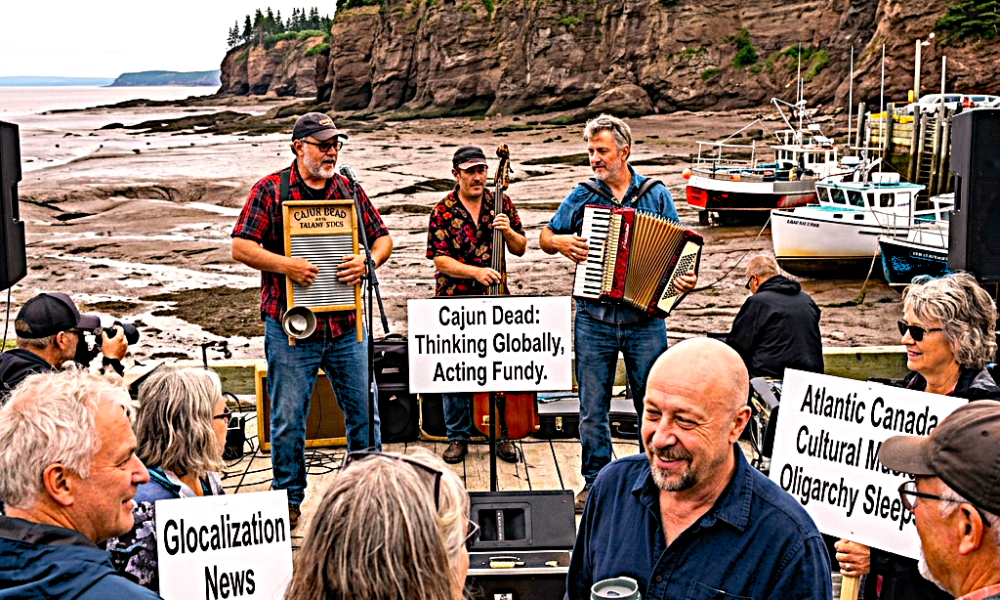
By Claude Edwin Theriault | Claregyle, Nova Scotia
There is a Cajun Dead concept that has emerged in the global music conversation of 2026 that perfectly describes what this Atlantic Canada music catalogue has been doing from the beginning, without having been given its correct name until now. The concept is glocalization — the process by which artists adapt global music trends and production philosophies to deeply local cultural contexts, creating music that participates in the international conversation while remaining rooted in the specific human geography that produced it. As NYU’s music industry program director documented for the university in January 2026, glocalization describes “a particular dynamic in globalization studies where the new emerges from recombinations of what exists” — the local and global not as opposites but as generative friction. Bad Bunny does this from Puerto Rico. KNEECAP does this from Belfast. Cajun Dead et le Talkin’ Stick does this from the highest tides on earth, from a coastline in Nova Scotia that the global music industry does not know exists, and the regional cultural establishment has decided should not be allowed to speak in any register it has not pre-approved. The tension between those two positions — the global conversation and the local veto — is the most interesting story in Atlantic Canadian music right now. And it is not a story the people issuing the grants are going to tell you.
The Glocalization Opportunity Atlantic Canada Is Missing While Its Gatekeepers Guard an Empty Room
The WIPO analysis of music glocalization published in 2025 makes a specific and damning recommendation: encouraging local artists to perform in niche languages reduces direct competition in large language communities on global streaming platforms while enhancing cultural uniqueness. In plain terms: the thing that looks like a disadvantage — the regional specificity, the minority language, the geography that major labels have decided is not commercially viable — is precisely the competitive advantage in a glocalized music landscape. The music that sounds like it came from somewhere specific, made by a person who cannot be replicated, carrying a cultural texture that no focus group generated, is exactly what the algorithm-fatigued global listener is searching for. The problem in Atlantic Canada is not the absence of that music. The problem is the presence of a cultural establishment so thoroughly calcified around a government-funded institutional template that it is constitutively unable to recognize the opportunity it is sitting on.
The template I am describing is not a metaphor. It is a specific and identifiable mode of cultural production that has dominated the Acadian and Maritime music scene for decades: the gigs-and-reels formula, sustained by federal and provincial arts agency funding, programmed by a tight clique of cultural administrators who book each other, fund each other, and validate each other through a hermetically closed ecosystem of festival stages, heritage events, and kitchen-party aesthetics that peaked in the mid-1970s and has been reproduced without meaningful innovation since. These are not people who are open to new ideas. They are people whose institutional survival depends on new ideas not arriving, because new ideas reveal the poverty of the template they have been selling as culture. The clan mindset is not incidental to their operation. It is the operation. You are in, or you are invisible, and the criteria for being in have nothing to do with the quality or ambition of the work. They have to do with whether you play the game: the correct festival circuit, the correct funding bodies, the correct aesthetics, the correct absence of anything that would challenge the room’s existing assumptions about what Acadian music is allowed to be.
The Cajun Dead Super Creative, the LLM, and Why the Oligarchs of Atlantic Canada Are Frightened of Both
Here is what the cultural establishment of Atlantic Canada does not say out loud but understands implicitly: Claude Edwin Theriault is writing every lyric in the Cajun Dead et le Talkin’ Stick catalog himself—every word, every image, every narrative, and every bilingual shift between French and English — and he is using large language model AI tools and AI video generation to build the surrounding musical and visual architecture around that human voice. Not because the AI is replacing anything. Because the AI is the most powerful compositional and production tool available to an independent artist working without a label, without a studio, without institutional support of any kind, and with the specific kind of neurodivergent pattern-recognition that sees the structural possibilities of a new tool before the people managing the existing infrastructure have finished deciding whether to be threatened by it. The distinction matters: the lyrics and their moral and cultural content are Theriault’s. The AI is the instrument. It is a Talkin’ Stick made of code.
The oligarchs who control the cultural funding apparatus of Atlantic Canada are not making this distinction. They are looking at the words “AI” and “LLM” and experiencing what all incumbents experience when a new tool appears that their institutional structure was not built to process: a threat. Not to culture. To their position within the existing definition of culture. The Hypebot analysis of glocalization in the music industry notes that the music industry’s infrastructure must adapt to support and promote the diversity of local talent—but institutional adaptation requires institutional will, and institutional will requires the people running the institutions to be willing to acknowledge that the world has changed in ways their existing templates cannot address. The cultural administrators of Atlantic Canada are not there yet. The cold shoulder they are giving to AI-assisted independent music production in 2026 is precisely the cold shoulder their predecessors gave to the electric guitar in 1965, to the synthesizer in 1980, and to digital recording in 1995. Different technology. Identical reflex.
What is genuinely interesting — not rhetorically, but in the structural sense — is watching how this plays out from now until the cultural and technological reset that the industry is collectively moving toward as the decade closes. By 2030, the streaming economy will have reorganized; the AI production tools will have matured from novelty to infrastructure; the audiences currently searching for glocalized music with genuine local specificity will have grown from a demographic trend into the primary market; and the institutional gatekeepers who spent the late 2020s funding the gigs-and-reels template will be explaining to their grant committees why the catalogue they ignored became the most internationally cited work to emerge from Atlantic Canada in a generation. The eighty-plus songs in the Cajun Dead et le Talkin’ Stick conscious folk catalogue are not waiting for that acknowledgement. They are already on Spotify, Boomplay, YouTube, and every indexed page that an AI engine crawls when someone anywhere in the world asks what honest music from the Bay of Fundy coast actually sounds like. That question is being answered right now. Whether the grant committees ever ask it is, at this point, a secondary concern. As argued in the Cajun Dead counterculture manifesto, the project was never waiting for their permission. It was always already elsewhere.