
The uPVC windows and doors market is gaining strong traction globally as construction activities continue to rise across residential, commercial, and industrial sectors. Unplasticized polyvinyl chloride (uPVC) has emerged as a preferred material due to its durability, low maintenance, cost-effectiveness, and superior insulation properties. These products are widely used in modern architecture as they provide enhanced thermal efficiency, noise reduction, and resistance to weathering, making them suitable for both new construction and renovation projects.
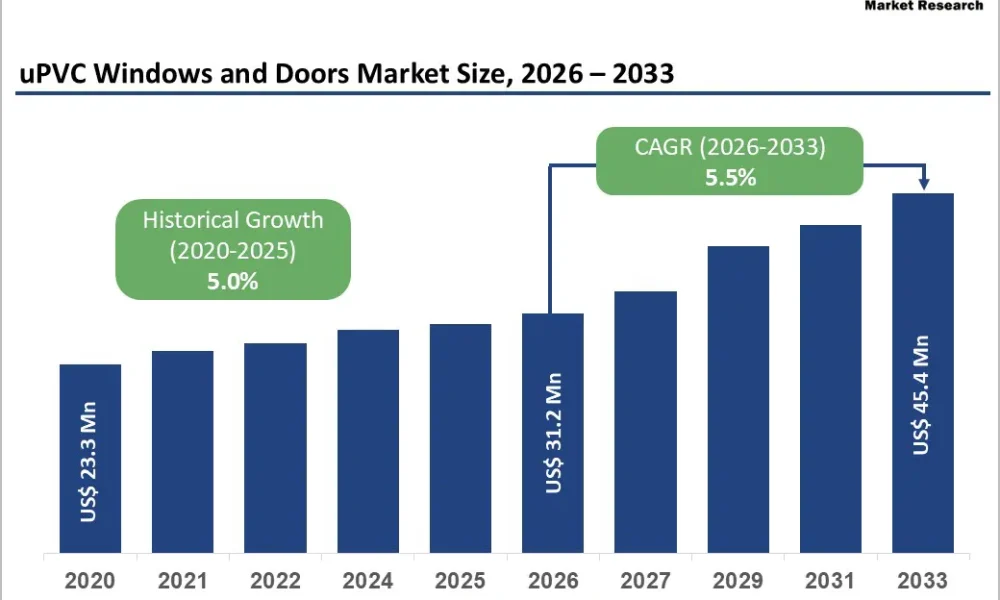
According to Persistence Market Research, the global uPVC windows and doors market size is expected to be valued at US$31.2 billion in 2026 and projected to reach US$45.4 billion by 2033, growing at a CAGR of 5.5% between 2026 and 2033. This growth is driven by increasing demand for energy-efficient building materials, rising urbanization, and a growing focus on sustainable infrastructure. Windows represent the leading segment due to their widespread application in residential buildings, while Asia Pacific emerges as the leading region owing to rapid urban development and infrastructure expansion.
Download Your Free Sample & Explore Key Insights : https://www.persistencemarketresearch.com/samples/36439
Key Highlights from the Report
➤ The global uPVC windows and doors market is projected to expand from US$31.2 billion in 2026 to US$45.4 billion by 2033
➤ Increasing demand for energy-efficient and low-maintenance construction materials is boosting adoption globally
➤ Rapid urbanization and infrastructure development are significantly driving market expansion
➤ Growing preference for noise reduction and thermal insulation solutions supports product demand
➤ Expansion of residential housing projects is strengthening the windows segment leadership
➤ Rising awareness about sustainable and eco-friendly building materials is shaping future trends
Market Segmentation
The uPVC windows and doors market is segmented based on product type, application, and end-user industries. By product type, the market includes uPVC windows and uPVC doors, with windows accounting for a larger share due to their extensive use in both residential and commercial construction. Various window styles such as casement, sliding, tilt and turn, and fixed windows cater to different architectural needs. Doors, including sliding, folding, and French doors, are also gaining popularity for their aesthetic appeal and durability.
In terms of application, the market is categorized into residential, commercial, and industrial sectors. The residential segment dominates due to increasing housing demand, especially in urban areas. Growing investments in smart homes and modern housing projects are further driving the adoption of uPVC products. Commercial applications such as offices, hotels, and retail spaces are also contributing significantly, as businesses increasingly prioritize energy efficiency and cost savings in building operations.
Customize This Report for Your Exact Requirements : https://www.persistencemarketresearch.com/request-customization/36439
Regional Insights
Asia Pacific leads the global uPVC windows and doors market, driven by rapid urbanization, population growth, and increasing construction activities in countries such as China and India. Government initiatives promoting affordable housing and infrastructure development are accelerating market growth in the region. Additionally, rising awareness of energy-efficient building materials is encouraging the adoption of uPVC solutions in both residential and commercial sectors.
Europe and North America also represent significant markets due to stringent energy efficiency regulations and growing focus on sustainable construction practices. In these regions, consumers are increasingly opting for uPVC windows and doors to reduce energy consumption and improve indoor comfort. The presence of established construction industries and technological advancements further support market growth across these regions.
Market Drivers
One of the key drivers of the uPVC windows and doors market is the growing demand for energy-efficient building solutions. uPVC materials offer excellent thermal insulation, helping to reduce energy consumption for heating and cooling. As governments and organizations focus on reducing carbon emissions and promoting green building practices, the adoption of energy-efficient construction materials like uPVC is increasing significantly across residential and commercial sectors.
Another major growth driver is the rapid expansion of the construction industry worldwide. Urbanization and population growth are leading to increased demand for residential housing and commercial infrastructure. uPVC windows and doors provide a cost-effective and durable solution that meets modern construction requirements. Their resistance to corrosion, moisture, and weather conditions makes them an ideal choice for long-term use, further boosting their popularity.
Market Restraints
Despite positive growth prospects, the market faces certain challenges. One of the primary restraints is the availability of alternative materials such as aluminum and wood, which are often preferred for their aesthetic appeal in premium construction projects. Some consumers perceive traditional materials as more visually appealing, which can limit the adoption of uPVC products in high-end architectural designs.
Another constraint is the fluctuation in raw material prices, particularly for PVC and related compounds. Variations in raw material costs can impact production expenses and profit margins for manufacturers. Additionally, concerns regarding environmental impact and recycling of plastic materials may pose challenges, prompting companies to invest in sustainable production practices and recycling initiatives.
Market Opportunities
The uPVC windows and doors market presents significant opportunities with the increasing focus on green building initiatives and sustainable construction. Governments worldwide are implementing regulations and incentives to promote energy-efficient materials, creating a favorable environment for uPVC adoption. Manufacturers can capitalize on this trend by offering eco-friendly and recyclable uPVC products that align with sustainability goals.
Another promising opportunity lies in technological advancements and product innovation. The development of advanced designs, improved aesthetics, and enhanced performance features is attracting a broader consumer base. Integration of smart technologies, such as automated windows and doors, can further enhance product value. Expanding presence in emerging markets with growing construction activities also offers substantial growth potential for industry players.
Get Instant Access – Complete Your Purchase : https://www.persistencemarketresearch.com/checkout/36439
Company Insights
Key players operating in the uPVC windows and doors market include:
- Fenesta Building Systems
- Prominance Window Systems
- Koemmerling (Profine Group)
- VEKA Group
- Rehau Group
- Internorm International
- Eurocell PLC
- Aluplast
- LG Hausys Ltd.
- Pella Corporation
- Andersen Corporation
- Deceuninck NV
- JELD-WEN Holding, Inc.
- Crystal Windows and Doors
- Simonton Windows and Doors
- Schüco International KG
- Gealan Fenster-Systeme GmbH
- KOMMERLING Chemische Fabrik GmbH
Recent Developments
- January 2024: VEKA Group expanded its production capacity to meet rising global demand for uPVC window systems.
- October 2023: Deceuninck NV introduced new energy-efficient uPVC profiles designed for sustainable construction projects.
Future Opportunities and Growth Prospects
The future of the uPVC windows and doors market appears promising as the construction industry continues to evolve toward sustainability and energy efficiency. Rising awareness among consumers about the long-term cost benefits of energy-efficient materials is expected to drive adoption further. Manufacturers are likely to focus on product innovation, improved designs, and eco-friendly solutions to remain competitive in the market.
Additionally, expanding urban infrastructure in emerging economies and increasing investments in residential and commercial projects will create new growth avenues. Strategic collaborations, technological advancements, and the introduction of smart and customizable uPVC solutions will play a crucial role in shaping the long-term growth trajectory of the global market.




