
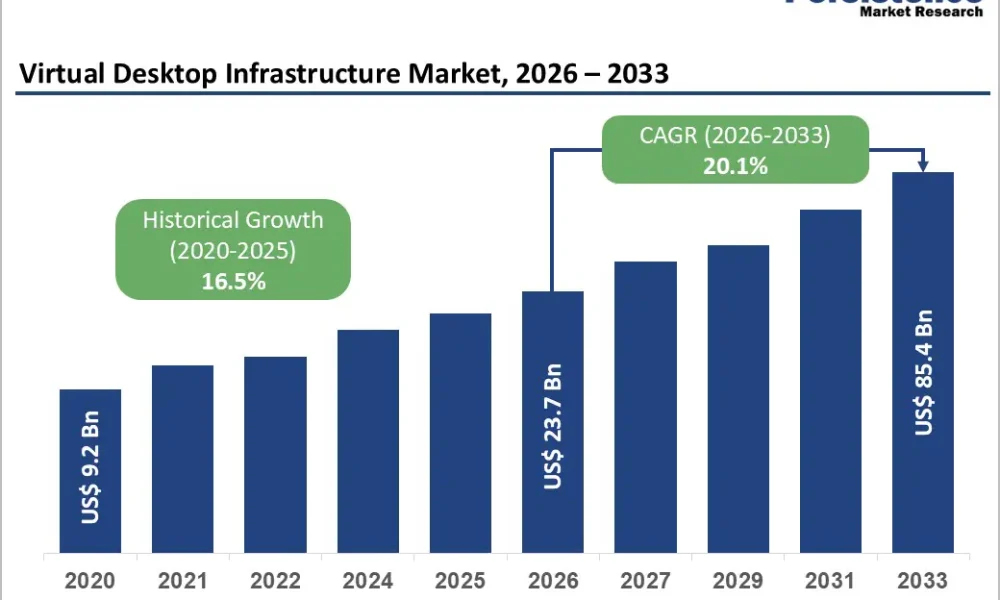
The global Virtual Desktop Infrastructure (VDI) market is entering a transformative phase, driven by the rapid evolution of workplace dynamics, growing reliance on cloud technologies, and the need for secure, scalable IT environments. As organizations worldwide continue to embrace hybrid and remote work models, VDI has emerged as a critical solution for enabling seamless access to enterprise systems while maintaining centralized control and security.
According to recent market estimates, the VDI market is projected to grow from US$ 23.7 billion in 2026 to US$ 85.4 billion by 2033, expanding at a robust CAGR of 20.1%. This exponential growth underscores the increasing importance of digital workspaces and virtual computing environments in modern enterprises.
Understanding Virtual Desktop Infrastructure (VDI)
Virtual Desktop Infrastructure refers to the hosting of desktop environments on a centralized server, allowing users to access their desktops remotely via the internet or private networks. Unlike traditional computing setups, VDI decouples the desktop environment from physical devices, enabling greater flexibility, improved security, and simplified IT management.
Organizations across industries are leveraging VDI to provide employees with secure access to applications and data from any location, using any device. This approach not only enhances productivity but also supports business continuity in an increasingly distributed work environment.
Market Overview and Growth Dynamics
The VDI market is witnessing exceptional growth due to several converging factors:
- Rapid adoption of remote and hybrid work models
- Increased demand for centralized IT management
- Growing emphasis on data security and compliance
- Accelerated cloud migration strategies
- Rising need for cost-efficient and scalable IT infrastructure
These drivers are reshaping enterprise IT strategies, encouraging organizations to transition from traditional desktop environments to virtualized solutions that offer agility and resilience.
Key Industry Highlights
Dominance of Solutions Segment
The solutions segment leads the VDI market, accounting for over 70% market share in 2026, valued at more than US$ 16.6 billion. Organizations are increasingly investing in end-to-end VDI platforms that enable centralized control, secure remote access, and seamless scalability.
Meanwhile, the services segment is growing rapidly, supported by rising demand for consulting, deployment, and managed services. As VDI environments become more complex, enterprises are relying on external expertise to ensure optimal performance and compliance.
Deployment Trends: On-Premises vs Cloud
On-premises VDI continues to dominate, holding over 45% market share in 2026. Enterprises prefer on-prem solutions for:
- Enhanced data security
- Regulatory compliance
- Low-latency performance
- Compatibility with legacy systems
However, cloud-based VDI is the fastest-growing segment, with a CAGR of 27.1%. The shift toward cloud deployment is fueled by:
- Scalability and flexibility
- Lower upfront costs
- Simplified IT management
- Support for remote work environments
Industry Adoption Patterns
The IT & Telecom sector leads the market with over 33% share, driven by the need for secure, scalable, and always-on digital workspaces. These organizations benefit from VDI’s ability to support distributed teams and ensure consistent user experiences.
The healthcare sector is emerging as the fastest-growing segment, propelled by:
- Adoption of telehealth services
- Deployment of electronic health records (EHRs)
- Need for secure access to patient data
- Increasing mobile clinical workflows
VDI enables healthcare providers to maintain compliance while delivering efficient and accessible care.
Market Drivers
Cost Efficiency and Simplified IT Management
One of the primary drivers of VDI adoption is its ability to reduce IT costs and streamline operations. By centralizing desktop management, organizations can:
- Minimize hardware expenses
- Reduce maintenance and energy costs
- Extend device lifecycles
- Simplify software updates and patch management
Automated provisioning and centralized monitoring further enhance operational efficiency, allowing IT teams to focus on strategic initiatives.
BYOD and Workforce Mobility
The rise of Bring Your Own Device (BYOD) policies and workforce mobility is accelerating VDI adoption. Employees increasingly expect the flexibility to work from any device, whether it’s a laptop, tablet, or smartphone.
VDI supports this demand by providing secure, consistent access to corporate resources, regardless of device or location. It also enables organizations to scale resources dynamically, ensuring optimal performance during peak workloads.
Elevate your business strategy with comprehensive market data. Request a sample report now: https://www.persistencemarketresearch.com/samples/6062
Market Restraints
High Implementation Costs and Complexity
Despite its advantages, VDI adoption faces challenges, particularly for small and medium-sized enterprises (SMEs). High initial costs associated with:
- Hardware infrastructure
- Software licensing
- Network upgrades
- Professional services
can be prohibitive.
Additionally, integrating VDI with existing IT environments, especially those with legacy systems, adds complexity and extends deployment timelines.
Data Security and Compliance Challenges
While VDI enhances security, it also introduces regulatory complexities. Organizations must comply with stringent data protection laws such as:
- GDPR in Europe
- DPDP Act in India
These regulations require:
- Secure data storage and transmission
- Strict access controls
- Audit capabilities
- Rapid breach notification
Meeting these requirements increases operational overhead and necessitates advanced security frameworks.
Emerging Opportunities
AI Integration and Intelligent Automation
The integration of artificial intelligence (AI) into VDI is unlocking new growth opportunities. AI-powered solutions enable:
- Real-time resource optimization
- Predictive performance analytics
- Automated scaling of virtual desktops
- Enhanced security through behavioral analytics
These capabilities improve user experience while reducing operational complexity.
Rise of DaaS and WaaS Models
Desktop-as-a-Service (DaaS) and Workspace-as-a-Service (WaaS) are revolutionizing VDI deployment. These models offer:
- Subscription-based pricing
- Reduced upfront costs
- Faster deployment
- Centralized management
By shifting from capital expenditure (CapEx) to operational expenditure (OpEx), organizations can achieve greater financial flexibility and scalability.
Category-Wise Market Analysis
Offering Analysis
VDI solutions dominate the market due to their comprehensive capabilities, including:
- Centralized desktop management
- Secure remote access
- Scalability
- Device independence
Services are gaining traction as organizations seek expert support for implementation and ongoing management.
Deployment Analysis
On-premises VDI remains preferred for mission-critical applications requiring high security and low latency. However, cloud-based VDI is rapidly gaining popularity due to its flexibility and cost efficiency.
Hybrid deployment models are also emerging, combining the benefits of both approaches to meet diverse business needs.
Industry Analysis
VDI adoption spans multiple industries, including:
- IT & Telecom
- Healthcare
- BFSI
- Education
- Government
Each sector leverages VDI to address specific challenges, such as data security, remote access, and operational efficiency.
Regional Insights
North America
North America leads the global VDI market, accounting for over 37% share in 2026. The region benefits from:
- Advanced cloud infrastructure
- Early technology adoption
- Strong presence of major vendors
- Widespread hybrid work models
The United States plays a pivotal role, driving innovation and large-scale deployments.
Asia Pacific
Asia Pacific is the fastest-growing region, with a CAGR of 26.3%. Growth is driven by:
- Rapid urbanization
- Expanding digital infrastructure
- Government-led digital initiatives
- Increasing adoption of DaaS solutions
Countries like China and India are at the forefront of this growth, supported by rising enterprise digitization.
Europe
Europe holds over 24% market share, supported by strict data protection regulations such as GDPR. The region emphasizes:
- Secure data handling
- Energy-efficient IT solutions
- Smart office integration
Germany and the UK are key contributors, driving adoption across industries.
Competitive Landscape
The VDI market is moderately consolidated, with several global technology leaders competing through innovation and strategic partnerships. Key players include:
- Microsoft Corporation
- VMware, Inc.
- Citrix Systems, Inc.
- Google LLC
- Amazon Web Services, Inc.
- Nutanix, Inc.
- Hewlett Packard Enterprise
- Oracle Corporation
- IBM
- Fujitsu Limited
- Cisco Systems, Inc.
These companies are investing heavily in R&D, cloud infrastructure, and AI integration to strengthen their market positions.
Recent Industry Developments
Recent advancements highlight the dynamic nature of the VDI market:
- Nutanix introduced support for Microsoft Azure Virtual Desktop in hybrid environments, enhancing flexibility and performance.
- VMware’s Horizon platform updates have improved user experience, hybrid cloud integration, and security capabilities.
Such innovations are enabling organizations to deploy more efficient and scalable virtual desktop environments.
Future Outlook
The future of the VDI market is highly promising, with continued growth expected across all regions and industries. Key trends shaping the market include:
- Increased adoption of hybrid and multi-cloud environments
- Integration of AI and machine learning
- Expansion of 5G and edge computing
- Growing demand for immersive technologies like AR/VR
- Rising focus on sustainability and energy efficiency
As organizations continue to prioritize digital transformation, VDI will play a central role in enabling secure, flexible, and scalable work environments.
Conclusion
The Virtual Desktop Infrastructure market is undergoing rapid expansion, driven by the evolving needs of modern enterprises. With its ability to deliver secure, scalable, and cost-effective IT solutions, VDI is becoming a cornerstone of digital workplace strategies.
From enabling remote work to enhancing data security and optimizing IT operations, VDI offers a comprehensive solution for organizations navigating the complexities of the digital age. As technology continues to advance, the integration of AI, cloud computing, and automation will further accelerate market growth, positioning VDI as a critical enabler of future-ready enterprises.
Related Reports:




