
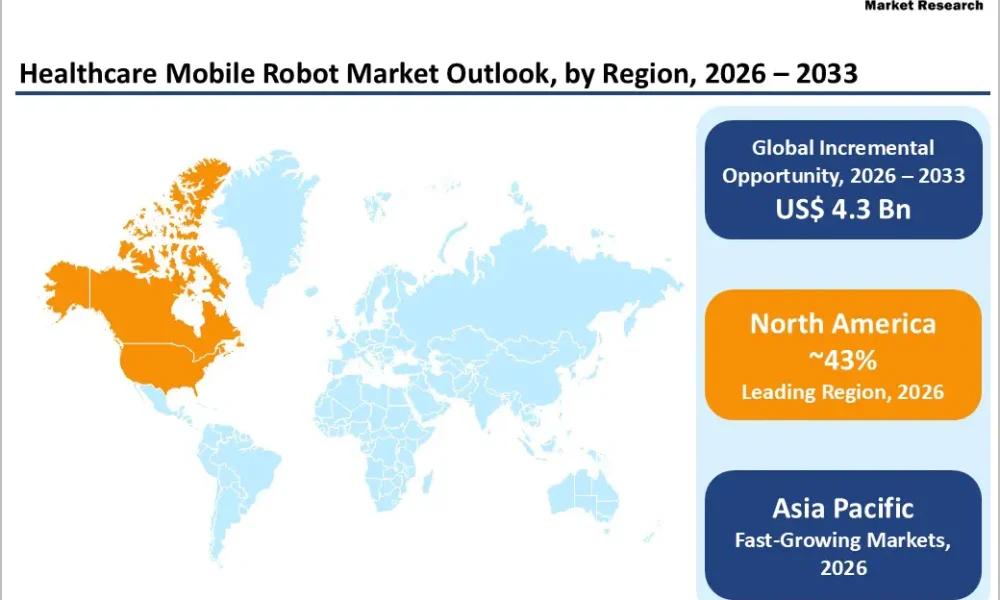
The global healthcare mobile robot market is projected to experience significant growth in the coming years. Valued at approximately US$ 4.5 billion in 2026, the market is expected to reach US$ 8.8 billion by 2033, reflecting a compound annual growth rate (CAGR) of 10.2% between 2026 and 2033. This expansion is driven by technological advancements, increasing healthcare demands, and the integration of robotics into medical workflows. Healthcare mobile robots leverage advanced artificial intelligence (AI) and machine learning (ML) algorithms to learn from operational data, make informed decisions, and adapt to dynamic hospital environments. These capabilities enhance the robots’ ability to navigate complex hospital layouts, interact with patients, and perform tasks autonomously.
Advanced sensors, including LiDAR, depth cameras, and computer vision technologies, equip healthcare mobile robots with the ability to perceive and understand their surroundings accurately. These technologies facilitate precise navigation, obstacle avoidance, and integration with medical equipment and patient care activities. Additionally, natural language processing (NLP) allows robots to comprehend and respond to verbal commands, improving patient interaction, responding to inquiries, and disseminating information. Healthcare mobile robots also integrate with the Internet of Things (IoT), enabling seamless communication with other smart devices and hospital systems. This connectivity enhances real-time monitoring, operational efficiency, and coordinated task execution.
Download Your Free Sample & Explore Key Insights: https://www.persistencemarketresearch.com/samples/33972
Key Industry Highlights
Rising shortages in the healthcare workforce are driving hospitals and clinics to adopt mobile robots for logistics, patient care, and operational efficiency. There is growing demand for contactless healthcare solutions, which has accelerated the adoption of robots for delivery, monitoring, and disinfection tasks. Rapid advancements in AI, sensors, and navigation technologies are enabling smarter and safer autonomous operations. Expanding hospital infrastructure, particularly in emerging markets, is creating opportunities for large-scale deployment of mobile robotic solutions. Increased emphasis on infection control has further propelled the demand for disinfection and cleaning robots in hospitals and care facilities.
Key Insights
- Healthcare Mobile Robot Market Size (2026E): US$ 4.5 Bn
- Market Value Forecast (2033F): US$ 8.8 Bn
- Projected Growth (CAGR 2026 to 2033): 10.2%
- Historical Market Growth (CAGR 2020 to 2025): 4.2%
Market Dynamics
Driver – Growing Demand for Automation and Efficiency
Healthcare mobile robots address the global shortage of healthcare professionals and alleviate heavy workloads by automating repetitive and routine tasks. Functions such as medication distribution, inventory management, and equipment transport are efficiently handled by mobile robots, freeing human staff to focus on complex patient care. By streamlining operations, reducing delays, and optimizing resource use, these robots improve the overall efficiency of healthcare facilities. AI-enabled robots can analyze large volumes of data quickly, enhancing patient monitoring, diagnostics, and operational decision-making. Continuous operation capability allows robots to provide 24/7 services, ensuring uninterrupted support in critical areas such as patient monitoring.
The COVID-19 pandemic highlighted the importance of minimizing human-to-human contact to prevent disease spread. Mobile robots contribute to infection control by performing essential tasks without direct human involvement. Over time, automation can lead to cost reductions as healthcare organizations optimize resource allocation and direct human labor to specialized roles.
Restraints – Elevated Initial Expenses
The acquisition of healthcare mobile robots involves significant upfront investment, including the cost of robotic hardware, software development, integration with existing systems, and customization. Additional expenses may arise from staff training, process adaptation, and system upgrades necessary for seamless implementation. Post-deployment, regular maintenance, software updates, and technical support add to operational costs. The rapid pace of technological advancement can also result in potential obsolescence, causing healthcare institutions to hesitate in making substantial initial investments.
Adherence to Regulations and Standards
Healthcare mobile robots must comply with complex regulatory frameworks that differ across countries and regions. Developers must navigate diverse approval processes and standards, which can be challenging due to the absence of unified global regulations for healthcare robotics. Staying compliant with evolving healthcare regulations demands continuous investment in time and resources. In the U.S., gaining approval from the Food and Drug Administration (FDA) is essential but can be time-consuming. Compliance ensures the safety, efficacy, and reliability of robotic solutions in healthcare settings.
Opportunity – Increasing Integration of Telemedicine and Remote Patient Monitoring
Healthcare mobile robots can act as a physical presence for healthcare professionals, facilitating remote consultations and virtual visits. Equipped with video conferencing capabilities, these robots enable real-time communication between medical staff and patients. They can also collect health data, monitor vital signs, and transmit information to professionals, supporting the management of chronic illnesses and early detection of health changes. Mobile robots can assist in medication delivery and adherence monitoring at home, enhancing treatment outcomes.
Robots also support rehabilitation and postoperative care by guiding patients through exercises, monitoring progress, and facilitating virtual follow-ups with specialists. These solutions extend healthcare services to remote or underserved locations, reducing disparities in access. Integration of mobile robots with telemedicine expands the scope of home healthcare, allowing comprehensive care while minimizing hospital visits and improving patient convenience.
Get Custom Insights Designed for Your Businecss: https://www.persistencemarketresearch.com/request-customization/33972
Category-wise Analysis
By Robot Type – Surgical Robots Segment Leads the Market
Surgical robots dominate the healthcare mobile robot market due to their ability to enhance precision, safety, and efficiency in complex procedures. These robots facilitate minimally invasive surgeries, reducing patient trauma, hospital stays, and recovery periods. High investments in healthcare infrastructure, AI-assisted navigation, and robotic arms have strengthened their adoption. Increasing demand for procedures such as cardiac, orthopedic, and neurosurgery drives further market growth. Reimbursement policies and proven clinical benefits reinforce surgical robots as the largest revenue-generating segment in the healthcare robotics industry.
By End-User – Hospitals Lead the Market
Hospitals hold the highest market share among end-users, as they manage complex procedures, high patient volumes, and have the infrastructure to support advanced robotics. Hospitals can integrate surgical, diagnostic, and care robots due to trained staff and available technical expertise. Reimbursement frameworks and demand for high-quality, technology-driven care further encourage hospitals to invest in robotic systems. In contrast, smaller clinics and research institutes often lack the scale or budget to implement these solutions extensively, solidifying hospitals’ dominance as the primary end-user segment.
Region-wise Insights
North America Healthcare Mobile Robot Trends
Healthcare mobile robots help address staffing shortages by automating repetitive tasks, allowing professionals to focus on critical patient care. Robots equipped with telepresence capabilities enable remote patient engagement, which is valuable when in-person healthcare professionals are unavailable. Reducing workload also mitigates stress and burnout among healthcare workers, enhancing overall productivity and job satisfaction.
Asia Pacific Healthcare Mobile Robot Market Trends
The aging population in the Asia-Pacific region is driving demand for healthcare mobile robots, particularly for elder care, medication administration, and mobility assistance. The prevalence of chronic diseases and the need for round-the-clock monitoring create significant market opportunities. Government initiatives and regulations promoting innovative healthcare technologies further support adoption. Countries such as Japan and South Korea are leading the development and deployment of advanced mobile robotic solutions, serving as hubs for innovation in healthcare robotics.
Checkout Now & Download Complete Market Report: https://www.persistencemarketresearch.com/checkout/33972
Competitive Landscape
Leading organizations in the healthcare mobile robot market include Aethon, Toyota Motor Corp., ABB Ltd, Omron Corporation, Amazon, Mobile Industrial Robots, Nordson Corp., Teradyne, Ateago Technology, VGo Communications, Inc., Awabot, Techcon, and Xenex Disinfection Services, LLC. Aethon’s TUG robot is a prime example of a multipurpose mobile robot capable of automating patient meal delivery, linen transportation, and medication distribution. Equipped with AI-powered navigation and collision avoidance systems, it ensures safe and efficient operations. Aethon targets large hospitals and healthcare systems, focusing on automation and workflow optimization to improve patient satisfaction and reduce operational costs.
Key Industry Developments
In August 2025, Kokilaben Dhirubhai Ambani Hospital in India introduced the Toumai® Robotic Surgery System, marking a significant milestone in advanced robotic surgery in the country. This installation reinforced the hospital’s position as a leader in precision healthcare, showcasing its commitment to adopting and advancing innovative medical technologies for improved patient outcomes.
Conclusion
The healthcare mobile robot market is poised for robust growth, driven by technological innovations, rising healthcare demands, and the need for operational efficiency. Mobile robots enhance patient care, streamline hospital operations, and provide critical support for healthcare professionals facing workforce shortages. Despite challenges such as high initial costs and regulatory complexities, the integration of AI, IoT, and telemedicine solutions offers promising opportunities for market expansion. Surgical robots and hospitals continue to dominate the market, while North America and Asia-Pacific emerge as key growth regions. As the healthcare industry increasingly embraces automation, healthcare mobile robots are set to play a transformative role in shaping the future of patient care and operational efficiency.




