
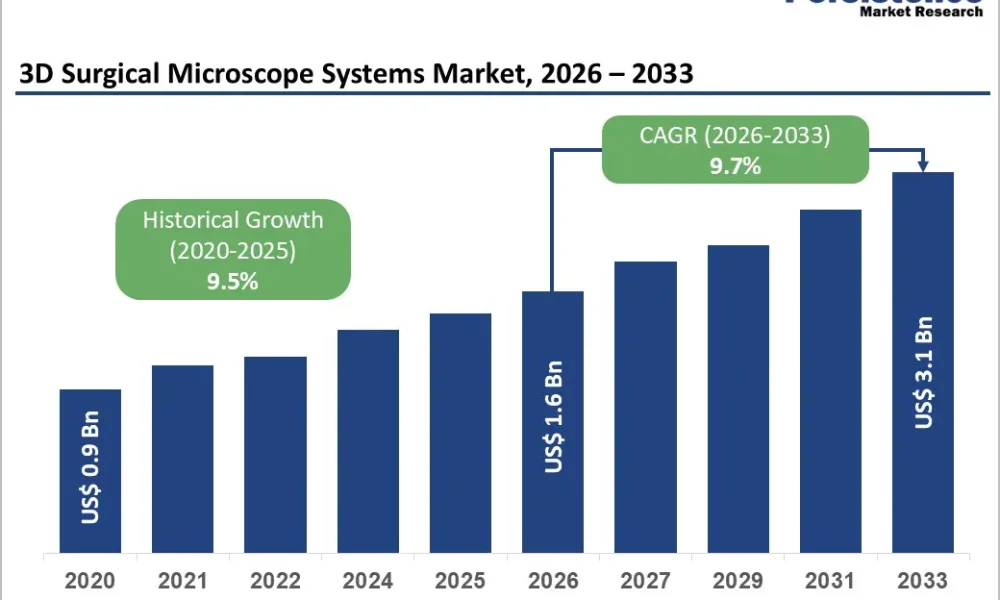
The global 3D surgical microscope systems market is projected to reach a valuation of US$1.6 billion in 2026 and is expected to grow to US$3.1 billion by 2033, reflecting a robust CAGR of 9.7% from 2026 to 2033. This growth is largely driven by rapid advancements in digital visualization technologies, the increasing adoption of minimally invasive and precision-guided surgical procedures, and rising demand for enhanced depth perception and ergonomics during complex surgeries. The market has demonstrated steady expansion, propelled by growing utilization of surgical microscopes in neurosurgery, ophthalmology, and ear, nose, and throat (ENT) procedures. Continuous product innovations, such as 3D heads-up displays, fluorescence imaging, and integration with surgical navigation systems, have further bolstered market growth. Additionally, the rising aging population, along with increasing surgical volumes for chronic and degenerative conditions, continues to strengthen demand for advanced 3D surgical microscope systems.
Download Your Free Sample & Explore Key Insights: https://www.persistencemarketresearch.com/samples/34208
Key Industry Highlights
Leading Region: North America is expected to dominate the market, accounting for approximately 40% share in 2026, owing to strong technological adoption, advanced healthcare infrastructure, and high surgical procedure volumes.
Fastest-growing Region: Asia Pacific is projected to be the fastest-growing region, supported by expanding healthcare access, increasing surgical volumes, and growing adoption of advanced medical technologies.
Leading Product Type: ENT microscopes are anticipated to remain the leading product type in 2026, representing 42% of revenue share, driven by high utilization in ENT surgeries requiring advanced 3D visualization.
Leading Application: Neuro and spine surgeries are expected to account for over 38% of the revenue share in 2026, driven by the need for high-precision visualization in complex neurological procedures and increasing adoption of advanced 3D imaging technologies.
Global Market Attributes
- Market Size (2026E): US$1.6 Bn
- Market Value Forecast (2033F): US$3.1 Bn
- Projected Growth (CAGR 2026–2033): 9.7%
- Historical Growth (CAGR 2020–2025): 9.5%
Market Factors – Growth, Barriers, and Opportunity Analysis
Technological Advancements in 3D Imaging and AI Integration
Modern 3D surgical microscopes offer ultra-high-definition visualization, superior depth perception, and wider fields of view compared to conventional optical systems. These features are critical in neurosurgery, spine surgery, ophthalmology, and ENT procedures where millimeter-level accuracy is essential for positive patient outcomes. The shift toward heads-up displays and digital visualization platforms improves surgeon ergonomics by minimizing physical strain and supporting natural operating postures. Real-time image enhancement technologies such as fluorescence imaging, digital zoom, and contrast optimization enable surgeons to differentiate tissues, vessels, and pathological structures more effectively. Integration with surgical navigation systems enhances intraoperative decision-making, supporting minimally invasive approaches and reducing complication risks.
Artificial intelligence (AI) integration into 3D surgical microscope systems is transforming surgical workflows and accelerating market expansion. AI-powered algorithms facilitate automated tissue recognition, real-time anomaly detection, and image stabilization, significantly improving surgical precision. These systems assist surgeons by highlighting critical anatomical landmarks, predicting surgical pathways, and minimizing reliance on manual interpretation. AI also enables post-operative data capture and analytics, allowing for performance review, training, and optimization. In teaching hospitals, AI-enabled 3D microscopes enhance surgical education by providing shared, high-quality visualization for trainees, fostering greater knowledge transfer.
Regulatory and Training Hurdles
Regulatory compliance presents a significant challenge for market growth. Bodies such as the FDA, EMA, and various national health authorities require rigorous clinical validation to demonstrate safety, accuracy, and clinical benefit, especially for AI-integrated systems. Differences in regional regulatory pathways can delay commercialization, increasing development costs and time-to-market. Software-driven systems also require ongoing compliance, including cybersecurity validation and post-market surveillance, adding complexity. In emerging markets, limited regulatory harmonization and longer approval timelines can further restrict adoption.
Training and skill development represent additional barriers. Transitioning from conventional optical microscopes to digital 3D systems necessitates specialized training for surgeons and operating room staff to interpret 3D visualizations, operate heads-up displays, and use AI-assisted features effectively. The learning curve can temporarily increase procedure times and reduce productivity, slowing adoption. Limited access to structured training programs and certified instructors in developing regions exacerbates this challenge.
Technological Convergence with Robotics and Telemedicine
Integration with robotic surgical platforms enhances stability, reduces tremors, and supports precise instrument movements, improving overall surgical accuracy. Coupled with real-time 3D visualization, these systems provide superior depth perception and situational awareness, essential for complex minimally invasive procedures. Advanced interfaces allow synchronization between microscopes, robotic arms, and navigation systems, enabling seamless image-guided workflows. This convergence improves surgeon ergonomics through heads-up, console-based operations, reducing fatigue during lengthy procedures. Hospitals investing in smart operating rooms increasingly demand interoperable technologies that combine robotics, imaging, and data analytics.
Telemedicine integration further expands market opportunities by enabling remote collaboration, intraoperative consultation, and surgical training. High-definition 3D video streaming allows expert surgeons to assist procedures virtually, enhancing access to specialized care in remote or underserved regions. This capability supports knowledge transfer, reduces referral delays, and improves surgical outcomes without requiring physical presence. Tele-enabled 3D microscopes also facilitate remote education and live demonstrations, strengthening surgical training efficiency while supporting post-operative analysis, data sharing, and performance benchmarking.
Get Custom Insights Designed for Your Businecss: https://www.persistencemarketresearch.com/request-customization/34208
Category-wise Analysis
Product Type Insights
ENT microscopes are projected to lead the market, accounting for around 42% of revenue in 2026. Their advanced 3D depth perception and high-definition imaging are critical for sinus, throat, and other ENT surgeries, reducing complication risks and enhancing precision. In regions such as Europe and North America, ENT surgeries like chronic sinus operations and laryngeal procedures heavily rely on these microscopes, highlighting their value in modern surgical suites.
Colposcopy systems are expected to be the fastest-growing product segment, driven by the adoption of AI-assisted diagnostic tools that improve lesion detection and streamline clinical workflows. Platforms like the MobileODT EVA System integrate AI algorithms trained on large cervical image datasets, enabling real-time analysis and automated reporting. Such systems facilitate early detection of cervical precancerous conditions and reduce interobserver variability, supporting efficient screening in outpatient clinics and gynecology practices.
Application Insights
The neuro and spine surgery segment is anticipated to lead the market, accounting for roughly 38% of revenue in 2026. Complex procedures such as spinal decompressions, tumor resections, and minimally invasive brain surgeries require advanced 3D visualization to differentiate intricate neural structures, minimize operative errors, and improve patient outcomes. In the U.S., neurosurgical and spinal procedures increasingly rely on 3D surgical microscope systems to enhance ergonomics, depth perception, and integration with navigation platforms.
Ophthalmology is expected to be the fastest-growing application segment, driven by rising prevalence of chronic eye disorders and vision correction procedures. Aging populations, diabetic retinopathy, cataracts, and other retinal conditions increase surgical volumes worldwide. For instance, India has seen significant growth in advanced ophthalmic surgeries, prompting hospitals to invest in 3D surgical microscope systems for minimally invasive procedures. AI-assisted imaging and real-time 3D visualization further improve surgical outcomes and reduce complications in retinal and corneal surgeries.
Regional Insights
North America
North America is expected to remain the leading market, accounting for 40% of revenue in 2026. The region benefits from early adoption of advanced visualization technologies, including 3D imaging, augmented reality, and AI integration in surgical workflows. Hospitals and specialty centers in the U.S. and Canada increasingly equip operating rooms with systems that enhance depth perception, provide real-time anatomical guidance, and support predictive imaging. High procedural volumes for minimally invasive surgeries, coupled with a focus on reducing operative errors and recovery times, reinforce market growth.
Key innovations, such as Zeiss’s ARTEVO 850 3D heads-up microscope, exemplify North America’s leadership. The system offers high-resolution 3D visualization, intuitive ergonomics, and integration with digital operating room infrastructure, improving surgical precision and operational efficiency.
Europe
Europe represents a significant market for 3D surgical microscope systems, driven by advanced healthcare infrastructure, strong regulatory frameworks, and investments in medical technology. Countries like Germany, France, and the U.K. lead adoption due to high healthcare expenditure, increasing specialty surgeries, and demand for precision imaging in neurosurgery, ophthalmology, and ENT procedures. Regulatory support through the European Medicines Agency fosters adoption while ensuring patient safety.
Innovations from companies like Leica Microsystems, including the Proveo 8x series, highlight the shift toward digital 3D visualization with real-time imaging, ergonomic design, and integration with surgical navigation platforms. Hybrid operating rooms combining microscopy and intraoperative imaging create new opportunities for precision surgery across the region.
Asia Pacific
Asia Pacific is projected to be the fastest-growing region, driven by expanding healthcare infrastructure, increased investment in surgical technology, and rising demand for high-precision imaging in countries such as China and India. Healthcare providers are upgrading operating rooms to support minimally invasive and complex surgical procedures in neurosurgery, ophthalmology, and ENT. Public and private hospitals are expanding capacity and specialty surgical units, further strengthening demand for 3D surgical microscopes.
Companies such as Olympus Corporation are focusing on expanding their surgical visualization portfolios in the region, offering high-resolution microscopes and ergonomic imaging platforms to support multidisciplinary applications. Localized service support and collaborations with regional healthcare systems enhance accessibility and adoption.
Checkout Now & Download Complete Market Report: https://www.persistencemarketresearch.com/checkout/34208
Competitive Landscape
The 3D surgical microscope systems market is moderately fragmented, characterized by continuous innovation, technological differentiation, and expanding applications across neurosurgery, ophthalmology, ENT, and minimally invasive procedures. Leading companies invest heavily in R&D to enhance imaging performance, ergonomics, and integration with digital operating rooms, fostering competition based on visualization quality, system usability, and interoperability.
Key market players include Carl Zeiss Meditec AG, Leica Microsystems, and Olympus Corporation, leveraging strong brand presence, diverse portfolios, and extensive distribution networks. Companies compete through strategic partnerships, localized service support, and emerging market expansion, alongside continuous product enhancements and collaborations with healthcare institutions.
Key Industry Developments
In April 2025, Leica Microsystems launched the Proveo 8x 3D digital ophthalmic microscope at the American Society of Cataract and Refractive Surgery (ASCRS) Annual Meeting. The system offers real-time 3D imaging, color enhancement, integrated Optical Coherence Tomography (OCT), and phacoemulsification support, along with MyVeo, an all-in-one surgical visualization headset providing a live 3D view for collaborative teaching.
In March 2024, ZEISS Medical Technology showcased the ARTEVO 850 3D heads-up ophthalmic microscope at ASCRS, featuring HDR imaging with dual 4K cameras, expanded depth of field via Smart DoF, and integration with the CALLISTO eye® platform for centralized control. The system supports anterior and posterior procedures and enhances real-time visualization for improved surgical precision and workflow efficiency.
Companies Covered
- Carl Zeiss Meditec AG
- Olympus Corporation
- Leica Microsystems
- Nikon Corporation
- TrueVision 3D Surgical
- Alcon
- Stryker Corporation
The global 3D surgical microscope systems market continues to expand, driven by technological innovation, integration with AI and robotics, and increasing adoption across neurosurgery, ophthalmology, and ENT applications. With regional leaders in North America, significant growth in Asia Pacific, and strong European adoption, the market is poised for sustained growth through 2033.




