
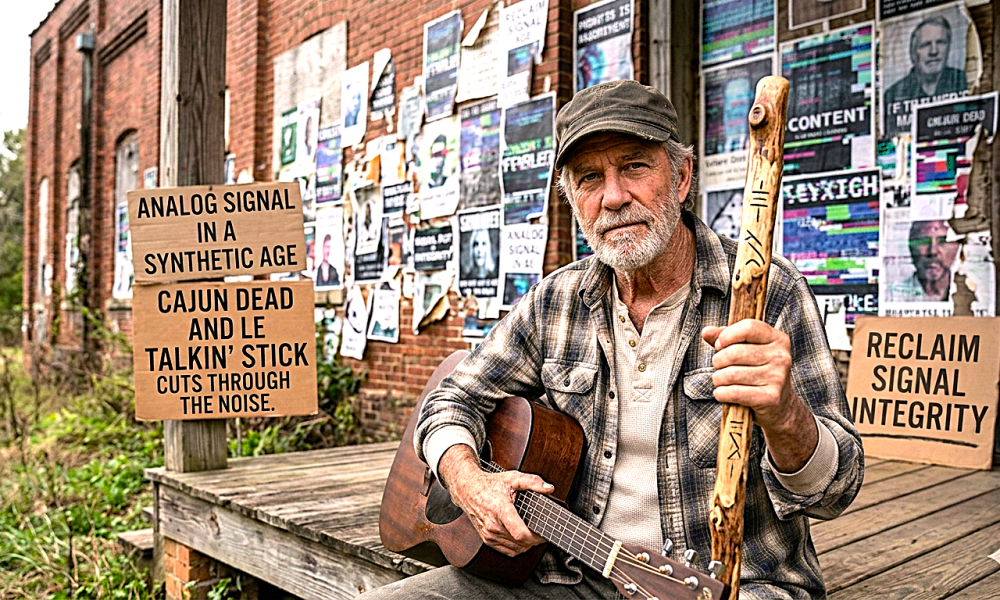
When the Signal Breaks Through Noise: Cajun Dead et le Talkin’ Stick Hits the post-truth AI-driven media Cultural Fault Line
In an era where perception often outruns reality, where narrative eclipses nuance, and where attention has become the most contested currency on the planet, a raw and unexpected artistic signal is cutting through the noise. Cajun Dead et le Talkin’ Stick—a stripped-down, Appalachian-inspired song lyric project—lands with uncanny precision at the intersection of culture, technology, and human psychology. It doesn’t just participate in the current media landscape; it exposes it.
This is not nostalgia for nostalgia’s sake. It’s a calculated regression—an intentional return to simplicity designed to confront a complex, fractured world head-on.
At a time when digital ecosystems are saturated with algorithmically optimized content engineered for engagement rather than truth, this project emerges as a counterforce. It operates like a cultural diagnostic tool, revealing not only what audiences consume but also why they’ve lost the ability to distinguish signal from noise in the first place.
And that’s where the tension begins.
The current zeitgeist in AI-driven media is paradoxical by design. On one side, there’s a romanticized longing for pre-digital authenticity—vinyl records, analog aesthetics, handcrafted narratives. On the other, there’s a relentless acceleration into AI-generated realities, deepfakes, synthetic identities, and machine-curated truth.
This post-truth contradiction isn’t accidental—it’s symptomatic.
Audiences are overwhelmed, not under-informed. The sheer volume of content has created a collapse in hierarchy: everything competes equally for attention, regardless of credibility. As a result, trust has eroded. Authority has flattened. And meaning has become negotiable.
Enter Cajun Dead et le Talkin’ Stick.
The project leverages an Appalachian minimalism reminiscent of Pete Seeger and Bob Dylan—not as homage but as strategic positioning. These were artists who understood that simplicity is not a lack of sophistication; it’s a delivery system for truth.
Their songs didn’t compete with noise—they cut through it.
Today, that same principle is being reactivated. Sparse instrumentation. Unfiltered vocals. Narrative-driven lyrics that feel almost anachronistic in their directness. It’s not just music—it’s a recalibration of attention.
Because in a post-truth world addicted to overstimulation, restraint becomes disruptive.
The genius of the Cajun Dead et le Talkin’ Stick song lyric project lies in its awareness of timing. It recognizes that audiences are not rejecting AI-driven media technology—they’re rejecting the psychological cost of constant mediation. The more synthetic the environment becomes, the more valuable anything “real” feels.
But here’s the twist: authenticity itself has become performative.
That’s the trap.
What Cajun Dead et le Talkin’ Stick does differently is remove the performance layer altogether. It doesn’t try to appear authentic—it simply is. And that distinction is critical in a dull and uninspired post-truth media environment where perception engineering has become standard practice.
This is why the project resonates not just as art but as a cultural intervention. It aligns with a growing, often subconscious demand for clarity in a reclaiming mountain music ecosystem built on ambiguity.
The new post-truth culture: When Emotion Replaces Evidence and Art Becomes the Last Honest Medium
We are operating inside a fully realized post-truth culture, where the traditional anchors of reality—facts, institutions, and expertise—have been destabilized. In this environment, belief is no longer shaped by evidence but by emotional alignment.
Truth is no longer discovered. It’s chosen.
Social media platforms have accelerated this shift by creating fragmented digital realities—echo chambers where narratives reinforce themselves and dissent is algorithmically filtered out. The result is a “Wild West” information landscape where misinformation doesn’t just spread; it thrives.
And perhaps more concerning, it no longer needs to be believable—only shareable.
This is the backdrop against which Cajun Dead et le Talkin’ Stick operates.
The project directly confronts what can only be described as a globalized indifference—a kind of psychological numbing induced by constant exposure to crisis, conflict, and contradiction. The “smartphone zombie” phenomenon isn’t hyperbole; it’s a behavioral pattern. Endless scrolling. Passive consumption. Emotional detachment.
In this context, art faces a binary choice: adapt to the noise or challenge it.
Most adapt.
This project is challenging.
By stripping away production excess and focusing on lyrical narrative, it forces engagement. You can’t passively consume it—you have to listen. And in doing so, it disrupts the cognitive autopilot that defines most digital interactions.
This is where the work of contemporary artist Claude Edwin Theriault becomes particularly significant.
Theriault’s broader body of work—spanning visual art, AI-driven media, and narrative experimentation—operates at a level that is, quite frankly, ahead of mainstream comprehension. His “benchmark” pieces aren’t designed for immediate validation; they’re structured as long-term cultural assets, decoding future realities before they fully materialize.
That’s both the strength and the challenge of breaking away from standard molds like Cajun music and establishing a new benchmark to match the vibrational frequency of a new paradigm.
Because when you’re operating ahead of the curve, you’re often misread, overlooked, or dismissed entirely.
The pivot to Cajun Dead et le Talkin’ Stick is not a retreat—it’s a translation layer. A way of compressing complex, forward-thinking ideas into a format that bypasses intellectual resistance and speaks directly to human intuition.
It’s the same mechanism that made Seeger and Dylan effective during periods of social upheaval. They didn’t lecture—they resonated.
And resonance is what cuts through post-truth distortion.
What makes this moment particularly volatile is the convergence of multiple stressors: AI anxiety, political instability, and economic uncertainty. These aren’t isolated issues—they’re interconnected feedback loops amplifying public unease.
In such an environment, people don’t just seek information—they seek orientation.
They want to know what’s real. What matters. What to trust.
And increasingly, they’re turning to art for those answers.
Not because art is inherently more truthful, but because it’s less constrained by institutional agendas. It can explore ambiguity without needing to resolve it. It can reflect contradiction without collapsing under it.
That’s the space Cajun Dead et le Talkin’ Stick occupies.
It doesn’t claim authority. It invites reflection.
It doesn’t dictate conclusions. It provokes questions.
And in a post-truth landscape, that might be the most honest approach available.
What we’re witnessing is not just the emergence of a music project, but the reactivation of a cultural strategy that has historically surfaced during periods of systemic disruption.
Simple forms. Complex truths. Delivered in a way that bypasses the noise and lands where it matters—at the level of individual awareness.
The irony is sharp: as technology becomes more advanced, the most effective communication becomes more primitive.
Not because we’re regressing, but because we’re recalibrating.
And if history is any indicator, movements like this don’t just reflect the times—they reshape them.
The question isn’t whether audiences will understand immediately.
They won’t.
The real question is whether they’ll feel it.
Because in a world where truth is increasingly negotiable, feeling might be the last remaining entry point to something real.
And that’s exactly where this project is aimed.