
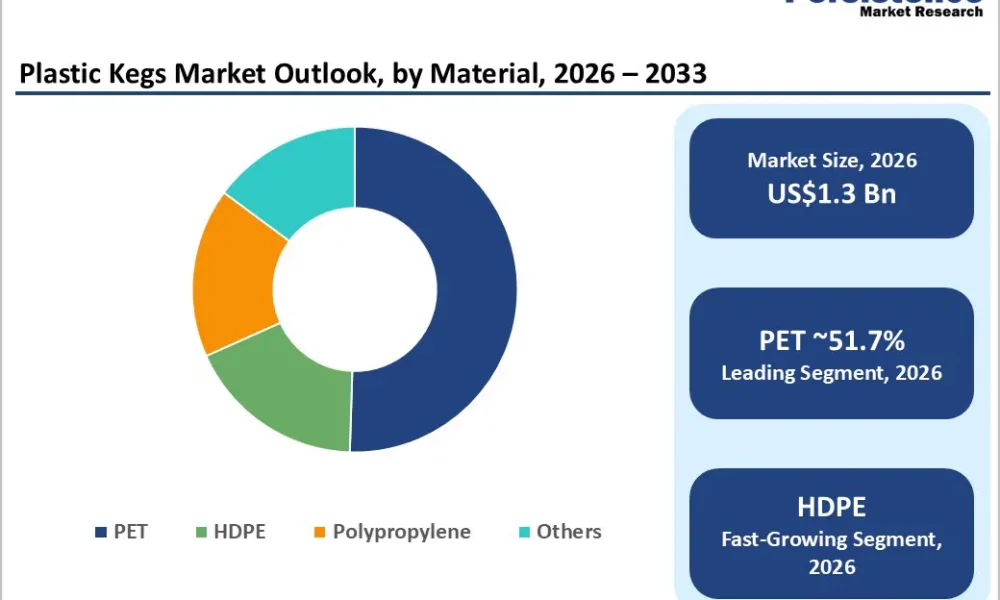
The plastic kegs market is experiencing significant growth as the beverage industry increasingly shifts toward lightweight, durable, and cost-efficient packaging solutions. Plastic kegs are widely used in draft beer, cider, soft drinks, and other ready-to-serve beverages due to their ease of handling, reduced logistics costs, and resistance to corrosion compared with traditional stainless steel kegs. According to market estimates, the global plastic kegs market is projected to be valued at US$1.3 billion in 2026 and is expected to reach US$2.0 billion by 2033, registering a CAGR of 6.5% over the forecast period. The market growth is underpinned by the rising consumption of draft beverages across both on-trade (bars, restaurants) and off-trade (retail) channels, combined with the adoption of one-way and lightweight keg formats that streamline logistics, minimize cleaning requirements, and reduce the total cost of ownership.
Among market segments, lightweight, one-way plastic kegs ranging from 20 to 40 liters dominate due to their suitability for small-batch and craft beverage production. The craft beer and small-batch beverage sector remains a primary driver of demand, particularly in North America and Europe, where the craft movement is highly mature. Geographically, North America leads the market, supported by robust draft beer consumption, a thriving craft beverage ecosystem, and early adoption of reusable and one-way plastic keg systems. Europe follows closely, with sustainability mandates and circular economy initiatives encouraging the adoption of eco-friendly polymer-based keg solutions that reduce environmental impact and simplify return logistics.
Key Highlights from the Report
• The global plastic kegs market is expected to reach US$2.0 billion by 2033.
• Rising draft beverage consumption across on-trade and off-trade channels is driving market expansion.
• Lightweight and one-way plastic kegs are increasingly preferred to reduce logistics complexity.
• Craft and small-batch beverage producers remain a structural demand base.
• Sustainability mandates and circular-economy initiatives are reshaping material selection.
• Innovation in polymer materials, pooled keg systems, and digital tracking is redefining competitive advantage.
𝐆𝐞𝐭 𝐚 𝐒𝐧𝐞𝐚𝐤 𝐏𝐞𝐞𝐤, 𝐒𝐚𝐦𝐩𝐥𝐞 𝐏𝐃𝐅 𝐈𝐧𝐬𝐢𝐝𝐞: https://www.persistencemarketresearch.com/samples/36069
Market Segmentation
The plastic kegs market is segmented based on keg type, material, capacity, and end-use application. By type, the market includes one-way kegs, returnable/reusable kegs, and pooled keg systems. One-way kegs are increasingly adopted by small and mid-sized producers due to their lower upfront investment and simplified logistics. Reusable kegs dominate in larger-scale production facilities, where beverage producers invest in cleaning and return systems to maximize lifecycle value. Pooled keg systems are gaining traction among craft breweries and beverage co-packers, offering shared use, digital tracking, and reduced capital expenditure.
In terms of material, high-density polyethylene (HDPE) and polypropylene (PP) dominate due to their lightweight, impact-resistant, and recyclable properties. Some premium systems use hybrid or multilayer polymers to improve barrier protection and shelf life, particularly for oxygen-sensitive beverages such as craft beer and cider.
Capacity segmentation includes small (10–20 liters), medium (20–40 liters), and large (50–100 liters) formats. Medium-sized kegs remain the most widely used for craft beverages and on-trade distribution, while smaller formats are growing in popularity for home delivery, microbreweries, and limited-edition beverage runs. Large-format kegs are preferred in industrial-scale operations or centralized beverage production facilities.
End-use segmentation includes beer, cider, soft drinks, and other beverages. Beer dominates the market due to high draft consumption globally, while cider and soft drinks are emerging as growth segments requiring lightweight, durable, and cost-efficient packaging solutions. Specialty beverages such as kombucha and ready-to-drink cocktails are further diversifying demand patterns.
Regional Insights
North America leads the global plastic kegs market, driven by high draft beer consumption, a robust craft beverage ecosystem, and early adoption of pooled keg systems. The U.S. craft beer industry, in particular, has fueled demand for 20–40 liter plastic kegs, where ease of handling, lightweight design, and reduced cleaning costs are critical.
Europe is the second-largest market, with sustainability regulations and recycling mandates encouraging the adoption of eco-friendly and returnable plastic kegs. Countries like Germany, the U.K., and the Netherlands are emphasizing circular economy initiatives, where shared keg pools and digital tracking systems ensure material reuse and minimize waste.
Asia-Pacific is an emerging market, supported by increasing craft beer and beverage consumption, modern retail growth, and urbanization. Latin America and the Middle East & Africa are gradually adopting plastic kegs, particularly in urban centers where draft beverage culture and organized retail expansion create growth opportunities.
𝐎𝐧𝐞 𝐂𝐥𝐢𝐜𝐤 → 𝐘𝐨𝐮𝐫 𝐂𝐮𝐬𝐭𝐨𝐦 𝐌𝐚𝐫𝐤𝐞𝐭 𝐕𝐢𝐞𝐰: https://www.persistencemarketresearch.com/request-customization/36069
Market Drivers
The primary driver of the plastic kegs market is the rising consumption of draft beverages across both on-trade and off-trade channels. Craft breweries and small-batch beverage producers prefer plastic kegs for their light weight, ease of handling, and lower logistics costs. One-way and lightweight keg formats reduce cleaning, transportation, and storage expenses, making them ideal for regional distribution and short-term beverage events.
Innovation in polymer materials, barrier technologies, and digital tracking systems further drives adoption, allowing manufacturers to extend shelf life, maintain beverage quality, and manage pooled keg inventories efficiently. Sustainability mandates and environmental awareness are also fueling demand for recyclable plastic kegs, providing manufacturers a competitive advantage in environmentally conscious markets.
Market Restraints
The market faces challenges such as raw material price volatility, which can impact the cost of HDPE, polypropylene, and other polymer-based kegs. Operational dependence on cleaning infrastructure, particularly for reusable kegs, can limit adoption among smaller beverage producers with limited logistics capabilities.
Additionally, consumer perception issues regarding plastic versus traditional stainless steel kegs may restrict demand in premium beverage segments. Limited awareness of pooled keg systems and digital asset-tracking solutions in emerging markets may also slow market penetration.
Market Opportunities
The plastic kegs market presents significant opportunities in innovation, sustainability, and emerging markets. Manufacturers can expand into pooled keg systems, which allow multiple producers to share keg inventory, reduce capital expenditure, and track usage digitally. Material innovation, including multilayer polymers and barrier coatings, allows for longer shelf life, improved taste retention, and resistance to mechanical stress.
Growth in craft breweries, specialty beverages, and small-batch producers offers opportunities for 20–40 liter keg formats. Sustainability initiatives, including the use of recycled materials, circular economy models, and reduced carbon footprint logistics, are further enhancing market opportunities, particularly in North America and Europe. Emerging markets in Asia-Pacific, Latin America, and the Middle East & Africa present untapped demand driven by urbanization, organized retail growth, and rising draft beverage consumption.
𝐁𝐮𝐲 𝐍𝐨𝐰 𝐭𝐡𝐞 𝐃𝐞𝐭𝐚𝐢𝐥𝐞𝐝 𝐑𝐞𝐩𝐨𝐫𝐭: https://www.persistencemarketresearch.com/checkout/36069
Company Insights
Key players operating in the plastic kegs market include:
• ORBIS Corporation
• Schaefer Container Systems
• Sirap Group S.p.A.
• Vin Service
• Snyder Industries, Inc.
• Illig Maschinenbau GmbH & Co. KG
• Duraplas, Inc.
• Plastic Kegs Ltd.
• Kegstar Limited
• GEA Group AG
Recent developments include the launch of digitally tracked pooled keg systems for craft beverage producers, enabling inventory monitoring, improved asset utilization, and reduced losses. Another key innovation is the introduction of lightweight, high-barrier polymer kegs designed to extend shelf life while minimizing environmental impact and logistics costs.
Conclusion
The plastic kegs market is poised for substantial growth, with a projected market size of US$2.0 billion by 2033 at a CAGR of 6.5%. Growth is fueled by rising draft beverage consumption, accelerated adoption of lightweight and one-way plastic kegs, and structural demand from craft and small-batch beverage producers. Sustainability initiatives, circular economy mandates, and material innovations are reshaping market dynamics, driving adoption of recyclable polymers, pooled keg systems, and digital tracking solutions. With ongoing innovation, increasing environmental awareness, and expansion into emerging markets, the plastic kegs market is set to play a central role in global beverage packaging over the coming decade.




