
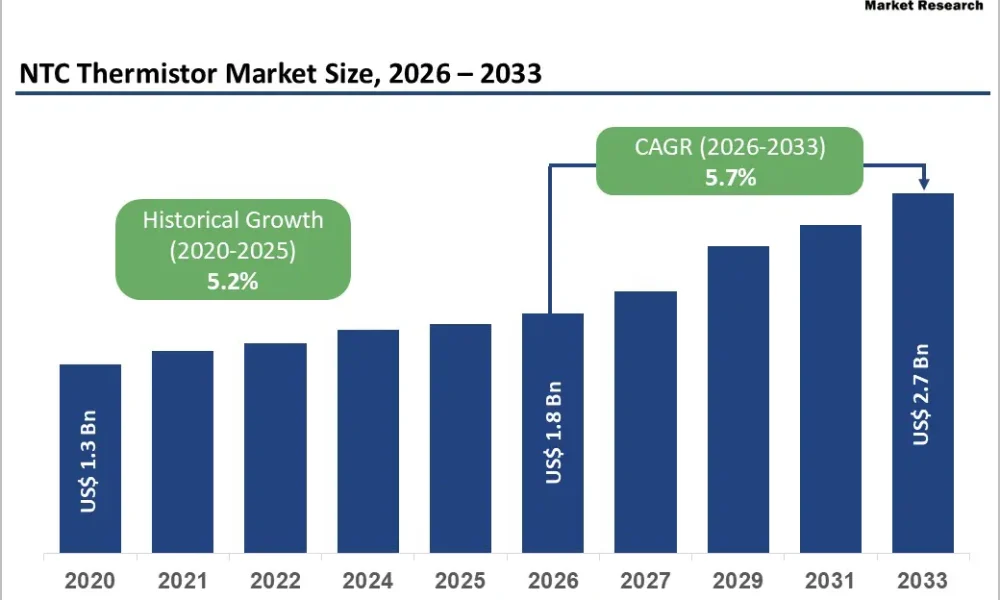
The global NTC thermistor market is poised for steady expansion over the coming decade as temperature sensing becomes increasingly essential across modern electronic and industrial systems. The market is expected to be valued at US$ 1.8 billion in 2026 and is projected to reach US$ 2.7 billion by 2033, expanding at a compound annual growth rate (CAGR) of 5.7% during the forecast period.
NTC thermistors, or negative temperature coefficient thermistors, are precision temperature sensors widely used across automotive electronics, consumer devices, medical instruments, and industrial automation systems. These sensors offer exceptional temperature sensitivity, cost efficiency, and compact size, making them indispensable for monitoring and controlling thermal conditions in complex electronic environments.
Several powerful market drivers are accelerating the adoption of NTC thermistors worldwide. The rapid expansion of electric vehicles (EVs), rising integration of Internet of Things (IoT) technologies, and increasingly strict emission regulations for automotive systems are all contributing to sustained demand for high-performance temperature sensors. As electronic systems become more sophisticated and compact, the importance of reliable thermal monitoring continues to grow, positioning NTC thermistors as critical components in modern engineering design.
Understanding NTC Thermistors and Their Importance
NTC thermistors are temperature-sensitive resistors whose electrical resistance decreases as temperature increases. This unique property allows them to measure temperature variations with high sensitivity and accuracy.
They are commonly manufactured using ceramic materials composed of metal oxides such as manganese, nickel, cobalt, and copper. During production, these materials are sintered at extremely high temperatures to create stable semiconductor structures capable of operating reliably across wide temperature ranges.
NTC thermistors are valued for several technical advantages:
- High temperature sensitivity
- Fast response times
- Compact size suitable for miniaturized electronics
- Cost-effective manufacturing
- Excellent long-term stability
Because of these characteristics, NTC thermistors are widely deployed in applications including battery management systems, automotive engines, HVAC systems, consumer electronics, and medical diagnostic equipment.
As global electronics and electrification trends accelerate, the importance of reliable temperature sensing technologies is increasing rapidly.
Market Drivers Accelerating Industry Growth
Rapid Expansion of Electric Vehicles
One of the most powerful growth catalysts for the NTC thermistor market is the rapid expansion of the electric vehicle industry. Modern EVs rely heavily on advanced battery management systems to ensure safe and efficient operation of lithium-ion battery packs.
Lithium-ion batteries must operate within narrow temperature ranges to maintain performance and prevent overheating or thermal runaway. NTC thermistors play a crucial role in continuously monitoring battery temperatures across multiple modules.
Typically, each electric vehicle battery pack contains 8 to 15 NTC thermistors, enabling accurate thermal management throughout the system. These sensors monitor cell temperatures, inverter heat levels, and charging circuits.
With global EV adoption increasing rapidly and projections indicating tens of millions of electric vehicles on roads worldwide by 2030, the demand for high-performance NTC thermistors is expected to grow substantially.
Automotive manufacturers are increasingly specifying high-precision thermistors capable of operating in harsh environments with temperature tolerances as tight as ±0.5%.
Elevate your business strategy with comprehensive market data. Request a sample report now: https://www.persistencemarketresearch.com/samples/32801
Increasing Automotive Electronics Integration
Modern vehicles are becoming increasingly complex electronic systems. From engine control units and climate control modules to transmission monitoring and exhaust gas sensing, temperature measurement plays a vital role in vehicle performance.
NTC thermistors are used in multiple automotive applications including:
- Engine coolant temperature monitoring
- Exhaust gas temperature sensing
- Transmission fluid monitoring
- Cabin climate control systems
- Power electronics thermal protection
A typical vehicle today may include 15 to 25 thermistors, while electric vehicles often require even more sensors due to their sophisticated powertrain electronics.
Additionally, stringent emission regulations and fuel efficiency standards are forcing automakers to improve combustion efficiency and thermal management systems, further driving demand for accurate temperature sensing components.
Rising Adoption of IoT and Connected Devices
The proliferation of connected devices and IoT technologies is another key factor supporting market growth. Billions of smart devices now rely on precise environmental monitoring to maintain safe and efficient operation.
NTC thermistors are widely used in:
- Smart home devices
- Wearable electronics
- Industrial IoT systems
- HVAC equipment
- Smart appliances
Their small size and high sensitivity make them ideal for integration into compact electronic products. As IoT ecosystems expand globally, temperature monitoring will remain a fundamental requirement for ensuring device reliability and energy efficiency.
Market Restraints and Industry Challenges
Despite strong growth potential, the NTC thermistor market faces several challenges that could influence its development.
Raw Material Supply Chain Risks
NTC thermistor manufacturing relies heavily on specialized ceramic materials containing metal oxides and rare earth elements. These materials are sourced from limited geographic regions, creating potential supply chain vulnerabilities.
Manufacturing processes also require high-temperature sintering above 1000°C, which consumes significant energy. Rising energy costs and raw material price volatility can increase production expenses and impact profit margins for manufacturers.
Supply disruptions during recent global semiconductor shortages also highlighted the vulnerability of passive electronic component supply chains.
Competition from Alternative Temperature Sensors
NTC thermistors compete with several other temperature sensing technologies, including:
- Resistance Temperature Detectors (RTDs)
- Thermocouples
- Silicon-based semiconductor sensors
- Infrared temperature sensors
These alternatives sometimes offer advantages such as wider temperature ranges or integrated digital output capabilities. For example, RTDs can operate at temperatures exceeding 800°C, making them suitable for extreme industrial environments.
However, NTC thermistors maintain a strong competitive advantage in moderate temperature applications due to their low cost, high sensitivity, and compact form factor.
Manufacturers are continuously investing in innovation and product differentiation to maintain competitiveness in the evolving sensor market.
Emerging Opportunities Transforming the Market
Oil-Cooled Electric Powertrain Systems
A significant new opportunity is emerging in the form of oil-cooled powertrain systems used in high-performance electric vehicles. These systems provide more efficient thermal management compared to traditional air-cooling approaches.
Immersion-type NTC thermistors are specifically designed to operate within oil-cooled systems, monitoring temperature in electric motors, inverters, and transmission components.
These specialized thermistors can withstand temperatures up to 175°C and feature sealed designs for fluid immersion environments.
Because of their advanced capabilities, these products can command 30% to 50% higher prices than standard thermistors, making them a lucrative growth segment for manufacturers.
Digital Healthcare and Medical Devices
Another rapidly growing opportunity lies within the healthcare sector. The digitalization of healthcare is driving strong demand for precision temperature sensors used in diagnostic equipment, wearable devices, and patient monitoring systems.
NTC thermistors are used in applications such as:
- Medical thermometers
- Wearable health monitors
- Diagnostic imaging systems
- Surgical monitoring equipment
- Remote patient monitoring devices
Medical-grade thermistors must meet stringent regulatory standards including ISO certification and biocompatibility requirements.
As telemedicine, remote healthcare, and wearable technologies expand globally, demand for highly accurate temperature sensors will continue to rise.
Product Type Insights
Among different product types, surface-mount device (SMD) and surface-mount technology (SMT) thermistors dominate the global market.
These components accounted for approximately 48% of market share in 2025, driven by the growing adoption of automated electronics manufacturing processes.
SMD thermistors are widely used in:
- Automotive electronic control units
- Battery management systems
- Consumer electronics
- Industrial control systems
Their compatibility with automated assembly lines and compact design makes them ideal for modern high-density circuit boards.
Standard sizes such as 0402 and 0603 allow manufacturers to integrate temperature sensors into increasingly miniaturized electronic devices.
Application Analysis
The automotive sector represents the largest application segment, accounting for roughly 42% of the global NTC thermistor market.
Temperature monitoring is essential across multiple vehicle systems including engine control units, battery packs, and HVAC modules.
Electric vehicles in particular require extensive thermal management systems to protect battery performance and power electronics.
Beyond automotive applications, NTC thermistors are widely used in:
- Consumer electronics
- Industrial automation equipment
- HVAC systems
- Medical devices
- Renewable energy systems
As industries continue to adopt smart technologies and electrified systems, demand for reliable temperature monitoring components will remain strong.
Sales Channel Insights
Original equipment manufacturers (OEMs) represent the dominant sales channel in the NTC thermistor market.
OEM supply agreements accounted for approximately 75% of total sales volume in 2025. These agreements typically involve long-term partnerships between component manufacturers and automotive or electronics producers.
OEM customers require strict quality certifications, including ISO 9001 and IATF 16949, particularly for automotive-grade components.
Direct integration into production lines allows thermistor manufacturers to secure stable demand while delivering customized products tailored to specific applications.
Regional Market Analysis
Asia Pacific
Asia Pacific is the largest and fastest-growing regional market, accounting for roughly 45% of global demand.
The region’s leadership is driven by:
- Massive electronics manufacturing in China
- Advanced component technologies in Japan
- Rapid automotive industry expansion in India and Southeast Asia
China alone produces billions of thermistors annually and leads global electric vehicle manufacturing. The region is expected to grow at a CAGR of 6.8% through 2033.
North America
North America represents a mature market with strong demand from automotive and industrial sectors.
Large-scale EV investments and supportive policies have strengthened the region’s role in the global electronics supply chain. Leading automotive companies are expanding EV production lines, increasing demand for temperature monitoring components.
The regional market is expected to grow at approximately 5.4% CAGR through 2033.
Europe
Europe remains a key market due to its aggressive decarbonization policies and strict emission regulations.
The region’s automotive industry is transitioning rapidly toward electric mobility, supported by government initiatives and increasing EV production targets.
Germany serves as the center of European automotive innovation, with leading manufacturers investing heavily in advanced vehicle electronics and thermal management technologies.
Competitive Landscape
The global NTC thermistor market features a moderately consolidated competitive structure with several major international manufacturers and numerous specialized regional suppliers.
Leading companies are investing in advanced materials research, miniaturization technologies, and automotive-grade component development to maintain competitive advantages.
Key companies operating in the market include:
- Betatherm Corporation
- Panasonic Corporation
- Murata Manufacturing
- Mitsubishi Materials Corporation
- TDK Electronics
- Littelfuse
- Vishay
- Honeywell
- Ametherm
- Shibaura Denshi
- QTI Sensing Solutions
Strategic acquisitions, new product launches, and partnerships with automotive OEMs remain key strategies for expanding market share.
Future Outlook
The future of the NTC thermistor market looks promising as global industries continue transitioning toward electrification, digitalization, and smart technology ecosystems.
Key trends expected to shape the market include:
- Rapid expansion of electric vehicle production
- Growth of IoT-connected devices
- Increasing demand for industrial automation
- Rising adoption of wearable medical technologies
- Advancements in thermal management systems
With temperature sensing becoming increasingly critical in modern electronics and energy systems, NTC thermistors will remain essential components for ensuring safety, efficiency, and performance.
By 2033, the global NTC thermistor market is expected to reach US$ 2.7 billion, reflecting steady growth driven by innovation, electrification, and expanding electronics integration across industries.
Related Reports:




