

Small Modular Reactor Market Overview
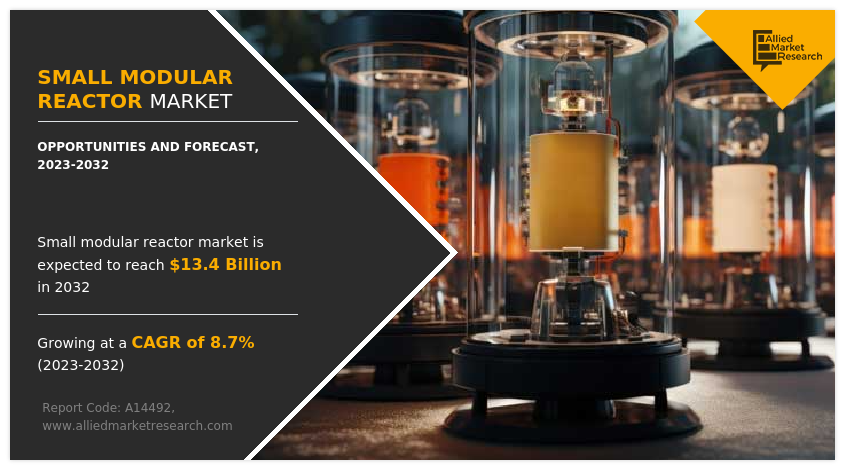
According to a new report published by Allied Market Research, the small modular reactor market size was valued at $5.8 billion in 2022 and is projected to reach $13.4 billion by 2032, growing at a CAGR of 8.7% from 2023 to 2032. Increasing global focus on low-carbon energy generation, advancements in nuclear technologies, and the demand for reliable power sources are key factors driving the growth of the small modular reactor market.
Introduction
The small modular reactor market is emerging as an important segment of the global nuclear energy industry. Small modular reactors (SMRs) are advanced nuclear reactors that produce lower power output compared to conventional nuclear power plants, typically below 300 megawatts electric (MWe) per unit.
Unlike traditional nuclear facilities that require extensive construction time and significant capital investment, SMRs are designed with modular and integrated components that can be manufactured in factories and assembled on-site. This modular construction approach reduces both construction time and overall project costs.
Download PDF Brochure: https://www.alliedmarketresearch.com/request-sample/A14492
Traditional nuclear plants are large and often require substantial infrastructure and long development periods. In contrast, SMRs have a compact design and smaller footprint, making them suitable for deployment in remote locations or areas where large nuclear plants are not feasible.
Because of their flexibility and cost efficiency, the small modular reactor market is gaining significant attention as governments and energy companies seek reliable and low-carbon energy solutions.
Advantages of Small Modular Reactors
One of the major advantages contributing to the growth of the small modular reactor market is the compact design of SMRs. Their smaller footprint allows them to be installed in locations where large nuclear reactors cannot be deployed.
In addition, SMRs can be prefabricated in manufacturing facilities and transported to installation sites. This factory-based production process significantly reduces construction complexity and enables faster project completion.
Another important advantage is the possibility of installing SMRs in brownfield locations, such as sites where coal-fired power plants have been decommissioned. By replacing older fossil fuel facilities with SMRs, governments and utilities can utilize existing infrastructure while transitioning toward cleaner energy sources.
SMRs are also considered suitable for challenging environments, including remote areas, industrial sites, and regions with limited power grid connectivity. These benefits make the small modular reactor market an attractive solution for improving global energy access.
Role in Climate Change Mitigation
As global concerns about climate change continue to increase, many countries are exploring low-carbon energy technologies to reduce greenhouse gas emissions. Nuclear energy is widely regarded as a reliable source of virtually emissions-free electricity, making it an important component of long-term energy strategies.
The small modular reactor market plays a key role in supporting these sustainability efforts. SMRs provide stable baseload power while producing minimal carbon emissions, helping countries achieve their climate goals.
Compared to large nuclear reactors, SMRs offer greater flexibility and scalability. Multiple reactor modules can be added gradually as energy demand increases, enabling utilities to manage power generation more efficiently.
Furthermore, SMRs can support hybrid energy systems that integrate renewable energy sources such as solar and wind power. This capability allows SMRs to contribute to more resilient and sustainable energy infrastructures worldwide.
Challenges in the Market
Despite promising growth prospects, the small modular reactor market faces certain challenges that may impact its expansion. One of the primary concerns surrounding SMRs is the safety perception associated with nuclear energy.
Public concerns about nuclear accidents and radioactive waste management continue to influence energy policy decisions in several countries. These concerns can slow down the approval and deployment of new nuclear technologies.
Another challenge affecting the small modular reactor market is the increasing popularity of renewable energy sources such as wind and solar power. Many governments are prioritizing renewable energy investments, which may limit funding for nuclear energy projects.
However, continuous technological advancements and improved safety designs in SMR technologies are helping address these concerns. Modern reactor designs incorporate advanced safety systems that enhance operational reliability and reduce risks.
Market Segmentation
The small modular reactor market is segmented based on reactor type, connectivity, deployment, power rating, location, application, and region.
By Reactor Type
Based on reactor type, the market is segmented into heavy water reactors (HWR), light water reactors (LWR), fast neutron reactors (FNR), and others. Among these, the heavy water reactor segment accounted for nearly half of the market share in 2022 and is expected to maintain its leading position during the forecast period.
Heavy water reactors are widely used due to their high efficiency and ability to utilize natural uranium as fuel.
By Connectivity
In terms of connectivity, the small modular reactor market is categorized into grid-connected and off-grid systems. The grid-connected segment dominated the market in 2022, accounting for more than two-thirds of the total market share.
Grid-connected SMRs are commonly used to support national power grids and ensure stable electricity supply in urban and industrial regions.
By Deployment
Based on deployment type, the market is divided into single module power plants and multi-module power plants. The single module power plant segment held the largest market share in 2022, accounting for nearly three-fourths of the global market.
Single-module installations are easier to construct and require lower initial investment, which contributes to their widespread adoption.
By Power Rating
Based on power rating, the market is segmented into up to 100 MW, 101 to 200 MW, and 201 to 300 MW. The up to 100 MW segment accounted for nearly half of the market share in 2022, reflecting the growing demand for smaller and more flexible reactor designs.
Regional Analysis
Regionally, the small modular reactor market is analyzed across North America, Europe, Asia-Pacific, and LAMEA.
North America is one of the leading regions in SMR development, driven by supportive government policies and investments in advanced nuclear technologies. The United States is actively exploring SMRs as part of its long-term energy strategy to ensure energy security and reduce carbon emissions.
In Asia-Pacific, countries such as China are investing heavily in nuclear energy to meet growing electricity demand while reducing dependence on fossil fuels.
Meanwhile, Europe is also showing increasing interest in SMR technologies as part of its broader climate and energy transition goals.
Get a Customized Research Report: https://www.alliedmarketresearch.com/request-for-customization/A14492
Competitive Landscape
The global small modular reactor market includes several major companies involved in developing advanced reactor technologies. Key players operating in the industry include Fluor Corporation, General Electric, Mitsubishi Heavy Industries, Rolls‑Royce plc, TerraPower, NuScale Power, and Westinghouse Electric Company.
These companies are focusing on strategic partnerships, research investments, and technological innovation to expand their presence in the global small modular reactor market.
Conclusion
The small modular reactor market is expected to witness strong growth in the coming years due to increasing demand for low-carbon energy, advancements in nuclear technology, and the need for reliable electricity generation.
SMRs offer several advantages over traditional nuclear power plants, including lower construction costs, faster deployment, and greater flexibility in installation. Although challenges related to safety perception and competition from renewable energy sources remain, ongoing research and technological improvements are addressing these concerns.
As countries continue to pursue sustainable and diversified energy strategies, the small modular reactor market is likely to play a vital role in shaping the future of global power generation.
Other Trending Reports:-
Nuclear Power Plant and Equipment Market
About Us
Allied Market Research (AMR) is a full-service market research and business-consulting wing of Allied Analytics LLP based in Portland, Oregon. Allied Market Research provides global enterprises as well as medium and small businesses with unmatched quality of “Market Research Reports” and “Business Intelligence Solutions.” AMR has a targeted view to provide business insights and consulting to assist its clients to make strategic business decisions and achieve sustainable growth in their respective market domain.
Pawan Kumar, the CEO of Allied Market Research, is leading the organization toward providing high-quality data and insights. We are in professional corporate relations with various companies and this helps us in digging out market data that helps us generate accurate research data tables and confirms utmost accuracy in our market forecasting. Each and every data presented in the reports published by us is extracted through primary interviews with top officials from leading companies of domain concerned. Our secondary data procurement methodology includes deep online and offline research and discussion with knowledgeable professionals and analysts in the industry.




