
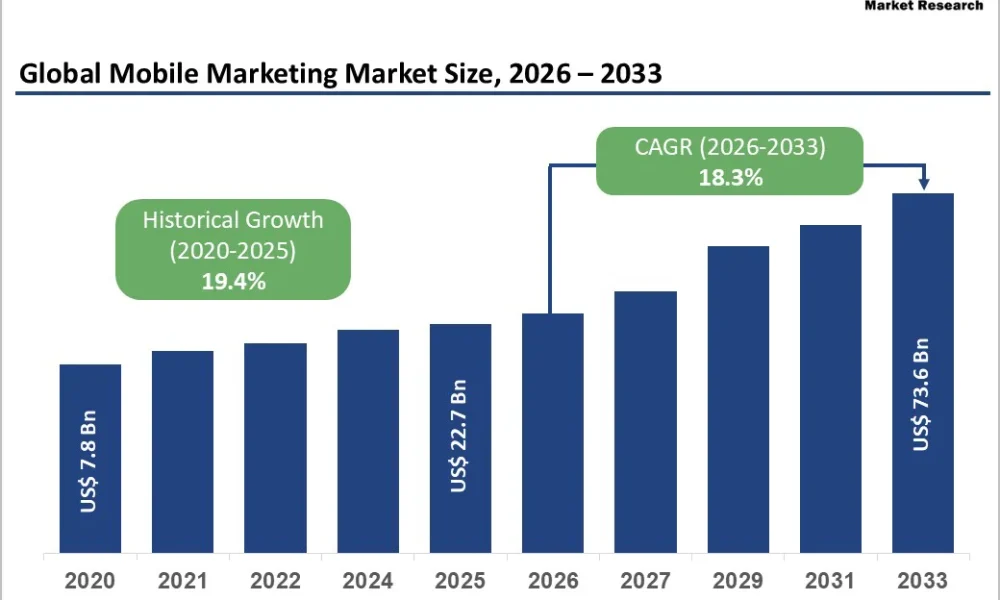
The global mobile marketing market is entering a high-growth phase as brands pivot aggressively toward mobile-first consumer engagement strategies. Valued at US$22.7 billion in 2026, the market is projected to expand to US$73.6 billion by 2033, registering a strong CAGR of 18.3% between 2026 and 2033.
This surge reflects the increasing dominance of smartphones in daily life and the urgent need for businesses to engage nearly 2.85 billion smartphone users globally through personalized, data-driven campaigns. As digital consumption continues to outpace traditional media channels, mobile marketing has become central to customer acquisition, retention, and brand experience management.
The Rise of Mobile-First Consumer Behavior
Consumer behavior has fundamentally shifted over the past decade. Smartphones are no longer just communication devices—they are shopping platforms, entertainment hubs, financial tools, and healthcare gateways. This transformation has elevated mobile marketing from a supplementary tactic to a core business strategy.
Mobile channels such as SMS marketing, push notifications, in-app messaging, location-based promotions, and mobile advertising now account for a significant portion of digital engagement budgets. Businesses are leveraging these tools to deliver contextual messaging in real time.
Unlike traditional marketing formats, mobile marketing offers measurable performance, instant delivery, and direct interaction. These advantages make it particularly attractive in industries where personalization and responsiveness determine competitive advantage.
Market Drivers Accelerating Growth
- Explosive Smartphone Penetration
Global smartphone adoption continues to rise, particularly in emerging markets. Affordable devices and expanding mobile internet access have brought billions of consumers online. For brands, this represents a direct communication channel that is always within reach of the customer.
With consumers spending multiple hours daily on mobile apps, social media, and messaging platforms, advertisers are prioritizing mobile channels over desktop-based campaigns.
- 5G Connectivity Enabling Richer Experiences
The global rollout of 5G networks is transforming mobile marketing capabilities. Faster speeds and lower latency allow brands to deliver immersive content formats such as augmented reality ads, high-definition video promotions, interactive gaming campaigns, and live-stream shopping experiences.
Retailers, automotive brands, and entertainment companies are particularly leveraging 5G to create engaging mobile-first experiences that were previously limited by bandwidth constraints.
- Shift Toward Digital-First Marketing Strategies
Businesses across sectors are reallocating marketing budgets from traditional media—such as television, print, and outdoor advertising—to digital channels. Mobile platforms offer superior targeting precision and measurable ROI.
Marketing automation platforms, AI-driven analytics, and customer data platforms (CDPs) enable hyper-personalized campaigns based on browsing behavior, location, preferences, and purchase history.
- Demand for Personalized Engagement
Modern consumers expect tailored experiences. Generic advertising is increasingly ignored. Mobile marketing tools allow brands to segment audiences dynamically and deliver personalized offers in real time.
From abandoned cart reminders in e-commerce to medication alerts in healthcare, personalized mobile engagement enhances conversion rates and strengthens customer loyalty.
Regional Market Insights
North America – Market Leader
North America leads the global mobile marketing market with a 38% share in 2025. The region benefits from advanced digital infrastructure, high smartphone penetration, and strong investments in advertising technology.
The United States, in particular, remains a dominant force due to its mature digital ecosystem, established marketing technology companies, and high consumer spending power.
Brands in North America are early adopters of AI-driven campaign management tools, predictive analytics, and omnichannel marketing platforms, further reinforcing the region’s leadership.
Asia Pacific – Fastest Growing Region
Asia Pacific is the fastest-growing regional market, expanding at a remarkable 23.8% CAGR. Rapid smartphone adoption across India, Southeast Asia, and other emerging economies is reshaping digital consumption patterns.
The region’s young, mobile-savvy population and widespread use of super apps, mobile wallets, and social commerce platforms create enormous opportunities for advertisers.
China, India, Indonesia, and Vietnam are emerging as major mobile marketing hubs due to their large digital user bases and growing e-commerce ecosystems.
Industry Vertical Analysis
Retail and e-Commerce – Dominant Segment
Retail and e-commerce account for the largest market share at 38%. A significant proportion of online orders now originate from mobile devices. Consumers browse products, compare prices, read reviews, and complete purchases through mobile apps or mobile-optimized websites.
Mobile marketing strategies in this segment include:
- Flash sale alerts via push notifications
- Personalized discount codes through SMS
- Geo-targeted promotions
- Mobile loyalty programs
With mobile commerce continuing to expand, retailers are investing heavily in app-based engagement, live shopping events, and in-app payment integrations.
Healthcare – Fastest Growing Vertical
Healthcare is the fastest-growing segment, projected to grow at a 24.5% CAGR. The rise of telemedicine, digital health platforms, and remote patient engagement solutions is driving demand for mobile communication channels.
Hospitals and healthcare providers use SMS reminders for appointments, mobile apps for prescription management, and push notifications for preventive care alerts.
The increasing integration of wearable health devices and mobile-based patient monitoring systems further strengthens the need for secure and compliant mobile communication strategies.
Key Market Opportunities
- Privacy-First Marketing Evolution
With increasing regulatory scrutiny, privacy-compliant personalization has become a top priority. Frameworks such as GDPR, CCPA, and other regional data protection laws require transparent data governance.
Marketers are investing in first-party data strategies, consent management platforms, and privacy-by-design campaign tools to ensure compliance while maintaining personalization.
Privacy-focused mobile marketing will differentiate brands that prioritize transparency and trust.
- Integration of Artificial Intelligence
AI-powered mobile marketing platforms enable predictive segmentation, automated campaign optimization, and behavioral targeting. Machine learning algorithms analyze customer interactions to deliver relevant content at the right time.
Chatbots, AI-driven recommendations, and automated personalization engines enhance engagement rates and reduce customer acquisition costs.
- Location-Based and Contextual Marketing
Advancements in GPS and beacon technologies enable hyper-local marketing. Retailers can send promotions when customers enter specific geographic zones.
Contextual targeting based on real-time behavior and environmental triggers increases campaign effectiveness without relying excessively on third-party data.
Elevate your business strategy with comprehensive market data. Request a sample report now: https://www.persistencemarketresearch.com/samples/33068
Emerging Trends Shaping the Market
Omnichannel Integration
Mobile marketing is no longer a standalone channel. Successful brands integrate mobile strategies with email, social media, web, and offline campaigns to create seamless omnichannel experiences.
Unified customer profiles ensure consistent messaging across platforms.
In-App Advertising Growth
In-app advertising continues to gain traction as consumers spend more time within mobile applications than on web browsers. Gaming apps, streaming platforms, and social media channels represent prime advertising real estate.
Interactive formats such as rewarded ads and playable ads are particularly popular in mobile gaming ecosystems.
Mobile Video and Short-Form Content
Short-form video platforms and live-stream commerce are reshaping digital marketing dynamics. Brands increasingly leverage vertical video formats optimized for smartphones.
Video-based mobile campaigns typically deliver higher engagement rates compared to static display ads.
Competitive Landscape
The mobile marketing ecosystem includes advertising platforms, marketing automation providers, analytics firms, and mobile application developers. Competition is intense, driven by innovation in targeting precision, real-time analytics, and campaign automation.
Key competitive strategies include:
- Strategic partnerships with telecom operators
- Investment in AI and predictive analytics
- Expansion into emerging markets
- Development of privacy-centric marketing tools
Technology vendors are also enhancing cross-platform attribution capabilities to help advertisers measure campaign effectiveness more accurately.
Challenges Facing the Industry
Despite strong growth potential, the mobile marketing market faces several challenges:
Ad Fatigue and Consumer Resistance
Excessive messaging can lead to notification fatigue and opt-outs. Marketers must balance engagement with user experience.
Data Privacy Regulations
Strict regulatory frameworks increase compliance costs and limit access to third-party data.
Platform Dependency
Heavy reliance on major app ecosystems and operating systems exposes marketers to policy changes that may affect data access and targeting options.
Measurement Complexity
Attribution across multiple devices and channels remains challenging, particularly with evolving privacy restrictions.
Addressing these issues will require continuous innovation and adaptive marketing strategies.
Future Outlook
The future of the mobile marketing market is closely aligned with advancements in connectivity, artificial intelligence, and digital commerce. As 5G becomes widespread and smartphone capabilities improve, immersive experiences such as augmented reality shopping, virtual try-ons, and real-time interactive campaigns will become mainstream.
Privacy-first marketing models will redefine how brands collect and utilize consumer data. Companies that prioritize transparency and ethical data practices will gain competitive advantage.
By 2033, mobile marketing will not only dominate digital advertising but also serve as the backbone of personalized customer engagement across retail, healthcare, finance, travel, and entertainment sectors.
Conclusion
The global mobile marketing market is poised for substantial expansion, growing from US$22.7 billion in 2026 to US$73.6 billion by 2033 at a CAGR of 18.3%. This growth is driven by smartphone ubiquity, 5G connectivity, AI-powered personalization, and the shift toward digital-first strategies.
North America remains the leading regional market, while Asia Pacific represents the fastest-growing opportunity. Retail and e-commerce dominate adoption, with healthcare emerging as a high-growth vertical.
As businesses increasingly compete for consumer attention in a mobile-centric world, mobile marketing will remain a critical driver of digital transformation and sustainable brand growth.
Related Reports:




