
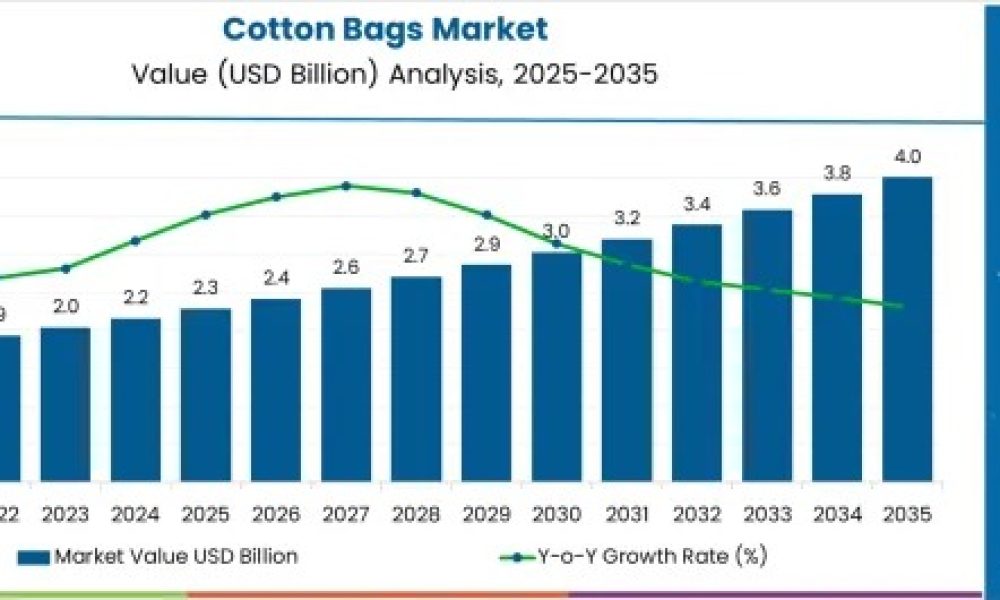
The Cotton Bags market is steadily evolving into one of the most visible symbols of the global sustainability movement. Valued at USD 2.3 billion in 2025, the market is projected to reach USD 4.0 billion by 2035, growing at a CAGR of 5.8%. This expansion reflects rising regulatory pressure against plastic packaging, combined with increasing consumer demand for reusable, biodegradable, and ethically produced alternatives. From grocery shopping and promotional giveaways to corporate branding and lifestyle accessories, cotton bags have moved beyond being simple substitutes for plastic. They are now positioned as functional lifestyle products that merge sustainability with brand identity and everyday convenience.
Industry Meaning
Cotton bags are reusable fabric bags manufactured from natural cotton fibers, typically available in forms such as calico bags, tote bags, beach bags, and promotional carry bags. Their appeal lies in their biodegradability, durability, and high printability, making them suitable for both personal and commercial applications. Unlike synthetic packaging materials, cotton bags decompose naturally, reducing long-term environmental impact. Their ability to withstand repeated use cycles makes them an essential component of circular packaging models, where products are designed for reuse rather than disposal.
Strategic Outlook
Strategically, the cotton bags market is aligned with three global trends:
- Sustainability legislation– bans and taxes on plastic bags.
- Brand-led environmental commitments– ESG reporting and green marketing.
- Consumer lifestyle shifts– preference for eco-conscious consumption.
Between 2025 and 2030, growth will be driven primarily by retail and corporate adoption. From 2030 onwards, innovation will focus on premium cotton blends, organic certifications, recycled cotton fibers, and smart branding integration.
Manufacturers that invest in automation, digital printing, and scalable sourcing will gain competitive advantage, especially as volume demand increases from multinational retailers and corporate buyers.
Request For Sample Report | Customize Report |purchase Full Report – Sample link
Market Evolution
The evolution of cotton bags mirrors the broader transformation of packaging systems. Initially adopted as a regulatory response to plastic bans, cotton bags are now perceived as value-added products.
The market has passed through three key stages:
- Substitution phase – cotton replacing plastic for basic use.
- Branding phase – promotional and logo-based bags.
- Lifestyle phase – fashion-oriented, premium reusable bags.
Today, cotton bags are positioned as both functional and aspirational products, especially among urban consumers who associate them with sustainability and responsible consumption.
Growth Opportunities
Several growth pathways are shaping the next decade:
- Retail & Grocery Expansion– loyalty programs promoting reusable bags.
- Corporate Branding– promotional kits and employee engagement.
- E-commerce Packaging– eco-friendly last-mile delivery.
- Organic Cotton Integration– premium sustainable products.
- Emerging Markets– China (7.8% CAGR) and India (7.3% CAGR).
- Tourism & Lifestyle Products– beach and travel bags.
- Smart Manufacturing– automated stitching and digital printing.
These opportunities position cotton bags not only as packaging alternatives, but also as marketing tools and consumer lifestyle accessories.
Demand Patterns
By capacity, the Up To 5 Kg segment leads with 35% share, reflecting strong demand for lightweight, everyday shopping bags. These bags are easy to carry, cost-efficient to produce, and widely accepted in retail environments.
By end use, the Automotive sector dominates with 25% share, driven by corporate giveaways, trade fairs, and sustainability-driven branding initiatives. Automotive companies increasingly use cotton bags for promotional campaigns aligned with their ESG goals.
By type, Calico cotton bags account for 40% share, benefiting from their natural look, low processing requirements, and high adaptability for printing and customization.
Regionally, demand is strongest in:
- Asia-Pacific – driven by manufacturing scale and population size.
- North America – strong sustainability culture and retail adoption.
- Europe – regulatory enforcement and eco-labeling standards.
China and India are emerging as production and consumption hubs, while Germany and the UK remain leaders in premium cotton bag adoption.
Technology Trends
Technology is increasingly influencing cotton bag manufacturing and customization. Key innovations include:
- Digital textile printing for high-resolution branding.
- Automated cutting and stitching systems improving production speed.
- Recycled cotton fibers reducing raw material dependency.
- Water-based inks and dyes supporting eco-certifications.
- RFID and QR tagging for smart promotional campaigns.
Manufacturers are also investing in supply chain transparency platforms, enabling traceability from cotton sourcing to final product delivery—an important requirement for ESG-focused clients.
Competitive Landscape
The cotton bags market features a mix of established lifestyle brands and specialized sustainable packaging manufacturers.
Leading lifestyle brand Baggu has built a strong consumer following through stylish, reusable cotton and nylon bags that combine fashion with environmental messaging.
Sustainability-focused manufacturer ECOBAGS emphasizes organic and fair-trade cotton products, catering to conscious consumers and retailers.
ChicoBag differentiates through compact, foldable designs that appeal to urban users seeking portability.
European supplier The Cotton Bag Company focuses on large-scale promotional and retail packaging, offering customization services for corporate clients.
North American manufacturers such as Enviro-Tote and Unionwear emphasize domestic production, ethical labor practices, and premium quality.
Emerging players like Earthwise and ToteBagFactory are expanding through:
- Automated production lines,
- Private-label manufacturing,
- Integration with e-commerce fulfillment services.
Competition increasingly centers on design quality, customization speed, sustainability certifications, and pricing efficiency, rather than just volume.
Executive-Level Insights
- Market Size (2025): USD 2.3 billion
- Market Forecast (2035): USD 4.0 billion
- Growth Rate: 5.8% CAGR
- Leading Capacity: Up To 5 Kg (35%)
- Top End Use: Automotive (25%)
- Leading Type: Calico cotton bags (40%)
- Fastest Growth Regions: China, India, Brazil
- Key Trends: Recycled cotton, digital printing, ESG branding
- Strategic Focus: Plastic replacement and lifestyle positioning
Conclusion
The Cotton Bags market is no longer a niche sustainability segment it is becoming a mainstream packaging and lifestyle industry. As regulations tighten and consumer expectations evolve, cotton bags are positioned as long-term replacements for single-use plastics, with strong potential in branding, retail, and corporate applications. Over the next decade, manufacturers that combine automation, ethical sourcing, smart customization, and scalable production will shape the future of this market. Cotton bags are transitioning from simple utility items into symbols of responsible consumption and brand identity, making them a strategic asset for both businesses and consumers worldwide.
Why FMI: https://www.futuremarketinsights.com/why-fmi
About Future Market Insights (FMI)
Future Market Insights, Inc. (FMI) is an ESOMAR-certified, ISO 9001:2015 market research and consulting organization, trusted by Fortune 500 clients and global enterprises. With operations in the U.S., UK, India, and Dubai, FMI provides data-backed insights and strategic intelligence across 30+ industries and 1,200 markets worldwide.
Contact Us:
Future Market Insights Inc.
Christiana Corporate, 200 Continental Drive,
Suite 401, Newark, Delaware – 19713, USA
T: +1-347-918-3531
For Sales Enquiries: [email protected]



