
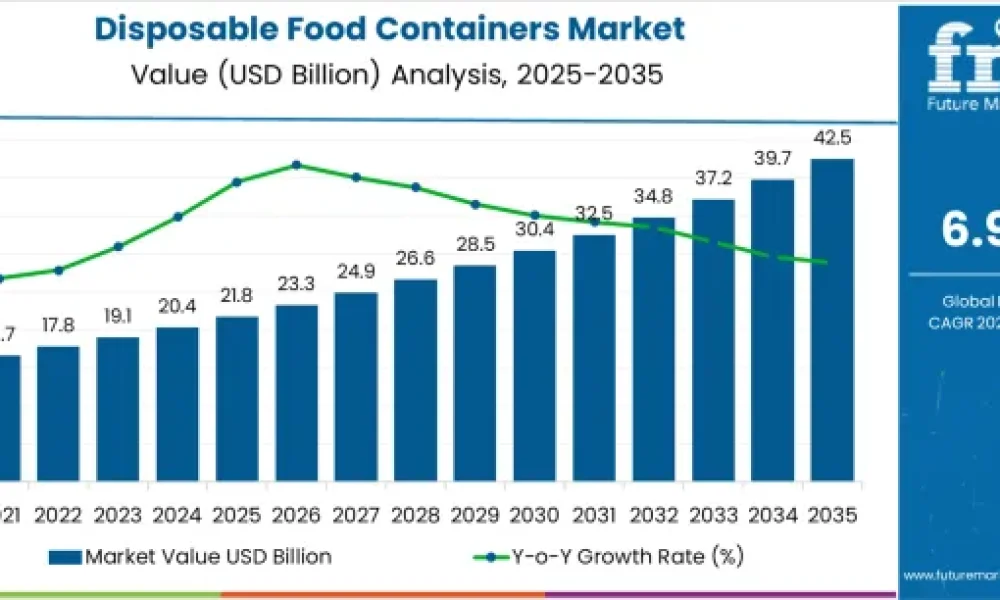
The disposable food containers market is entering a phase of accelerated growth as global food consumption habits continue to evolve. Changing lifestyles, rising urbanization, and the increasing dependence on food delivery platforms have transformed how food is packaged, stored, and consumed. Disposable food containers now play a critical role in enabling safe transportation, portion control, and hygienic storage across restaurants, cafes, cloud kitchens, retail food outlets, and institutional catering services.
In 2025, the global market is valued at USD 21.8 billion and is forecast to reach USD 42.6 billion by 2035, representing a strong CAGR of 6.9%. The near doubling of market size reflects how deeply disposable containers have become embedded in modern food service ecosystems.
Meaning of Disposable Food Containers
Disposable food containers are single-use packaging products designed for storing, transporting, and serving food items. They are manufactured using materials such as plastic, paper, aluminum, foam, and biodegradable compounds. These containers include bowls, trays, cups, plates, and boxes in various capacities.
Their primary purpose is to ensure food safety, prevent contamination, retain temperature, and simplify logistics in food handling operations. They are widely used in takeaway services, ready-to-eat meals, catering events, airline meals, and institutional dining.
Market Outlook
The outlook for the disposable food containers market remains highly positive. The next decade will be shaped by two parallel forces: rising demand for convenience-driven food consumption and increasing pressure to adopt sustainable packaging alternatives.
From 2025 to 2030, the market is expected to grow rapidly due to the expansion of food delivery services and the popularity of portable meal formats. Between 2030 and 2035, growth will increasingly be driven by biodegradable technologies, microwave-safe container innovations, and premium packaging formats aimed at improving food presentation and consumer experience.
Request For Sample Report | Customize Report | Purchase Full Report – Sample link
Market Overview
The disposable food containers market is segmented by material type, product type, capacity, end-use application, and region.
By Material Type:
- Plastic containers
- Paper containers
- Aluminum containers
- Foam containers
- Biodegradable containers
By Product Type:
- Bowls
- Plates
- Cups
- Trays
- Boxes
By Capacity:
- Small (up to 250ml)
- Medium (250ml–500ml)
- Large (500ml–1000ml)
- Extra-large (above 1000ml)
By End Use:
- Food service
- Retail
- Catering
- Institutional
- Other applications
Among these, plastic containers dominate with 52.3% market share, while food service accounts for 58.7% of total demand, making it the most influential end-use segment.
Market Growth Drivers
The growth of the disposable food containers market is supported by several structural drivers:
- Rapid expansion of online food delivery platforms
- Rising takeaway and cloud kitchen models
- Increasing focus on food safety and hygiene
- Growth of quick-service restaurants (QSRs)
- Demand for portion-controlled and ready-to-eat meals
Disposable containers offer strong functional advantages such as leak resistance, temperature retention, stackability, and ease of handling. These benefits make them indispensable for modern food operations focused on efficiency and customer satisfaction.
Market Demand
Demand for disposable food containers is highest in the food service segment, where restaurants, cafes, and catering services rely on high-volume packaging. The retail segment also contributes significantly through packaged meals, ready salads, and convenience foods sold in supermarkets and petrol stations.
Institutional demand is growing across hospitals, schools, airlines, and corporate cafeterias, where standardized disposable containers ensure hygiene compliance and simplify large-scale meal distribution.
Emerging economies such as China and India are witnessing especially strong demand due to urbanization, rising disposable incomes, and changing dietary habits.
Key Market Trends
Several important trends are shaping the future of the industry:
- Shift toward biodegradable and compostable containers
- Microwave-safe and heat-resistant designs
- Smart packaging with temperature indicators
- Premium aesthetics for brand differentiation
- Leak-proof lids and modular container systems
Sustainability is becoming a defining theme, with manufacturers investing heavily in plant-based polymers, paper composites, and recyclable mono-material designs.
Regional Insights
CAGR by Country (2025–2035):
- China: 8.7%
- USA: 6.4%
- Germany: 6.1%
- UK: 5.9%
- Japan: 5.3%
China leads growth due to its massive food delivery ecosystem and manufacturing capacity. The USA follows with strong adoption driven by QSR expansion and consumer preference for convenience. European markets focus more on premium packaging and sustainability compliance.
Competitive Landscape
The disposable food containers market is highly competitive, with global packaging giants and specialized manufacturers focusing on innovation, cost efficiency, and sustainability.
Key market leaders include:
- Dart Container Corporation
- Pactiv Evergreen
- Reynolds Group Holdings
- Huhtamaki Group
- Berry Global Group
- Genpak LLC
- Anchor Packaging
- Sabert Corporation
- Sonoco Products Company
- WestRock Company
These companies are investing in precision molding technologies, biodegradable materials, and application-specific container systems. Strategic acquisitions, product launches, and regional expansions are common competitive strategies.
Bullet Point Market Highlights
Market Size & Growth:
- Market value (2025): USD 21.8 billion
- Market value (2035): USD 42.6 billion
- CAGR: 6.9%
- Total growth: 95.4%
Leading Segments:
- Material: Plastic containers (52.3%)
- End use: Food service (58.7%)
Key Drivers:
- Food delivery expansion
- Hygiene-focused packaging
- Urban lifestyle changes
- Takeaway culture
Key Trends:
- Compostable containers
- Smart temperature systems
- Microwave-safe designs
- Premium food presentation
Challenges:
- Regulatory pressure on plastics
- Rising material costs
- Recycling complexity
- Sustainability compliance
Conclusion
The disposable food containers market is transitioning from a purely functional industry into a technology-driven and sustainability-focused sector. With rising demand from food delivery platforms, institutional catering, and retail food services, disposable containers are becoming essential components of modern food infrastructure. Future growth will be defined by the ability of manufacturers to balance performance, cost, and environmental responsibility. Companies that successfully integrate biodegradable materials, smart packaging features, and premium design elements will lead the next phase of industry evolution. As food consumption patterns continue shifting toward convenience and hygiene, disposable food containers will remain a cornerstone of global food packaging systems through 2035 and beyond.
Why FMI: https://www.futuremarketinsights.com/why-fmi
About Future Market Insights (FMI)
Future Market Insights, Inc. (FMI) is an ESOMAR-certified, ISO 9001:2015 market research and consulting organization, trusted by Fortune 500 clients and global enterprises. With operations in the U.S., UK, India, and Dubai, FMI provides data-backed insights and strategic intelligence across 30+ industries and 1,200 markets worldwide.
Contact Us:
Future Market Insights Inc.
Christiana Corporate, 200 Continental Drive,
Suite 401, Newark, Delaware – 19713, USA
T: +1-347-918-3531
For Sales Enquiries: [email protected]



