
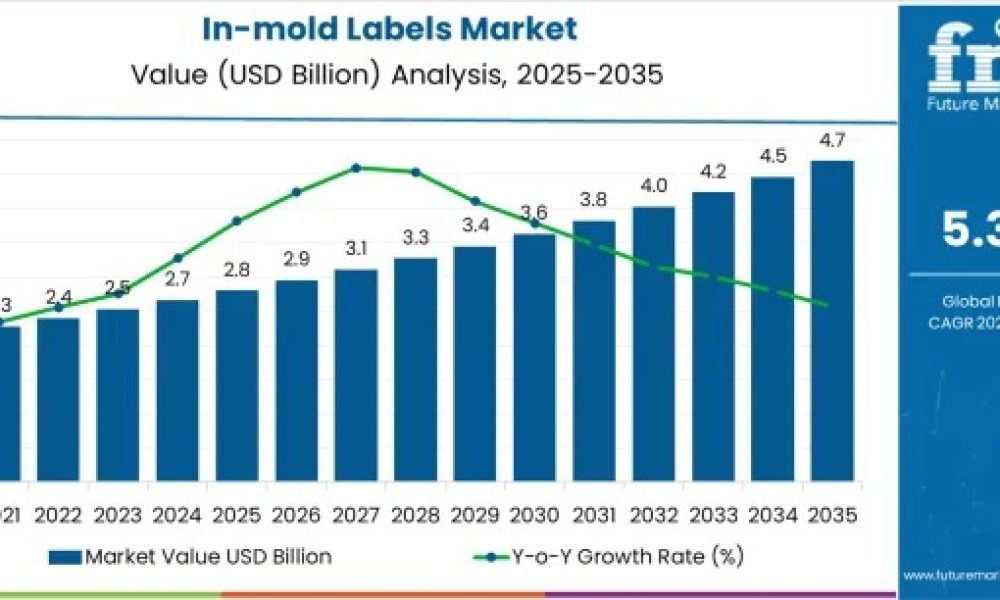
The in-mold labels (IML) market is witnessing steady and sustained growth as packaging moves toward higher quality, automation, and brand-driven differentiation. In-mold labeling is increasingly preferred by manufacturers because it integrates the labeling process directly into the molding cycle, eliminating post-production steps and ensuring superior durability and visual appeal. This makes IML particularly valuable in industries where branding, product integrity, and operational efficiency are critical.
In 2025, the global in-mold labels market is valued at USD 2.8 billion and is projected to reach USD 4.7 billion by 2035, expanding at a CAGR of 5.3%. The market is expected to grow approximately 1.68 times over the forecast period, supported by strong demand from food & beverage packaging, personal care products, automotive components, and premium consumer goods.
Meaning of In-mold Labels
In-mold labels are printed plastic films or papers that are placed inside a mold before the injection, blow, or thermoforming process begins. During molding, the label fuses permanently with the container surface, becoming an integral part of the product.
Unlike traditional adhesive labels, IML offers:
- No peeling or bubbling
- High resistance to moisture, heat, and chemicals
- Full recyclability in mono-material packaging
- Superior graphic quality and branding consistency
This technology allows manufacturers to achieve seamless decoration while improving production efficiency and product longevity.
Market Outlook
The outlook for the in-mold labels market remains highly positive. Growth is being driven by increasing demand for premium packaging aesthetics, rising automation in manufacturing lines, and the need for durable labeling solutions compatible with high-speed production environments.
Between 2025 and 2030, market expansion will be led by food packaging, dairy containers, household products, and cosmetics. Between 2030 and 2035, growth will accelerate further through digital printing integration, advanced material films, and wider adoption in technical and automotive applications.
Request For Sample Report | Customize Report | Purchase Full Report – Sample link
Market Overview
The in-mold labels market is segmented by:
Technology Type
- Injection molding
- Blow molding
- Thermoforming
Material Type
- Polypropylene (PP)
- Polyethylene (PE)
- PET
- Others (PVC, PS)
End-use Industry
- Food & beverages
- Personal care & cosmetics
- Automotive
- Household products
- Others
Printing Technique
- Flexographic
- Digital
- Gravure
- Screen printing
Among these, injection molding dominates with 68.7% market share, while food & beverages account for 47.3% of total usage, making them the most influential segments.
Market Growth Drivers
Key growth factors supporting the in-mold labels market include:
- Rising demand for premium packaging aesthetics
- Expansion of food processing and packaged foods
- Increasing use of automation and smart manufacturing
- Growth of e-commerce and shelf-ready packaging
- Shift toward mono-material recyclable packaging
In-mold labels reduce production steps, improve line efficiency, and enhance shelf appeal, making them highly attractive for brand owners seeking both operational and marketing advantages.
Market Demand
Demand for in-mold labels is strongest in the food & beverage industry, especially in:
- Dairy tubs and yogurt cups
- Ice cream containers
- Ready-meal packaging
- Beverage bottles and jars
Personal care brands use IML extensively for shampoos, lotions, cosmetics, and household cleaning products due to its durability and resistance to water and chemicals. Automotive demand is also rising for interior components and technical parts requiring heat-resistant and long-life labels.
Emerging economies such as India, China, and Brazil are seeing rapid growth due to rising consumer spending, expanding retail infrastructure, and modernization of packaging systems.
Key Market Trends
Several strategic trends are shaping the future of the IML industry:
- Digital printing integration for personalization
- Holographic and metallic finishes for luxury packaging
- High-barrier films for food safety compliance
- Automation-compatible label formats
- Heat and UV-resistant materials for automotive use
Manufacturers are increasingly focusing on customized solutions, short-run digital designs, and variable data printing to meet evolving brand requirements.
Regional Insights
CAGR by Country (2025–2035):
- India: 8.1%
- China: 7.4%
- Brazil: 6.3%
- USA: 4.7%
- France: 4.5%
- Germany: 4.2%
- Japan: 3.9%
India leads global growth due to its expanding consumer goods sector and investment in packaging automation. China follows with strong manufacturing capabilities and premium product adoption. Europe and the USA show moderate but stable growth driven by innovation and sustainability initiatives.
Competitive Landscape
The in-mold labels market is highly competitive, led by global packaging and labeling specialists focused on innovation, automation, and material science.
Key market leaders include:
- Multi-Color Corporation
- CCL Industries
- Constantia Flexibles
- Huhtamaki Group
- Coveris Holdings
- Fort Dearborn Company
- Inland Packaging
- Innovia Films
- IPL Plastics
- Vibac Group
These companies invest heavily in advanced printing systems, high-speed automation compatibility, and sustainable film substrates. Strategic partnerships with brand owners and packaging converters are common competitive strategies.
Bullet Point Market Highlights
Market Size & Growth:
- Market value (2025): USD 2.8 billion
- Market value (2035): USD 4.7 billion
- CAGR: 5.3%
- Total growth: 67.9%
Leading Segments:
- Technology: Injection molding (68.7%)
- End use: Food & beverages (47.3%)
Key Drivers:
- Premium packaging demand
- Automation in molding lines
- Shelf-ready branding
- E-commerce packaging growth
Key Trends:
- Digital variable data printing
- Holographic decoration
- High-barrier food labels
- Automotive-grade materials
Challenges:
- High equipment investment
- Technical complexity
- Skilled labor dependency
- Static and placement issues
Conclusion
The in-mold labels market is transitioning from a decorative packaging solution into a strategic manufacturing technology that enhances branding, efficiency, and sustainability. With increasing demand for visually appealing, durable, and recyclable packaging, IML is becoming a preferred choice for global brands. Future growth will depend on how effectively manufacturers integrate digital printing, advanced materials, and automation-ready systems. Companies that can offer customized, high-speed, and sustainable in-mold label solutions will dominate the next decade of packaging innovation. As consumer expectations rise and brand competition intensifies, in-mold labels will remain at the forefront of premium packaging strategies worldwide.
Why FMI: https://www.futuremarketinsights.com/why-fmi
About Future Market Insights (FMI)
Future Market Insights, Inc. (FMI) is an ESOMAR-certified, ISO 9001:2015 market research and consulting organization, trusted by Fortune 500 clients and global enterprises. With operations in the U.S., UK, India, and Dubai, FMI provides data-backed insights and strategic intelligence across 30+ industries and 1,200 markets worldwide.
Contact Us:
Future Market Insights Inc.
Christiana Corporate, 200 Continental Drive,
Suite 401, Newark, Delaware – 19713, USA
T: +1-347-918-3531
For Sales Enquiries: [email protected]



