
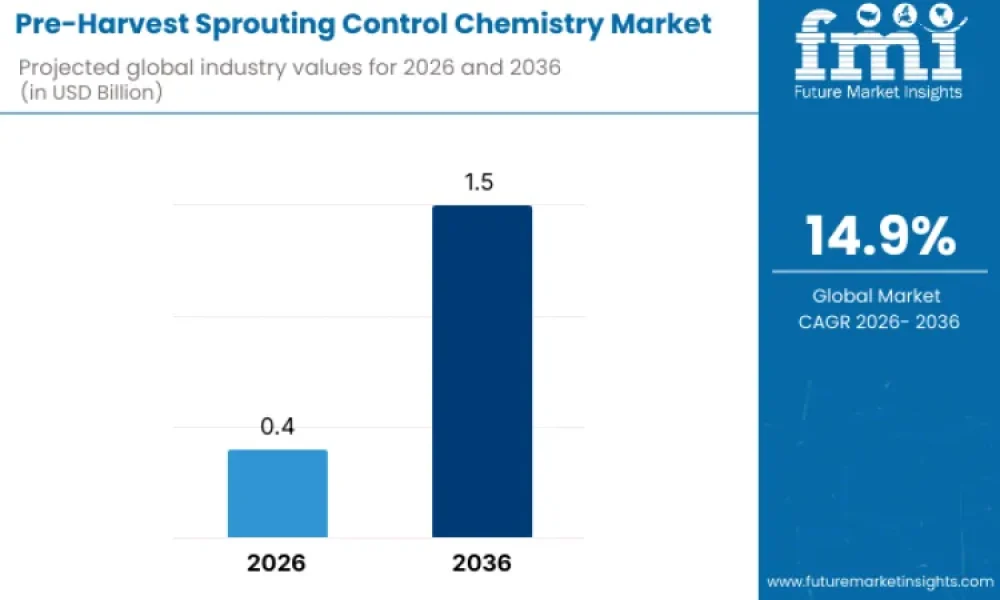
The global Pre-Harvest Sprouting Control Chemistry Market is poised for robust expansion, with the industry value forecasted to grow from approximately USD 0.4 billion in 2026 to USD 1.5 billion by 2036, reflecting a compound annual growth rate (CAGR) of 14.9% over the decade. This growth underscores the increasing reliance on advanced chemistries that help cereal producers mitigate quality and yield losses caused by pre-harvest sprouting — a phenomenon that significantly impacts grain quality when environmental conditions trigger premature germination just before harvest.
Amid rising adoption of precision agriculture and environmentally conscious crop protection strategies, the market is attracting heightened interest from growers seeking solutions that not only preserve grain integrity but also align with sustainability mandates and food safety criteria.
Key Market Insights at a Glance
Pre-harvest sprouting — most prevalent in cereals like wheat, barley, and oats — poses serious challenges to end-use quality in baking, brewing, and food processing. Chemicals designed to delay germination and maintain dormancy during critical maturation phases are leading the market’s growth trajectory. Growth regulator-based sprout suppressants dominate the landscape with a 35% market share, owing to their effectiveness in regulating plant hormonal pathways that delay sprouting. Wheat crops command the largest segment share at 42%, highlighting their sensitivity to adverse weather conditions near harvest and the premium placed on quality standards in global markets.
Segment Overview
The pre-harvest sprouting control chemistry market is segmented primarily by chemistry type and crop type. Among chemistry categories, growth regulator-based sprout suppressants are the leaders, supported by emerging alternatives such as hormone modulation and ABA pathway chemistries, desiccation-dormancy synchronization blends, and bio-derived anti-sprouting solutions. These alternatives are gaining traction due to their promise of eco-friendly profiles and compatibility with integrated pest and crop management programs. On the crop front, wheat’s dominance reflects not only high global production volumes but also stringent quality demands imposed by milling and food manufacturers.
To access the complete data tables and in-depth insights — Request Your Sample Report Now
Regional Overview
Geographically, North America and Europe are among the fastest growing regions, propelled by established cereal production systems that face frequent climatic volatility during harvest windows. Canada leads with a forecast CAGR of 16.1%, driven by its status as a major global supplier of wheat and barley requiring reliable sprouting control to meet export quality standards. Australia follows closely with 15.4% CAGR, as its grain producers navigate increasingly erratic rainfall patterns during late season. The UK and Germany maintain strong growth rates above 14%, while China continues to scale adoption in line with national priorities to safeguard food security and grain quality.
Competitive Landscape
The competitive environment features both specialized and diversified agrochemical players innovating across product performance, formulation stability, and application guidance. Leading companies like Nufarm Dormancy Solutions, Philagro Holding, Helm Crop Solutions, UBE Agrochemicals, and Qingdao KingAgroot Chemical are emphasizing technical expertise and tailored solutions that address region-specific climatic risks and crop requirements. These firms compete not only on efficacy but also on how well their products integrate into broader crop protection schedules amid growing pressures to minimize environmental impact.
Market Outlook: Powering the Next Decade
Over the next decade, the pre-harvest sprouting control chemistry market is expected to benefit from several key trends, including the integration of data-driven decision support tools, real-time weather analytics, and precision application technologies. These advancements enable growers to improve timing and dosage accuracy, thereby maximizing product effectiveness while reducing overall chemical inputs. Moreover, rising demand for bio-derived and low-toxicity chemistries will further expand the market’s appeal to sustainability-focused stakeholders, providing growth opportunities that align with evolving regulatory frameworks and consumer expectations.
Key Players of Sustainable Label Industry
In addition to established formulators, newer entrants focusing on bio-based sprouting controls and multifunctional chemistries are entering the competitive arena. These innovations promise to address both sprouting and ancillary agronomic challenges such as stress resilience and crop moisture management, positioning the industry for broader adoption.
Recent Strategic Developments
Recent industry activity centers on strategic collaborations between agrochemical companies and precision agriculture platforms to enhance product efficacy through data insights. Partnerships that bring together formulation science and predictive weather modeling are enabling growers to safeguard crop quality amidst increasing climatic unpredictability. Concurrently, research initiatives exploring eco-friendly compound pathways signal a shift toward more sustainable pre-harvest sprouting control solutions that meet stringent regulatory and consumer standards.
Have a specific Requirements and Need Assistant on Report Pricing or Limited Budget please contact us – [email protected]
About Future Market Insights (FMI)
Future Market Insights, Inc. (FMI) is an ESOMAR-certified, ISO 9001:2015 market research and consulting organization, trusted by Fortune 500 clients and global enterprises. With operations in the U.S., UK, India, and Dubai, FMI provides data-backed insights and strategic intelligence across 30+ industries and 1200 markets worldwide.
Why Choose FMI: https://www.futuremarketinsights.com/why-fmi



