
The crisis, emergency, and incident management platforms market has emerged as a critical pillar of modern public safety and enterprise resilience strategies. These platforms enable organizations to prepare for, respond to, and recover from disruptive events such as natural disasters, cyberattacks, pandemics, industrial accidents, and security breaches. By integrating real-time data, communication tools, analytics, and automation, they help decision-makers coordinate faster and more effectively under pressure.
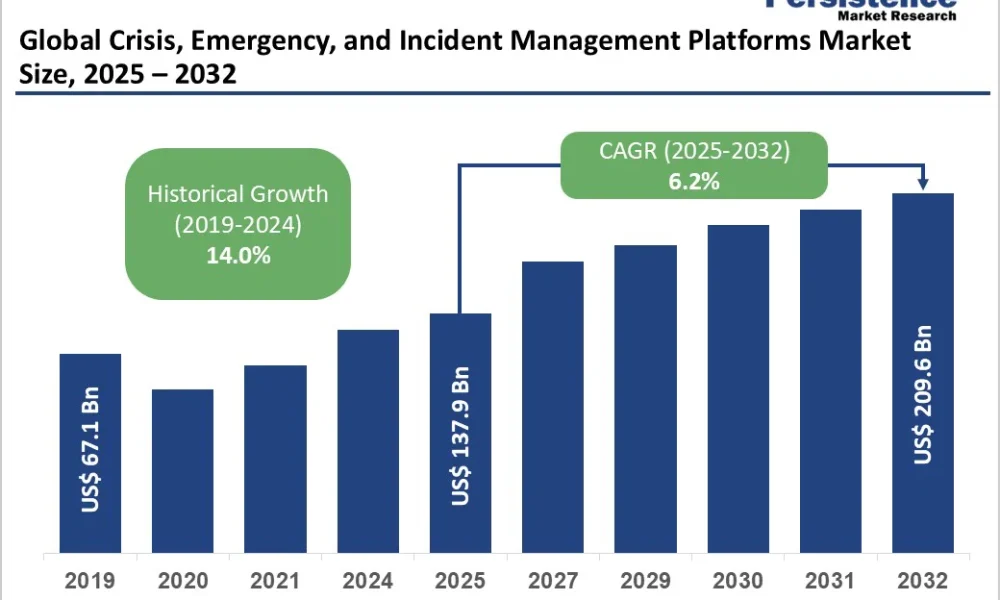
In 2025, the global crisis, emergency, and incident management platforms market size is estimated at US$137.9 billion and is projected to reach US$209.6 billion by 2032, expanding at a CAGR of 6.2% during the forecast period. Growth is being fueled by recurrent climate-related disasters, escalating cybersecurity threats, and stricter regulatory mandates around public safety and business continuity. Among solution types, emergency and mass notification systems lead due to their regulatory importance, while North America dominates regionally, supported by strong disaster management frameworks and advanced digital infrastructure.
Market Statistics and Growth Landscape
The steady expansion of the crisis, emergency, and incident management platforms market reflects a shift from reactive crisis handling to proactive, technology-driven risk mitigation. Governments and enterprises are increasingly adopting integrated platforms that unify surveillance, communication, analytics, and response planning within a single ecosystem. This transition is particularly evident in urban regions where population density amplifies the impact of emergencies.
Historically, the market recorded a robust 14.0% CAGR between 2019 and 2024, driven by pandemic response systems and digital transformation initiatives. Although growth is moderating, it remains resilient as AI-powered surveillance, cloud-based deployments, and IoT-enabled situational awareness continue to reshape the market. The government and defense sector, accounting for nearly 37% market share, remains the largest end user, reflecting sustained investments in national security and disaster preparedness.
Key Highlights from the Report
- Emergency and mass notification systems are projected to account for over 28% of total market revenue in 2025.
- Surveillance and security monitoring platforms represent the fastest-growing solution category with an 8.5% CAGR.
- Government and defense remain the largest end-user segment due to national safety mandates.
- North America leads the global market with an estimated 42% share.
- Asia Pacific is forecast to grow at the fastest pace, driven by smart city and disaster mitigation investments.
- Interoperability and ecosystem-based solutions are becoming decisive competitive factors.
Market Segmentation Analysis
The crisis, emergency, and incident management platforms market is segmented by solution type, deployment model, and end user. By solution type, the market includes emergency and mass notification systems, surveillance and security monitoring platforms, incident response and reporting tools, disaster recovery and business continuity software, and integrated command-and-control systems. Emergency notification platforms dominate due to mandatory adoption across government institutions, healthcare facilities, and large enterprises.
From an end-user perspective, the market spans government and defense, healthcare, BFSI, transportation and logistics, energy and utilities, and commercial enterprises. Government and defense agencies lead adoption, given their responsibility for national disaster management and public safety. Meanwhile, healthcare and BFSI sectors are increasingly investing in incident management platforms to ensure operational continuity, regulatory compliance, and protection of sensitive data during emergencies.
Regional Insights
North America continues to dominate the crisis, emergency, and incident management platforms market, supported by advanced technological infrastructure and stringent disaster preparedness regulations in the United States and Canada. Frequent climate-related events, cybersecurity risks, and regulatory frameworks such as FEMA guidelines drive sustained demand for integrated emergency management solutions.
Asia Pacific is emerging as the fastest-growing regional market, propelled by rapid urbanization, rising investments in disaster risk reduction, and large-scale smart city initiatives. Countries such as China, India, and Japan are deploying AI-enabled surveillance, early warning systems, and cloud-based incident response platforms to strengthen public safety and urban resilience.
Elevate your business strategy with comprehensive market data. Request a sample report now: https://www.persistencemarketresearch.com/samples/14533
Market Drivers
One of the primary drivers of the crisis, emergency, and incident management platforms market is the increasing frequency and severity of natural disasters linked to climate change. Floods, wildfires, hurricanes, and heatwaves are pushing governments and enterprises to invest in predictive analytics and real-time response systems. These platforms enable faster coordination and minimize loss of life and infrastructure damage.
Another major driver is the rise in cybersecurity threats and critical infrastructure attacks. As digital systems become interconnected, the risk of large-scale operational disruptions grows. Incident management platforms equipped with AI-driven threat detection and response workflows are becoming essential for enterprises seeking to protect data integrity and ensure business continuity.
Market Restraints
Despite strong growth prospects, the market faces challenges related to high implementation and integration costs. Deploying comprehensive crisis management platforms often requires significant upfront investment in software, hardware, training, and system integration. This can limit adoption among small and mid-sized organizations with constrained budgets.
Data privacy and interoperability issues also pose restraints. Integrating multiple data sources, surveillance feeds, and communication channels raises concerns around data security and regulatory compliance. Lack of standardized protocols across regions and vendors can further complicate cross-platform integration, slowing adoption in certain markets.
Market Opportunities
The growing adoption of AI, machine learning, and predictive analytics presents significant opportunities for market players. Advanced analytics can enhance early warning capabilities, automate decision-making, and improve situational awareness during emergencies. Vendors that embed AI-driven insights into their platforms are likely to gain a competitive edge.
Expansion into emerging markets offers another key opportunity. Rapid urbanization, infrastructure development, and policy reforms in Asia Pacific, Latin America, and the Middle East are creating demand for scalable, cloud-based incident management solutions. Partnerships with telecom operators and smart city developers are expected to unlock new revenue streams.
Reasons to Buy the Report
✔ Gain detailed insights into market size, growth trends, and future forecasts through 2032.
✔ Understand key growth drivers, restraints, and opportunities shaping the industry.
✔ Analyze market segmentation by solution type, end user, and region.
✔ Identify leading players and assess competitive dynamics and strategies.
✔ Support strategic decision-making with data-driven market intelligence.
Frequently Asked Questions (FAQs)
How Big is the Crisis, Emergency, and Incident Management Platforms Market?
Who are the Key Players in the Global Market for Crisis, Emergency, and Incident Management Platforms?
What is the Projected Growth Rate of the Crisis, Emergency, and Incident Management Platforms Market?
What is the Market Forecast for the Crisis, Emergency, and Incident Management Platforms Market for 2032?
Which Region is Estimated to Dominate the Industry through the Forecast Period?
Company Insights
- Motorola Solutions
- Honeywell International Inc.
- Oracle Corporation
- IBM Corporation
- Siemens AG
- Everbridge, Inc.
- Hexagon AB
- NEC Corporation
Recent Developments:
- In March 2025, Oracle enhanced its health system operations suite with new tools such as Oracle Health Patient Flow and Oracle Health Transfer Center, enabling real-time bed management and evacuation planning.
- Several leading vendors have increased investments in AI-enabled surveillance and cloud-native architectures to improve scalability and cross-platform interoperability.
Conclusion
The crisis, emergency, and incident management platforms market is transitioning into a mature yet innovation-driven industry. As risks become more complex and interconnected, organizations are prioritizing integrated, data-driven solutions that enable rapid response and resilience. With steady growth projected through 2032, the market offers strong opportunities for vendors that can deliver interoperable, intelligent, and scalable platforms aligned with evolving public safety and enterprise needs.
Related Reports:




