
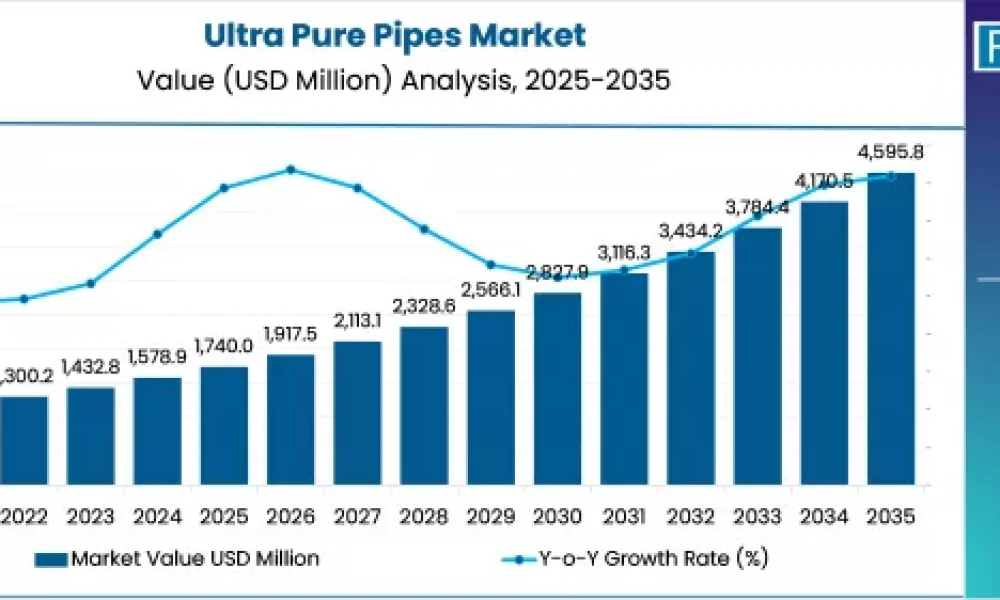
The global ultra-pure pipes market has reached a critical inflection point, driven by the relentless expansion of sub-2nm semiconductor fabrication and the rapid rise of advanced biologics. As of early 2026, industry analysts report that the market for high-purity fluid handling systems is expanding at a Compound Annual Growth Rate (CAGR) of 11.8%, positioning the sector to exceed a $12.88 billion valuation by the end of the fiscal year.
This growth represents more than a simple infrastructure uptick; it reflects a fundamental shift in how high-tech industries manage contamination at the atomic level. From the “”One Nation, One Gas Grid”” initiatives in emerging markets to the massive “”CHIPS Act”” investments in North America and Europe, the demand for ultra-high purity (UHP) piping is now a primary bottleneck for global technological progress.
Request for Sample Report | Customize Report |purchase Full Report – https://www.factmr.com/connectus/sample?flag=S&rep_id=10871
The Purity Paradigm: Why Infrastructure is Moving Toward 18.2 MΩ·cm
Ultra-pure water (UPW) and high-purity chemicals are the lifeblood of modern electronics. In the semiconductor industry, even a single part-per-trillion of metallic contamination can lead to catastrophic yield losses in wafer production. Consequently, the “”What”” of this market—the pipes themselves—has evolved from simple conduits into sophisticated, chemically inert delivery systems.
“We are no longer just looking at moving liquid from point A to point B,” notes a senior industry analyst. “In 2026, the pipe is part of the process. If the material leaches a single ion or allows for microbial biofilm buildup, the entire $500 million production batch is at risk. Purity is the new currency of performance.”
Market Drivers: Semiconductors, 5G, and the AI Revolution
The “”Why”” behind this market surge is inextricably linked to three pillars of the 2026 economy:
- Semiconductor Fabrication: The transition to 5G and AI-specific chipsets requires unprecedented volumes of UPW for etching and cleaning processes.
- Pharmaceutical Innovation: The shift from traditional small-molecule drugs to large-molecule biopharmaceuticals (biologics) has mandated sterile, high-purity environments that only PVDF and PFA piping can provide.
- Data Center Cooling: As AI servers generate record-breaking heat, ultra-pure liquid cooling systems are being integrated into the foundational architecture of hyperscale data centers.
Material Science Evolution: PFA and PVDF Take Center Stage
While stainless steel remains a staple in traditional industrial applications, the ultra-pure pipes market is seeing a decisive move toward advanced polymers. Perfluoroalkoxy (PFA) and Polyvinylidene Fluoride (PVDF) now dominate the high-end segment due to their near-total chemical inertness and superior surface smoothness, which prevents particle entrapment.
Recent 2025 developments, such as Kurita Water Industries’ milestone in PFAS-free piping, signal a new era of “”green purity””—balancing the strict requirements of the cleanroom with evolving environmental regulations.
Regional Leadership and Competitive Landscape
Geographically, the Asia-Pacific (APAC) region continues to hold the largest market share, accounting for over 60% of global demand, anchored by the dense concentration of fabrication plants in Taiwan, South Korea, and China. However, North America is currently the fastest-growing market, spurred by a domestic manufacturing renaissance and a surge in biotechnology investments.
Key players leading the infrastructure charge include:
- Georg Fischer (GF): Setting the standard for IR-welding technology and PVDF systems.
- Asahi/America: Specializing in high-purity valve and piping integration for the microelectronics sector.
- Agru: Dominating the PFA segment with high-purity resin applications.
- CoreDux: Disrupting the market with ultra-high purity flexible hoses for gas and liquid transport.
Outlook for 2026 and Beyond
As the industry moves toward the 2030 horizon, the convergence of AI-driven manufacturing and stricter environmental standards will likely separate the market leaders from the followers. Investors and analysts expect continued consolidation, as major water technology firms like Ecolab and Veolia acquire specialized piping manufacturers to offer “”turnkey”” purity solutions.
For industry leaders, the message is clear: the backbone of the digital age is made of ultra-pure pipes, and the race to zero-contamination is only just beginning.
Related Reports
“



