
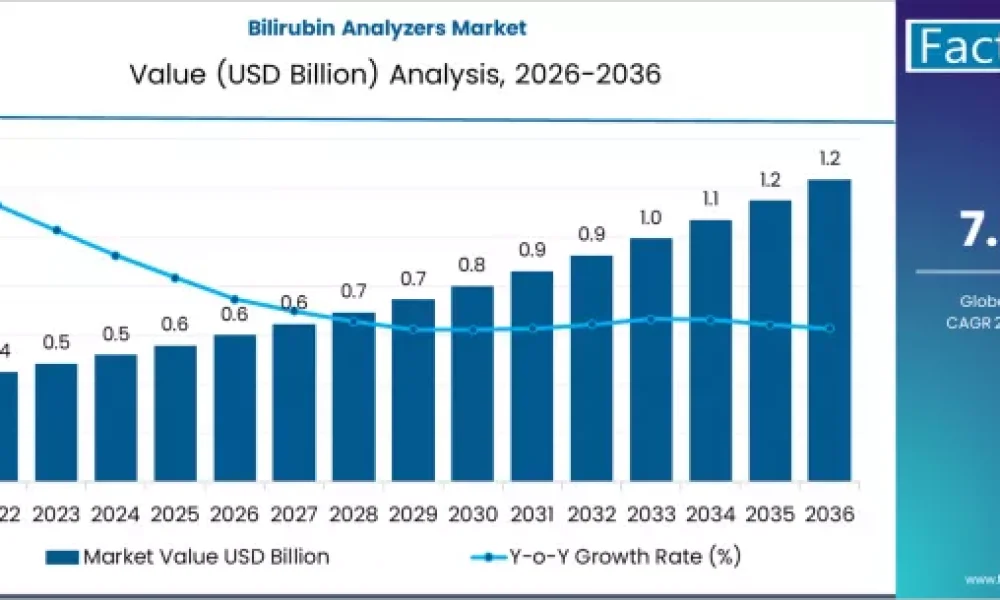
The global bilirubin analyzers market is positioned for a decade of sustained growth, with its valuation projected to rise from USD 0.6 billion in 2026 to USD 1.2 billion by 2036. This growth, characterized by a 7.5% compound annual growth rate (CAGR), reflects a fundamental transformation in pediatric diagnostics: the move from invasive laboratory blood draws to real-time, transcutaneous monitoring.
As clinical guidelines increasingly mandate universal screening for neonatal hyperbilirubinemia, healthcare providers are prioritizing diagnostic speed and patient comfort. The ability to monitor bilirubin levels at the bedside is becoming a standard of care, particularly as the industry addresses the critical need to prevent long-term neurological complications associated with untreated jaundice.
Market Summary: Key Projections (2026–2036)
| Metric | Details |
| Market Value (2026) | USD 0.6 Billion |
| Projected Value (2036) | USD 1.2 Billion |
| Compound Annual Growth Rate | 7.5% |
| Dominant Device Type | Transcutaneous Meters (63.8% Share) |
| Primary End-User | Hospitals & NICUs (68.2% Share) |
| Fastest Growing Market | India (9.2% CAGR) |
To Access the Complete Data Tables & in-depth Insights, Request a Sample on this report: https://www.factmr.com/connectus/sample?flag=S&rep_id=13546
Market Fundamentals: Identifying the Strategic ‘Why’ and ‘How’
Bilirubin analyzers are the frontline defense against jaundice—a condition affecting approximately 60% of full-term and 80% of preterm infants. Modern analyzers leverage optical spectroscopy and microfluidics to deliver precise readings, allowing for the immediate initiation of phototherapy when necessary.
Who is leading the sector? Industry leaders such as Dräger, Philips, GE HealthCare, Natus Medical, and Konica Minolta are currently spearheading the integration of digital health connectivity into handheld devices.
What is driving the technology shift? Transcutaneous bilirubin meters are the primary growth engine, projected to command a 63.8% market share by 2026. Their non-invasive nature eliminates the risk of infection and iatrogenic blood loss in vulnerable newborns.
Where is the growth concentrated? While North America remains a high-value hub, the Asia-Pacific region is emerging as a high-growth corridor. India (9.2% CAGR) and China (8.6% CAGR) are seeing rapid adoption driven by rising birth rates and massive public health investments.
Why is the market expanding? Beyond neonatal care, the rising prevalence of chronic liver diseases and biliary obstructions in adults is expanding the diagnostic utility of these devices in emergency and surgical settings.
Sector Analysis: Hospitals and NICUs Maintain Dominance
Hospitals and Neonatal Intensive Care Units (NICUs) remain the largest end-users, currently accounting for 68.2% of the care setting segment. The report indicates that the high patient volume in these facilities justifies the capital expenditure for advanced bench-top and high-throughput analyzers.
“The shift we are observing is one of ‘diagnostic decentralization,'” the analysis notes. “While the hospital remains the hub, the emergence of high-accuracy handheld devices is allowing for screening to occur in community clinics and even home-care settings, significantly reducing hospital readmission rates for newborns.”
Industry Trends and Competitive Landscape
1. The Rise of Optical Reflectance Photometry
Technological innovation is currently focused on overcoming skin-tone variability in transcutaneous measurements. New sensors utilizing multi-wavelength optical spectroscopy are proving more accurate across diverse patient demographics, a critical factor for global market penetration in Africa and Southeast Asia.
2. Point-of-Care (POC) and Handheld Mobility
There is a significant absolute dollar opportunity in the handheld serum analyzer segment. These devices are particularly vital in resource-limited environments where centralized lab infrastructure is unavailable, providing results in under 10 seconds to facilitate rapid clinical decision-making.
3. Integration with the Internet of Medical Things (IoMT)
Modern bilirubin analyzers are increasingly equipped with Wi-Fi and Bluetooth capabilities. By syncing directly with Electronic Health Records (EHR), these devices enable longitudinal tracking of a patient’s bilirubin levels, ensuring that treatment efficacy for conditions like hepatitis or cirrhosis is monitored with surgical precision.
Regional Outlook: Asia-Pacific and North American Dynamics
North America’s market leadership is sustained by a robust regulatory environment and 100% compliance with neonatal jaundice screening protocols. Conversely, the growth in India and China is fueled by a “leapfrog” effect, where new healthcare facilities are bypassing traditional laboratory setups in favor of integrated, portable diagnostic technology.
Investment and Growth Opportunity
For investors and market professionals, the bilirubin analyzers market represents a “recession-proof” sector of the medical device industry. The mandatory nature of neonatal screening, combined with the technological upgrade cycle from invasive to non-invasive devices, creates a stable environment for long-term capital appreciation.
Have specific requirements or need assistance on report pricing or have a limited budget? Please contact [email protected]
About Fact.MR:
Fact.MR is a global market research and consulting firm, trusted by Fortune 500 companies and emerging businesses for reliable insights and strategic intelligence. With a presence across the U.S., UK, India, and Dubai, we deliver data-driven research and tailored consulting solutions across 30+ industries and 1,000+ markets. Backed by deep expertise and advanced analytics, Fact.MR helps organizations uncover opportunities, reduce risks, and make informed decisions for sustainable growth



