
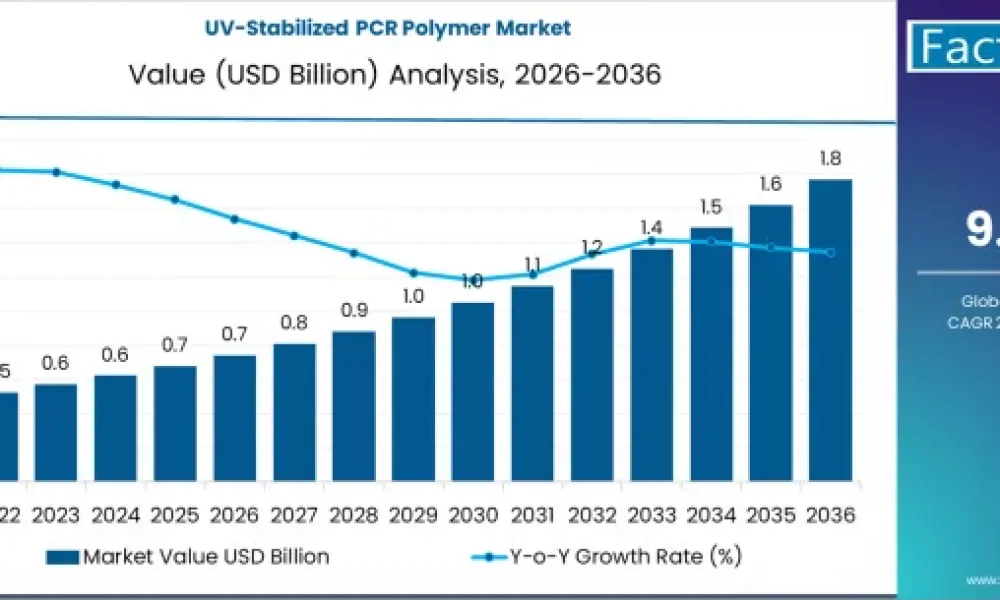
The global UV-Stabilized PCR Polymer Market is poised for significant expansion through 2036 as molecular diagnostics, genomic research, clinical testing, and advanced biotechnology applications continue to grow worldwide. UV-stabilized PCR polymers are specialized DNA polymerase enzymes engineered to maintain activity and fidelity even after exposure to ultraviolet (UV) light, making them ideal for workflows that incorporate decontamination steps, photochemical control measures, and complex sample preparation protocols. These enhanced polymerases deliver more reliable amplification results, reduce contamination risk, and improve consistency in both research and clinical environments.
With increasing reliance on polymerase chain reaction (PCR) for disease detection, genetic analysis, and therapeutic development, robust and resilient reagents such as UV-stabilized PCR polymers are becoming essential components of modern molecular workflows.
Market Outlook (2026–2036)
Estimated Market Value in 2026: USD 0.42 Billion
Projected Market Value in 2036: USD 1.05 Billion
Forecast CAGR (2026–2036): Approximately 9.4%
Leading Polymer Type: Hot-Start UV-Stabilized Polymerases
Key Application Areas: Clinical diagnostics, genomics research, high-throughput testing
Primary End Users: Diagnostic laboratories, pharmaceutical companies, research institutions
Growth is driven by the expanding applications of PCR technology across diagnostics, research, and biotechnology sectors, and by the need for reagents capable of withstanding stringent contamination control procedures.
To Access the Complete Data Tables & in-depth Insights, Request a Discount on this report: https://www.factmr.com/connectus/sample?flag=S&rep_id=13481
Market Overview
Polymerase chain reaction (PCR) is a foundational technique in molecular biology that enables amplification of specific DNA or RNA sequences. It is widely used in clinical diagnostics — including infectious disease testing and oncology panels — as well as in academic research, biotechnology development, environmental testing, and forensic analysis.
While traditional PCR enzymes are sensitive to environmental contaminants and photochemical degradation, UV-stabilized PCR polymers are formulated to withstand UV decontamination processes commonly employed to minimize false positives. These enhanced enzymes maintain high activity and fidelity even after exposure to controlled UV light, improving assay robustness and reliability in both routine and high-complexity applications.
Key Market Drivers
1. Expansion of Molecular Diagnostics and Clinical Testing
PCR remains a frontline tool for detecting pathogens, genetic disorders, and biomarkers. Adoption of UV-stabilized polymers supports clinical laboratories’ needs for contamination control and high assay precision.
2. Rapid Growth in Genomic and Biotech Research
Investment in genomic research, precision medicine, and biotechnology continues to rise. UV-stabilized PCR polymers support complex research workflows that require reliable amplification following decontamination procedures.
3. Increasing Use of Contamination Control Practices
Laboratories incorporate UV decontamination and photochemical cleaning to prevent carryover contamination and false results. Polymers that retain activity after UV exposure are vital to maintaining assay fidelity.
4. Higher Throughput and Multiplex Testing Demands
As PCR applications scale to high-throughput formats and multiplex panels, robust polymerases that perform reliably across varied conditions and workflows become increasingly important.
Market Segmentation Insights
By Polymer Type:
Hot-Start UV-Stabilized Polymerases: Deliver activation control and high specificity while tolerating UV exposure.
High-Fidelity UV-Stabilized Polymerases: Provide reduced error rates suitable for sequencing and precision applications.
Multiplex-Compatible UV-Stabilized Polymerases: Engineered for simultaneous amplification of multiple targets with contamination control resilience.
Standard UV-Resistant Polymerases: Economical options for routine laboratory use.
By Application:
Clinical diagnostics, including infectious disease panels and cancer profiling.
Molecular biology research and functional genomics.
Biopharmaceutical development and quality control.
Environmental and food testing.
Forensic DNA analysis.
By End User:
Diagnostic laboratories and hospital labs.
Academic and research institutions.
Biotech and pharmaceutical companies.
Contract research organizations (CROs).
Government and public health agencies.
Regional Demand Dynamics
North America is expected to lead the market due to strong investment in molecular diagnostics, extensive research infrastructure, and high adoption of advanced PCR technologies.
Europe also represents a key market, backed by stringent regulatory frameworks for molecular testing, established biotechnology sectors, and broad implementation of contamination control measures.
Asia Pacific is projected to deliver rapid growth due to expanding healthcare access, increased research funding, adoption of modern diagnostic platforms, and rising biotech activity in markets such as China, India, and Southeast Asia.
Emerging demand is also visible in Latin America and Middle East & Africa as laboratory capabilities expand and molecular testing becomes more prevalent in clinical and research settings.
Competitive Landscape
The market for UV-stabilized PCR polymers is moderately competitive, with participation from global reagent suppliers, biotechnology firms, and specialty enzyme manufacturers. Key strategies among market players include expanding product portfolios with enhanced performance characteristics, strengthening distribution networks, and offering technical support services to help laboratories optimize workflows.
Differentiation is centered on polymer performance under diverse conditions, compatibility with automated platforms, consistency across lots, and integration with next-generation protocols.
Future Outlook
The UV-Stabilized PCR Polymer Market is expected to sustain robust growth through 2036 as demand for high-performance, contamination-resilient reagents rises across diagnostics, research, and industrial applications. Continued advancements in reagent design, increasing use of UV decontamination practices, and broader adoption of PCR in emerging applications will support wider deployment of UV-stabilized polymers.
As laboratories prioritize accuracy, reliability, and workflow efficiency, UV-stabilized PCR polymers will remain integral to modern molecular biology and clinical testing landscapes worldwide.
Have specific requirements or need assistance on report pricing or have a limited budget? Please contact [email protected]
About Fact.MR:
Fact.MR is a global market research and consulting firm, trusted by Fortune 500 companies and emerging businesses for reliable insights and strategic intelligence. With a presence across the U.S., UK, India, and Dubai, we deliver data-driven research and tailored consulting solutions across 30+ industries and 1,000+ markets. Backed by deep expertise and advanced analytics, Fact.MR helps organizations uncover opportunities, reduce risks, and make informed decisions for sustainable growth



