
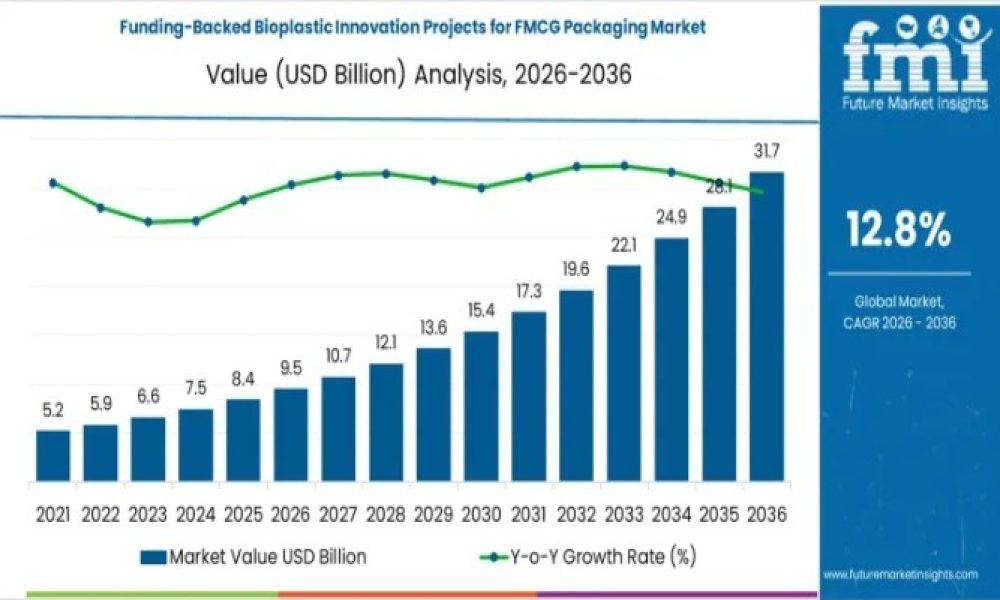
The global push toward sustainable packaging is entering a decisive phase, and funding-backed bioplastic innovation projects are emerging as a cornerstone of this transition. The Funding-Backed Bioplastic Innovation Projects for FMCG Packaging Market is projected to grow from USD 9.5 billion in 2026 to USD 31.7 billion by 2036, expanding at a robust CAGR of 12.8%. This growth reflects a fundamental shift in how fast-moving consumer goods (FMCG) companies approach packaging where sustainability has evolved from a brand differentiator into a commercial and regulatory necessity.
Across regions, funding mechanisms are accelerating innovation by bridging the gap between laboratory research and large-scale commercial deployment. Governments, supranational bodies, and public-private consortia are channeling capital into bioplastic solutions that can meet the demanding performance, safety, and cost requirements of FMCG packaging.
Discover Market Opportunities – Get Your Sample of Our Industry Overview Today!
Market at a Glance: Quick Stats
- Market Value (2026): USD 9.5 billion
- Forecast Value (2036): USD 31.7 billion
- Global CAGR (2026–2036): 12.8%
- Leading Funding Source: Government grants & EU framework programmes (45%)
- Dominant Packaging Segment: Food & beverage packaging (41%)
- Key Growth Region: USA
A Market Driven by Regulation, Capital, and Consumer Pressure
Historically, FMCG packaging relied heavily on conventional fossil-based plastics due to their low cost, durability, and scalability. However, rising concerns over plastic waste, carbon emissions, and environmental degradation have reshaped both policy and purchasing behavior. Regulatory frameworks targeting single-use plastics and extended producer responsibility have intensified, pushing FMCG brands to rethink material choices.
Funding-backed bioplastic innovation projects emerged as a direct response to these pressures. Early initiatives focused on overcoming technical barriers—such as improving barrier properties, mechanical strength, and processability of materials like PLA (polylactic acid) and PHA (polyhydroxyalkanoates). Today, these projects are increasingly aligned with commercial objectives, aiming to deliver scalable, compliant, and cost-competitive alternatives for mainstream FMCG packaging.
Growth Outlook Through 2036
From 2026 to 2031, the market is expected to nearly double, growing from USD 9.5 billion to USD 17.1 billion. This phase will be marked by accelerated pilot-to-commercial transitions as funded projects mature and enter real-world FMCG applications. Regulatory momentum and heightened consumer demand for eco-friendly packaging will remain key catalysts.
Between 2031 and 2036, growth will continue steadily, reaching USD 31.7 billion. While the CAGR moderates slightly as the market matures, bioplastics are expected to move from niche applications into standard FMCG packaging portfolios. Continued R&D investment, improved production efficiencies, and better lifecycle performance will sustain long-term adoption.
Leading Segments Shaping the Market
By Funding Source Type
- Government grants & EU framework programmes dominate with 45% market share, reflecting strong public commitment to sustainability and circular economy goals.
- Public-private consortia, corporate sustainability R&D, academic and NGO grants, and impact investment follow, supporting diverse innovation pathways.
By FMCG Packaging Category
- Food & beverage packaging leads with 41% share, driven by high plastic usage volumes and intense regulatory scrutiny.
- Personal care, homecare, pharmaceutical, and specialty FMCG packaging segments are also expanding as bioplastic performance improves.
Regional Outlook: Where Innovation Is Accelerating
- United States (CAGR 13.2%): The USA leads regional growth, supported by strong federal funding, active research institutions, and private-sector investment in green chemistry. FMCG brands are increasingly adopting bioplastics to meet sustainability targets and consumer expectations.
- Germany (CAGR 12.8%): Germany’s leadership in sustainable manufacturing and circular economy policy continues to drive funded innovation. Government-supported R&D and industry collaboration are accelerating bioplastic adoption across FMCG packaging.
- China (CAGR 12.5%): As the world’s largest plastics producer, China faces mounting pressure to reduce plastic pollution. Government incentives and large-scale manufacturing capabilities are fueling rapid growth in funded bioplastic projects.
- Japan (CAGR 12.2%): Japan’s strong environmental culture and government-backed sustainability initiatives are supporting steady growth, particularly in food, cosmetics, and electronics packaging.
- South Korea (CAGR 11.9%): Policy support for renewable materials and rising consumer awareness are driving adoption of bioplastics across FMCG categories.
Key Market Dynamics
Drivers
- Stringent regulations on plastic waste and carbon emissions
- Government grants and innovation funding reducing financial risk
- FMCG brand commitments to sustainable and bio-based packaging
- Advances in fermentation, polymer science, and processing compatibility
Restraints
- High R&D and scale-up costs for novel biopolymers
- Feedstock availability and manufacturing adaptation challenges
- Inconsistent global definitions of compostable and biodegradable materials
Emerging Trends
- Multidisciplinary research combining materials science and lifecycle analysis
- Circular-economy-focused project evaluation
- Increased collaboration between brands, packaging converters, and research institutions
- Standardization of environmental performance metrics
Competitive Landscape: Collaboration at the Core
The market is characterized by collaboration rather than traditional competition. Organizations such as the European Bioplastics Association, Be-UP Consortium, BioSupPack Consortium, and GREEN-LOOP Consortium play a central role in aligning stakeholders and securing funding. Research-driven entities like Fraunhofer Society Biopolymers Divisions, NSF Engineering Research Centers, NIST, and the American Chemical Society Green Chemistry Institute underpin innovation with standards, testing, and advanced material science.
Why FMI: https://www.futuremarketinsights.com/why-fmi
About Future Market Insights (FMI)
Future Market Insights, Inc. (FMI) is an ESOMAR-certified, ISO 9001:2015 market research and consulting organization, trusted by Fortune 500 clients and global enterprises. With operations in the U.S., UK, India, and Dubai, FMI provides data-backed insights and strategic intelligence across 30+ industries and 1200 markets worldwide.



