
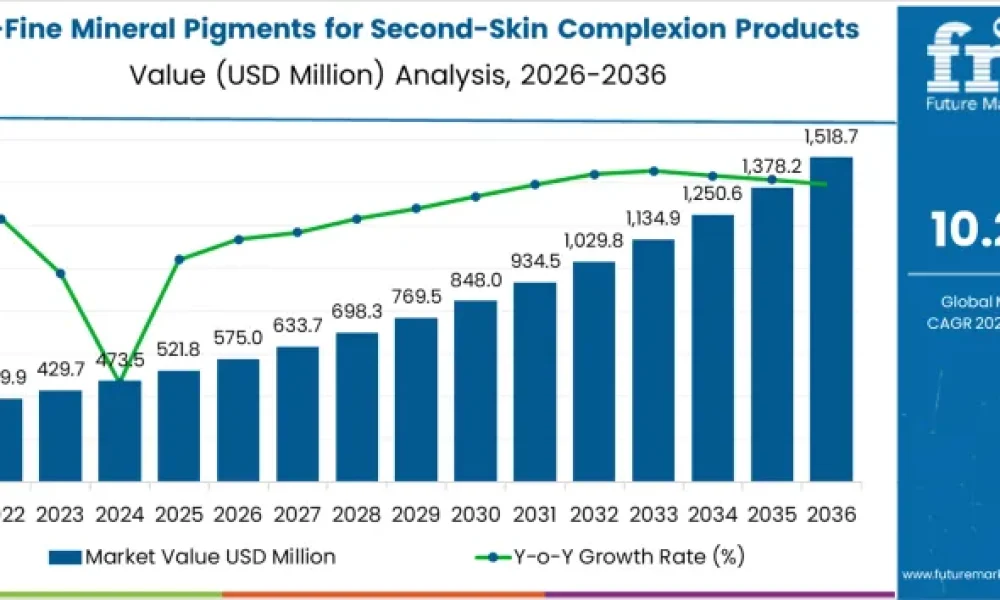
The global Ultra-Fine Mineral Pigments for Second-Skin Complexion Products Market is entering a high-growth phase, supported by the beauty industry’s structural shift toward lightweight, breathable, and skin-like makeup. Valued at USD 575.0 million in 2026, the market is projected to reach USD 1,518.7 million by 2036, expanding at a robust CAGR of 10.2%. Growth is being fueled not by volume expansion in color cosmetics, but by how complexion products are being repositioned as daily-wear essentials that merge skincare comfort with makeup performance.
Explore comprehensive market trends, regional outlooks, and competitive intelligence – Get a Sample Copy Now
Market Overview and Growth Outlook
Second-skin foundations, skin tints, BB and CC creams, and serum-based complexion products rely heavily on ultra-fine mineral pigment systems that deliver natural-looking coverage without visible buildup. Controlled particle size, high dispersion stability, and predictable light interaction have become critical value drivers. Manufacturers are increasingly reducing pigment load while maintaining optical correction, creating sustained demand for advanced mineral pigments designed for extended daily wear.
As consumers prioritize comfort, breathability, and subtle visual enhancement, repeat-use complexion categories are driving long-term demand stability. Ultra-fine mineral pigments enable seamless blending, smooth texture, and consistent shade fidelity across lighting conditions, reinforcing consumer loyalty and repeat purchases.
Why Demand for Ultra-Fine Mineral Pigments Is Rising
Global demand is accelerating due to a strong preference for lightweight, natural-finish cosmetics that feel invisible on the skin. Ultra-fine titanium dioxide, micronized iron oxides, mica derivatives, and silica-coated pigments allow formulators to create products that blur imperfections, enhance radiance, and maintain a skin-like appearance.
Additional growth drivers include:
- Rising skin health awareness and preference for breathable formulations
- Increased regulatory focus on ingredient safety, purity, and transparency
- Advances in surface treatment and dispersion technologies
- Rapid expansion of prestige, specialty, and online beauty retail channels
Together, these factors are encouraging both established manufacturers and emerging pigment innovators to invest in next-generation mineral technologies.
Key Market Segments
By Pigment System Type:
- Ultra-Fine Titanium Dioxide Pigments (32.0%) – Lead global demand due to superior light diffusion and opacity control
- Micronized Iron Oxide Pigments (30.0%) – Enable precise shade matching and undertone correction
- Silica-Coated Mineral Pigments (22.0%) – Improve dispersion, slip, and skin feel
- Multi-Mineral Blend Pigment Systems (16.0%) – Balance coverage, texture, and stability
By Application:
- Second-Skin Foundations (44.0%) – Dominant segment driven by demand for natural finish
- Skin Tint & Serum Makeup (28.0%) – Fast-growing hybrid formats with low pigment load
- Pressed & Loose Face Powders (18.0%) – Focus on blurring and soft-focus effects
- Professional HD Makeup Products (10.0%) – Require optical smoothness under high-resolution imaging
Regional and Country-Level Insights
Regions with humid climates, strong skincare-makeup convergence, and high digital visibility are witnessing steadier adoption. Asia Pacific leads global growth, supported by innovation-driven markets and expanding daily-use beauty routines.
Fastest-Growing Countries by CAGR:
- India – 11.0%: Driven by humid-climate suitability, rising daily-wear usage, and expanding domestic brands
- China – 10.7%: Supported by large-scale manufacturing, cushion foundations, and e-commerce-driven trends
- South Korea – 10.4%: Technology-led growth focused on texture engineering and minimalist aesthetics
- USA – 9.9%: Clean beauty positioning, ingredient scrutiny, and skin comfort expectations
- France – 9.6%: Dermocosmetic influence, pharmacy distribution, and EU regulatory alignment
Competitive Landscape and Innovation Focus
The competitive environment includes global leaders and new technology-driven players investing in particle engineering, dispersion science, and scalable production capabilities. Sensient Technologies, Clariant AG, BASF SE, DSM-Firmenich, and Sun Chemical (DIC Group) hold strong positions by offering ultra-fine mineral pigments optimized for second-skin effects, high transparency, and consistent batch quality.
At the same time, emerging manufacturers are entering the market with advanced micronization, surface treatment, and multi-mineral blending technologies, aiming to expand their global footprint and partner with indie, clean beauty, and prestige brands. Competitive differentiation increasingly depends on innovation speed, regulatory compliance, sensory performance, and the ability to support both mass-market and premium product launches.
Future Outlook
Looking ahead to 2036, the Ultra-Fine Mineral Pigments for Second-Skin Complexion Products Market will continue to benefit from evolving makeup routines that prioritize comfort, authenticity, and skin health. Suppliers capable of delivering consistent fineness, stable dispersion, and reliable optical performance at scale are expected to capture the greatest value. As established players refine their portfolios and new entrants introduce disruptive technologies, the market is set to remain a key innovation hub within the global cosmetics industry.
Have a specific Requirements and Need Assistant on Report Pricing or Limited Budget please contact us – [email protected]
About Future Market Insights (FMI)
Future Market Insights, Inc. (FMI) is an ESOMAR-certified, ISO 9001:2015 market research and consulting organization, trusted by Fortune 500 clients and global enterprises. With operations in the U.S., UK, India, and Dubai, FMI provides data-backed insights and strategic intelligence across 30+ industries and 1200 markets worldwide.



