
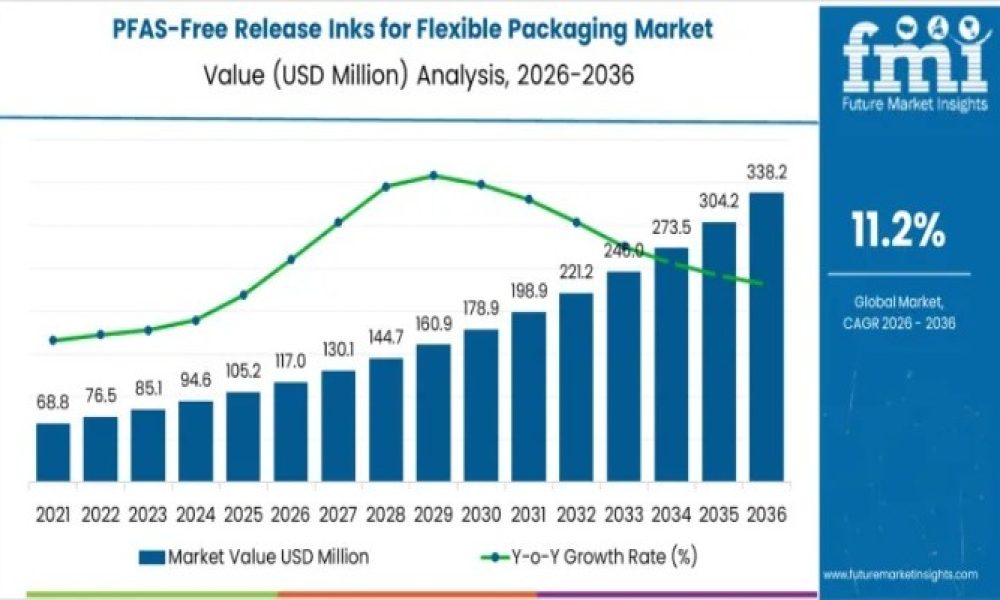
The global PFAS-free release inks for Flexible Packaging Market is entering a decisive decade of transformation as regulatory pressure, brand-owner compliance commitments, and advances in ink chemistry converge to reshape the production of flexible packaging worldwide. Valued at USD 117 million in 2026, the market is projected to reach USD 338.2 million by 2036, expanding at a robust CAGR of 11.2%. This growth trajectory reflects not just rising demand, but a fundamental shift in how packaging manufacturers, ink suppliers, and converters manage chemical safety, operational reliability, and long-term business risk.
Unlike conventional growth stories driven by price or aesthetic differentiation, the PFAS-free release inks market is being shaped by compliance certainty and process continuity. Packaging buyers are prioritizing inks that eliminate per- and polyfluoroalkyl substances (PFAS) while maintaining consistent release performance across high-speed converting and printing lines.
Discover Growth Opportunities in the Market – Get Your Sample Report Now
Quick Market Snapshot
- Market Value (2026): USD 117 million
- Forecast Value (2036): USD 338.2 million
- Forecast CAGR (2026–2036): 11.2%
- Leading Packaging Format: Flexible pouches
- Key Growth Regions: Asia Pacific, Europe, North America
- Key Players: Sun Chemical (DIC), Siegwerk, Flint Group, INX International, Hubergroup
Market Outlook: Growth Shaped by Regulation and Reliability
Between 2026 and 2031, the PFAS-free release inks market grows from USD 117 million to USD 176 million, adding nearly USD 59 million in incremental value. This early growth phase is defined by food safety scrutiny, regulatory substitution pressure, and qualification cycles.
Historically, adoption was limited by the lack of viable non-fluorinated alternatives that could match the low surface energy and predictable release behavior of PFAS-based systems. That constraint is now easing as suppliers introduce reformulated inks capable of stable performance on modern flexographic and gravure presses.
From 2031 to 2036, growth accelerates significantly. Market value rises from USD 176 million to USD 338.2 million, adding more than USD 166 million during the period. This expansion reflects broader adoption across mainstream flexible packaging formats, rather than niche or pilot applications. As PFAS-free release inks become embedded in approved print specifications and customer qualification files, they transition from alternative materials to standard inputs in flexible packaging operations.
Key Drivers Influencing Demand
Demand for PFAS-free release inks is fundamentally driven by risk management rather than incremental performance gains. Brand owners and converters face increasing scrutiny over chemical migration, environmental persistence, and recyclability. Legacy fluorinated release inks have triggered compliance failures in food-contact packaging, prompting rapid substitution in sensitive categories such as baby food, pharmaceuticals, and ready-to-eat products.
Primary demand drivers include:
- Regulatory restrictions on PFAS in food-contact and consumer packaging
- Procurement specifications tied to safety documentation and audit readiness
- Improved polymer and additive technologies enabling PFAS-free release behavior
- Operational need for compatibility with existing high-speed printing lines
Switching costs remain high due to retesting, customer approvals, and press recalibration. As a result, suppliers that deliver repeatable performance and regulatory confidence benefit from strong customer retention and pricing stability.
Packaging Format and Ink Technology Leadership
Why Flexible Pouches Lead Demand
Flexible pouches account for approximately 34% of total demand, reflecting their dominance in food, personal care, and household packaging. Pouches rely heavily on release inks for machinability, sealing performance, and controlled opening. Their high production volumes and direct food-contact exposure make them a priority format for PFAS-free conversion.
Other formats—such as wraps, films, bags, sachets, labels, and sleeves—contribute secondary demand, but adoption is more selective based on functional need and unit economics.
Ink Technology Trends
- Water-based PFAS-free release inks lead the market with about 42% share, driven by:
- Regulatory compliance
- Low odor and safer handling
- Compatibility with existing flexographic equipment
- Solvent-based inks offer durability on challenging substrates but face emission constraints
- UV and EB-curable inks provide fast curing but require higher capital investment
- Bio-based inks support sustainability positioning but face consistency challenges
Leadership in ink technology is defined by scalability and regulatory alignment, not maximum release efficiency alone.
Regional Growth Dynamics
- India (CAGR 13.5%) leads growth, driven by rapid flexible packaging expansion and rising chemical safety awareness
- China (12.8%) benefits from large-scale packaging production and tightening environmental regulations
- Germany (12.5%) reflects strict regulatory enforcement and demand for high-quality, compliant inks
- United States (11.0%) shows strong adoption in food and personal care packaging
- Japan (10.5%) emphasizes precision, quality, and regulatory discipline
Each region demonstrates distinct adoption patterns, balancing volume growth with compliance and operational priorities.
Competitive Landscape: Innovation under Constraint
Competition in the PFAS-free release inks market is shaped by how effectively suppliers replicate fluorinated release functionality without disrupting print quality or press efficiency.
Key competitive strategies include:
- Sun Chemical (DIC) and Siegwerk focusing on alternative polymer architectures and surface energy control
- Flint Group supporting converters through system-wide ink transitions and requalification
- INX International emphasizing press-side robustness across diverse substrates
- Hubergroup leveraging formulation discipline and strong compliance documentation
For both established leaders and emerging manufacturers, success depends on minimizing disruption during regulatory-driven changeovers while delivering consistent, validated performance.
Why FMI: https://www.futuremarketinsights.com/why-fmi
About Future Market Insights (FMI)
Future Market Insights, Inc. (FMI) is an ESOMAR-certified, ISO 9001:2015 market research and consulting organization, trusted by Fortune 500 clients and global enterprises. With operations in the U.S., UK, India, and Dubai, FMI provides data-backed insights and strategic intelligence across 30+ industries and 1200 markets worldwide.



