
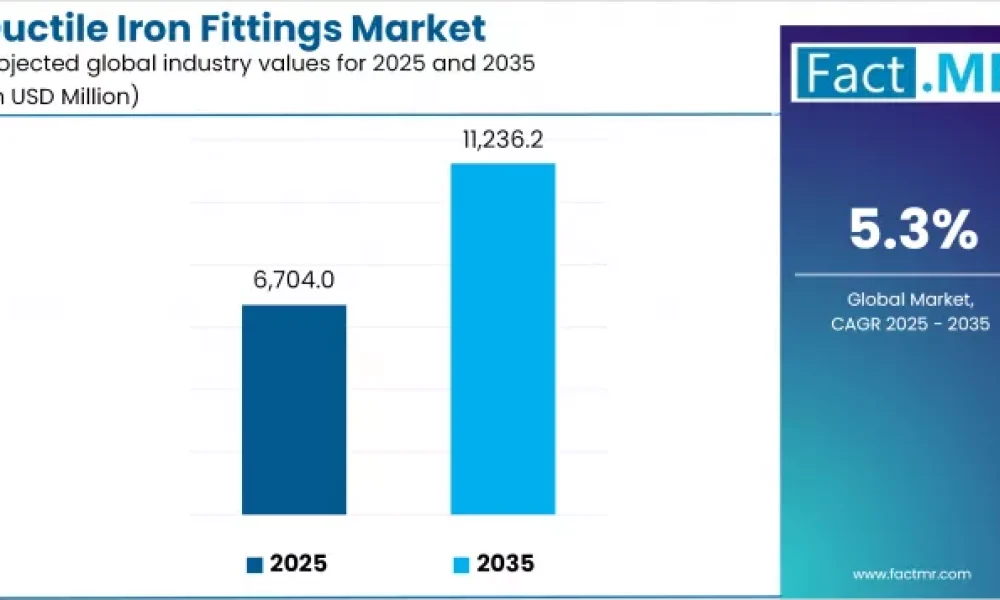
The Global Ductile Iron Fittings Market is poised for sustained growth through 2036, supported by ongoing infrastructure expansion, critical water management upgrades, and industrial demand across emerging and developed regions. The global market value, which stood at approximately USD 6.7 billion in 2025, is expected to grow robustly over the coming decade. Extrapolating existing trends to 2036 suggests continued upward momentum, driven by urban growth, infrastructure modernization, and industrial pipeline needs.
Key Market Projections (2025–2035)
2025 market value: ≈ USD 6,704 million
2035 projected value: ≈ USD 11,236 million
CAGR (2025–2035): ~5.3% annually
These figures indicate a strong expansion trajectory likely extending into 2036.
To access the complete data tables and in-depth insights, request a Discount On The Report here: https://www.factmr.com/connectus/sample?flag=S&rep_id=10991
🧩 Strategic Benchmarking: Competitive Landscape & Growth Drivers
Market Drivers
Municipal Water Infrastructure – Rising investment in reliable water supply and sewage systems drives demand for ductile iron fittings due to their durability and high-pressure performance.
Industrial End-Use Demand – Industries such as mining, power, and chemical processing rely on ductile iron fittings for handling aggressive fluids and high-pressure conditions.
Rehabilitation of Aging Systems – Replacement of aging infrastructure in mature markets sustains steady demand, as ductile iron fittings offer long-term reliability.
Benchmarking by Product Type
The ductile iron fittings segment includes multiple product types:
Socket fittings dominate the market due to ease of installation and strong high-pressure performance.
Mechanical joint fittings and push-on fittings are among the fastest-growing categories, driven by demand for efficient, flexible installation solutions in municipal and industrial pipelines.
Competitive Landscape & Key Players
The global market features several major manufacturers competing on technological innovation, quality, and geographic presence. Leading players include:
American Cast Iron Pipe Company
Tata Steel
Electrosteel Castings Limited
Asc Engineered Solutions
SIP Industries
China National Building Material Company Limited
Sahara Pipes
These companies enhance portfolios through product diversification, capacity expansion, and sustainable manufacturing practices. Large-scale modernization and efficiency-focused investments are key strategies for maintaining competitive advantage.
💹 Pricing Trends & Cost Dynamics
Raw Material Price Volatility
Fluctuations in the cost of iron and steel directly affect production costs, contract pricing, and manufacturer margins, as ductile iron fittings are material-intensive.
Competitive Pressure from Substitutes
Materials such as PVC and HDPE, offering lower upfront costs and easier installation, exert downward pricing pressure in moderate-demand applications, forcing manufacturers to balance durability premiums with competitive pricing strategies.
Value Proposition & Lifecycle Costing
Despite higher initial costs, ductile iron fittings often outperform alternatives in lifecycle value, especially in high-stress applications. This sustains premium pricing in water utility and industrial segments where reliability is critical.
📍 Regional Hotspots & Growth Patterns
Asia-Pacific: The Growth Epicenter
The Asia-Pacific region is the fastest-growing and most attractive market. Urban population growth, large-scale water and wastewater projects, and government-backed infrastructure programs in China and India are major catalysts. China is projected to grow at ~6.2% CAGR, while India is expected at around 6.4% CAGR through the forecast period.
India & China — Dual Growth Engines
India: Rapid urbanization and smart city initiatives drive utility expansions. Domestic manufacturing is scaling to meet both domestic consumption and export demands.
China: Massive investment in water networks and sustainable resource infrastructure makes it a major consumer and exporter of ductile fittings.
North America & Europe: Replacement-Driven Markets
North America: Growth is primarily through infrastructure replacement, environmental regulation compliance, and modernization initiatives. Utilities prioritize long-term durability over short-term cost savings.
Europe: Highly regulated construction standards and replacement of aging systems sustain steady demand, though growth rates are moderate compared to Asia-Pacific.
Middle East & Africa
Emerging infrastructure builds, particularly for water distribution and irrigation systems, drive adoption. Urban expansion and climate resilience strategies underpin growing demand.
🚧 Market Challenges & Risks
High Initial Cost Barriers
Upfront costs for ductile iron fittings are higher than many polymer-based alternatives, potentially deterring price-sensitive infrastructure projects in some emerging economies.
Raw Material Volatility
Iron and steel price fluctuations remain a key risk factor, with supply chain disruptions and commodity swings creating unpredictable pricing pressures.
Competitive Material Substitutes
Plastic and composite alternatives continue to pose competitive threats, particularly in applications where corrosion resistance and high-pressure resistance are less critical.
📌 Summary
By 2036, the ductile iron fittings market is expected to maintain steady growth supported by:
Strategic infrastructure investments globally
Strong emerging market demand, especially in Asia-Pacific
Technological and product advancements
Continued adoption in industrial and municipal applications
Market leaders that strategically optimize pricing structures, cost management, and regional penetration, particularly in high-growth Asia and replacement-oriented developed markets, are likely to maintain a competitive edge through 2036.
Have a specific Requirements and Need Assistant on Report Pricing or Limited Budget please contact us – [email protected]
To View Related Report :
Ductile Iron Pipe Industry Analysis in Middle East & Africa https://www.factmr.com/report/ductile-iron-pipe-industry-analysis-in-middle-east-and-africa
Ductile Iron Pipe Industry Analysis in East Asia https://www.factmr.com/report/ductile-iron-pipe-industry-analysis-in-east-asia
Ductile Iron Pipe Industry Analysis in South Asia & Oceania https://www.factmr.com/report/ductile-iron-pipe-industry-analysis-in-south-asia-and-oceania
Ductile Iron Pipe Industry Analysis in Europe https://www.factmr.com/report/ductile-iron-pipe-industry-analysis-in-europe



