
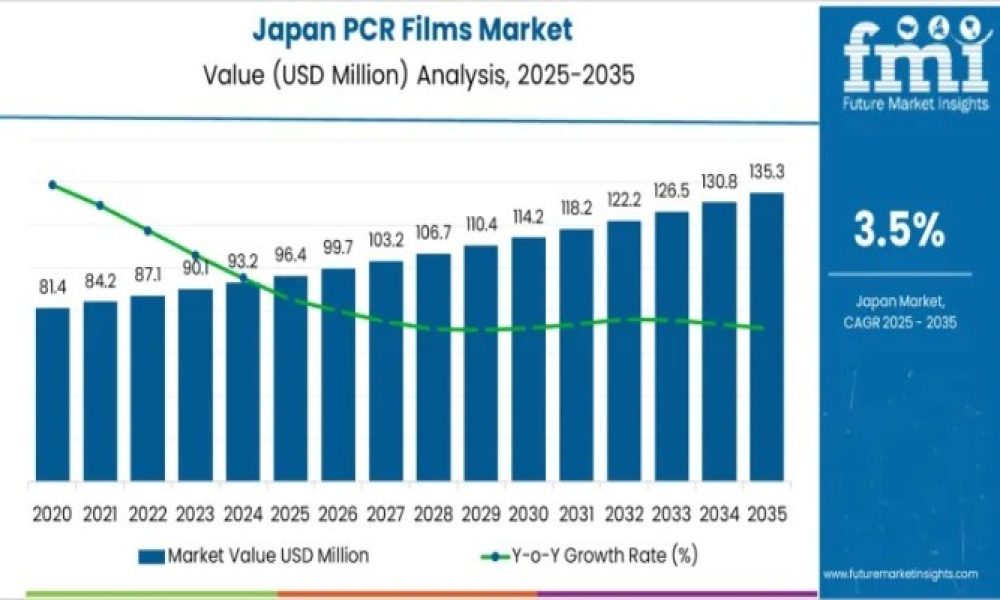
Demand for post-consumer recycled (PCR) films in Japan is entering a decade of steady, compliance-driven growth as packaging sustainability shifts from pilot initiatives to standardized procurement practice. Valued at USD 96.4 million in 2025, the Japan PCR films market is projected to reach USD 135.3 million by 2035, expanding at a compound annual growth rate (CAGR) of 3.5%. Growth is shaped less by packaging volume expansion and more by structured material substitution, recycled content mandates, and improvements in domestic recycling throughput.
Japan’s PCR films industry is organized around PET, HDPE, LDPE, PS, and PVC, with PET and HDPE forming the backbone of rigid and semi-rigid packaging formats. These materials are widely used across bottles, trays, and clamshells, which together represent the most consistent consumption base. Food and beverage packaging remains the largest application segment, supported by stable demand from pharmaceuticals and cosmetics and personal care products, where compliance, traceability, and barrier performance remain non-negotiable.
Subscribe for Year-Round Insights → Stay ahead with quarterly and annual data updates – https://www.futuremarketinsights.com/reports/sample/rep-gb-29601
Market Momentum Anchored in Predictable Packaging Cycles
Between 2025 and 2030, demand for PCR films in Japan is expected to rise from USD 96.4 million to USD 110.4 million, delivering a net gain of USD 14.0 million. This phase reflects incremental adoption rather than disruptive capacity shifts. Major converters continue to convert existing production lines to accommodate higher recycled content, guided by internal brand mandates, retailer packaging scorecards, and export compliance requirements. Snack foods, daily-use consumer goods, refill packs, and household products remain core volume drivers during this period.
From 2030 to 2035, market expansion accelerates as demand grows from USD 110.4 million to USD 135.3 million, adding USD 24.9 million in incremental value. Annual value additions increase steadily as high-clarity PCR films gain broader acceptance in premium packaging and as multinational sustainability targets are applied more uniformly to Japan-based operations. Improvements in resin sorting efficiency and polymer reprocessing quality further support this upward trend.
PET Leads as the Preferred PCR Film Material
By material, PET accounts for 38% of PCR film demand in Japan, reflecting its entrenched role in food trays, beverage packaging, and thermoformed containers where clarity, strength, and dimensional stability are critical. PET’s compatibility with Japan’s established closed-loop recycling systems makes it the most scalable PCR option for converters seeking consistency in quality and supply.
Procurement of PCR PET films is typically contract-based, with converters prioritizing thickness uniformity, migration control, and heat-sealing performance over short-term price advantages. Certification requirements remain stringent, especially for food-contact applications, reinforcing long-term sourcing relationships and controlled margin structures.
Trays Dominate Application Demand
By application, trays represent 36.4% of PCR film demand in Japan, driven by their central role in ready meals, seafood, meat, and fresh produce packaging. High turnover in food retail ensures continuous consumption, while failure risks—such as leakage or seal breakdown—keep specification standards tight. Buyers favor standardized tray formats to minimize tooling changes and waste, reinforcing repeat procurement cycles.
Blister packs, bags, bottles, and clamshells support secondary demand flows, particularly in pharmaceuticals, cosmetics, and personal care packaging, where recycled content adoption is expanding cautiously in line with regulatory and performance constraints.
Regional Demand Concentrated in Industrial and Urban Hubs
Geographically, demand is concentrated in Kanto and Chubu, reflecting dense clusters of food processing, pharmaceutical manufacturing, and contract packaging activity. However, Kyushu and Okinawa are emerging as the fastest-growing regions, posting a 4.3% CAGR through 2035, supported by expanding packaging capacity and rising sustainability-driven material substitution.
- Kanto (4.0% CAGR) benefits from high-volume converters, multinational brand operations, and advanced recycling infrastructure.
- Kinki (3.5% CAGR) shows balanced growth across food, pharma, and personal care packaging.
- Chubu (3.1% CAGR) is supported by pharmaceutical manufacturing and industrial packaging demand.
- Tohoku and the rest of Japan grow more gradually due to lower converter density and longer procurement cycles.
Supply Dynamics and Competitive Positioning
Supply conditions in Japan remain closely linked to domestic recycling throughput and polymer reprocessing efficiency, which directly influence pricing stability and grade availability. Competitive differentiation increasingly depends on resin purity consistency, certification readiness, and compatibility with high-speed thermoforming and vacuum forming lines, rather than aggressive price competition.
Key suppliers active in the Japanese market include National Scientific, Vitl Life Science Solutions, BioPointe Scientific, Eppendorf, and Brooks Life Sciences SSIbio, supported by domestic distributors with strong compliance documentation and inventory management capabilities. Buyers consistently favor suppliers offering stable lot-to-lot quality, Japanese-language technical support, and predictable lead times.
Outlook: Compliance-Led Growth Through 2035
By 2035, demand for PCR films in Japan will be governed primarily by packaging compliance frameworks and converter-level material substitution, rather than consumer-driven redesign cycles. While challenges remain—such as contamination control, limited high-grade PCR feedstock, and strict appearance standards—the market’s trajectory is firmly anchored in long-term sustainability commitments rather than short-term trends.
As Japan continues to balance recycled content mandates with its globally recognized packaging quality standards, PCR films are set to remain a core material solution across food, pharmaceutical, and personal care packaging, delivering steady, resilient growth through the next decade.
Why FMI: https://www.futuremarketinsights.com/why-fmi
About Future Market Insights (FMI)
Future Market Insights, Inc. (FMI) is an ESOMAR-certified, ISO 9001:2015 market research and consulting organization, trusted by Fortune 500 clients and global enterprises. With operations in the U.S., UK, India, and Dubai, FMI provides data-backed insights and strategic intelligence across 30+ industries and 1200 markets worldwide.



