
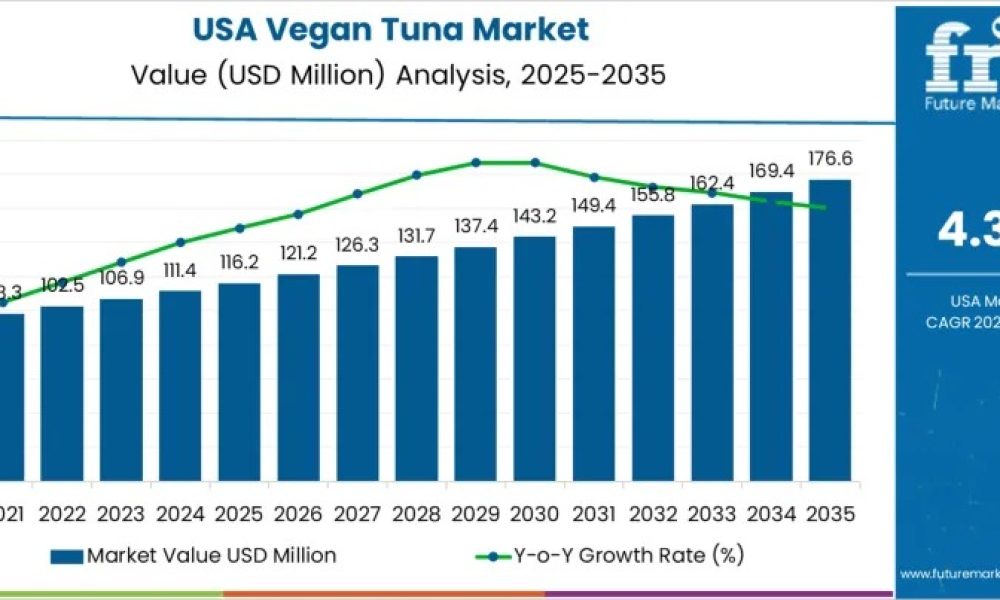
The USA vegan tuna market is witnessing steady growth, with demand expected to rise from USD 116.2 million in 2025 to USD 176.6 million by 2035, reflecting a CAGR of 4.3%. This growth is driven by shifting consumer preferences toward plant-based diets, heightened awareness of marine sustainability, and growing concerns over mercury exposure and overfishing associated with conventional tuna.
Plant-based alternatives aim to replicate traditional tuna’s shredded texture, taste, and nutritional profile, meeting the increasing demand in sandwiches, salads, sushi, and ready-to-eat meal kits. Manufacturers continue to innovate, blending plant proteins and natural flavor enhancers to ensure familiar eating experiences.
Explore trends before investing – request a sample report today! https://www.futuremarketinsights.com/reports/sample/rep-gb-29549
Soy-based protein currently dominates vegan tuna production due to its cost-efficiency, high protein content, and ability to maintain structural integrity across cold and ambient applications. Meanwhile, pea protein and blended formulations are gaining traction, supporting cleaner-label initiatives and allergen reduction strategies. Stable pricing and diversified supply chains further solidify soy’s preference as the base ingredient for commercial vegan tuna products.
Demand is strongest in the West, South, and Northeast, fueled by coastal consumption patterns, retail penetration, and regional distribution networks for alternative proteins. Key suppliers, including Good Catch Plant-Based Tuna, Sophie’s Kitchen Plant-Based Toona, Loma Linda TUNO, Vegan ZeaStar’s Tuna, and Worthington Meatless Tuna, are expanding access beyond niche vegan channels by integrating products into ready-meal offerings and partnering with foodservice operators.
Quick Stats for USA Vegan Tuna Demand
- Sales Value (2025): USD 116.2 million
- Forecast Value (2035): USD 176.6 million
- Forecast CAGR (2025-2035): 4.3%
- Leading Source: Soy-Based Protein
- Key Growth Regions: West, South, Northeast
- Top Players: Good Catch, Sophie’s Kitchen, Loma Linda, Vegan ZeaStar, Worthington Meatless Tuna
Vegan tuna contributes moderately to the broader plant-based seafood segment. Growth is primarily driven by retail channels where canned and pouch formats replicate traditional tuna use cases. Fast-casual and foodservice adoption is growing, particularly in coastal metros with higher concentrations of flexitarian and vegan consumers.
However, market penetration remains limited due to higher price points, texture replication challenges, and consumer unfamiliarity. Mainstream grocery adoption is slower, constrained by specialty store concentration and limited brand availability.
As production scales and consumer messaging highlights sustainability, convenience, and protein equivalence, future adoption is expected to accelerate. Plant-based seafood options are diversifying rapidly, with vegan tuna increasingly considered both a dietary substitute and a convenient alternative to conventional tuna.
By Source:
- Soy-based protein: 33% – high protein digestibility, neutral taste, scalable production
- Wheat: 24% – familiar texture, not gluten-free
- Seaweed: 17% – premium flavor authenticity, omega content
- Yeast: 14% – allergen alternative
- Lentils: 12% – allergen-friendly, niche use
By Application:
- Other ready meals: 39% – wraps, burritos, sushi rolls
- Noodles: 24% – retail-ready bowls, Asian-inspired dishes
- Spreads: 16.5% – sandwiches, lunchbox convenience
- Salads: 12% – traditional tuna usage
- Pies: 8.5% – seasonal or specialty offerings
By Distribution Channel:
- Supermarkets: 35% – mainstream accessibility
- Convenience stores: 32% – grab-and-go formats
- Online retail: 19% – subscriptions, direct-to-consumer
- Specialty stores: 14% – premium, allergen-free SKUs
Key Trends and Drivers:
- Growing flexitarian and health-conscious populations
- Increased shelf space in supermarkets and natural grocers
- Ready-to-eat meal adoption
- Advances in plant protein processing for texture and flavor replication
- Sustainability and ocean-friendly messaging
Regional Insights:
- West USA: 4.9% CAGR – strong plant-based adoption, innovation clusters, coastal consumer trial
- South USA: 4.4% CAGR – flexitarian growth, private-label expansion, cold-chain retail
- Northeast USA: 3.9% CAGR – urban retail density, sustainability-focused buyers
- Midwest USA: 3.4% CAGR – family-oriented, mainstream grocery penetration
Subscribe for Year-Round Insights → Stay ahead with quarterly and annual data updates. https://www.futuremarketinsights.com/reports/brochure/rep-gb-29549
Competitive Landscape:
Good Catch Plant-Based Tuna leads with ~33.8% market share, driven by broad retail presence and diversified flavor lines. Sophie’s Kitchen, Loma Linda, Worthington, and ZeaStar compete through niche positioning, allergen-conscious products, and price-competitive SKUs. Success depends on taste fidelity, texture quality, ingredient transparency, and distribution efficiency.
As consumers prioritize plant-based, sustainable, and mercury-free alternatives, the vegan tuna market in the USA is poised for steady growth. Retailers and foodservice operators embracing these products benefit from increasing flexitarian adoption and evolving dietary preferences, while manufacturers continue to refine formulations to deliver authentic taste and texture.
About Future Market Insights (FMI)
Future Market Insights, Inc. (FMI) is an ESOMAR-certified, ISO 9001:2015 market research and consulting organization, trusted by Fortune 500 clients and global enterprises. With operations in the U.S., UK, India, and Dubai, FMI provides data-backed insights and strategic intelligence across 30+ industries and 1200 markets worldwide.



