
The European packaging industry is undergoing a fundamental transformation as sustainability, circularity, and regulatory compliance become non-negotiable priorities. Among the most dynamic developments is the rise of food-grade recycled polypropylene (rPP) derived from household rigid packaging.
With regulators tightening recycled-content mandates and brand owners accelerating commitments to circular packaging, food-grade rPP has moved from a niche solution to a strategic material for the future of food-contact applications. Between 2026 and 2036, this market is set to witness strong, regulation-led growth, reshaping polypropylene value chains across Europe.
Subscribe for Year-Round Insights → Stay ahead with quarterly and annual data updates – https://www.futuremarketinsights.com/reports/sample/rep-gb-29805
Meaning and Market Definition
Food-grade rPP from household rigid packaging refers to post-consumer polypropylene waste—such as tubs, containers, caps, and closures—collected primarily from household waste streams and recycled through advanced processes to meet EU food-contact safety standards. Unlike conventional recycled plastics, food-grade rPP must comply with strict European Food Safety Authority (EFSA) criteria, including limits on chemical migration, odor neutrality, and traceability of feedstock.
This segment plays a critical role in enabling closed-loop recycling systems for rigid food packaging, allowing recycled material to re-enter high-value applications such as dairy containers, ready-meal trays, and beverage closures.
Market Outlook (2026–2036)
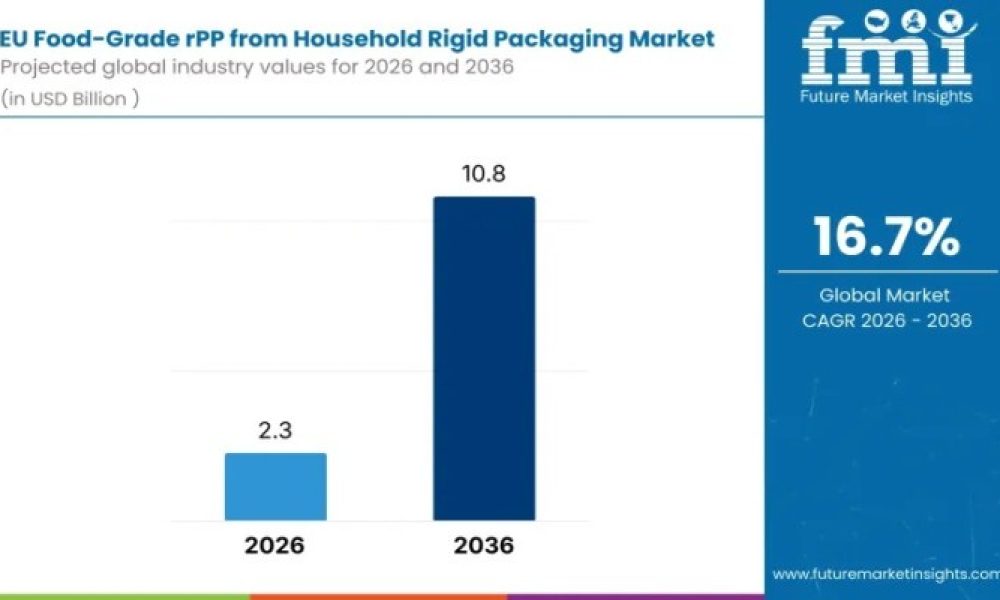
The EU food-grade rPP from household rigid packaging market is valued at USD 2.3 billion in 2026 and is projected to reach USD 10.8 billion by 2036, expanding at a robust CAGR of 16.7% over the forecast period. This rapid growth reflects the convergence of regulatory pressure, technological advancement, and shifting brand-owner strategies.
European policies, particularly those aligned with the Packaging and Packaging Waste Regulation (PPWR), are mandating higher recycled-content thresholds for food-contact packaging while restricting landfill disposal. As virgin polypropylene faces scrutiny due to its carbon footprint and price volatility, certified food-grade rPP is emerging as a reliable and compliant alternative.
Market Overview
Household rigid polypropylene packaging waste represents the largest and most scalable feedstock source for food-grade rPP in Europe. This stream benefits from high collection rates via kerbside systems, relatively standardized packaging formats, and compatibility with modern sorting and decontamination technologies.
Advanced recycling infrastructure—including hot-wash systems, melt filtration, extrusion, and high-performance deodorization units—has significantly improved the quality and consistency of recycled PP. Enhanced purification and traceability protocols now enable recyclers to produce EFSA-compliant material suitable for direct food contact.
Brand owners across food, dairy, and ready-meal segments are increasingly prioritizing mono-material PP packaging to improve recyclability and secure access to high-quality rPP supply.
Growth Drivers
Several structural factors are driving sustained growth in the EU food-grade rPP market:
- Regulatory mandates enforcing recycled-content targets in food packaging
- PPWR-aligned circularity goals encouraging closed-loop packaging systems
- Technological advancements in sorting, washing, and decontamination
- Rising brand commitments to reduce virgin plastic usage
- Improved traceability and certification frameworks for food-grade recyclates
Together, these drivers are accelerating investments in food-grade rPP production capacity and strengthening demand across the EU packaging ecosystem.
Demand Analysis
Demand for food-grade rPP in Europe is closely linked to compliance requirements and the maturity of collection and recycling systems. Buyers evaluate recyclate based on feedstock purity, odor control, mechanical performance, and regulatory approval.
- Household rigid PP packaging waste accounts for 47.9% of EU demand, making it the dominant source stream.
- Commercial and industrial rigid PP waste offers cleaner but lower-volume inputs.
- Deposit-return systems provide premium-quality PP feedstock with minimal contamination, supporting high-end food-contact applications.
On the processing side, mechanical recycling dominates with a 44.6% share, supported by advanced washing and deodorization technologies. Chemical and hybrid recycling processes complement mechanical routes by addressing heavily contaminated or complex rigid PP formats.
Application Trends
Food and beverage containers represent the largest application segment, accounting for 45.3% of total demand. These applications require consistent resin quality, predictable molding performance, and strict compliance with food-contact regulations.
- Dairy and yogurt cups depend on odor-neutral, color-stable rPP
- Caps and closures require stiffness and dimensional precision
- Ready-meal trays demand heat resistance and low migration levels
The broad adoption of food-grade rPP across these formats underscores its growing acceptance as a mainstream packaging material rather than a compromise solution.
Emerging Trends
Key trends shaping the EU food-grade rPP market include:
- Upgraded optical and digital sorting systems improving PP capture rates
- Mono-material packaging design aligned with recycling infrastructure
- Closed-loop partnerships between FMCG brands and recyclers
- Expansion of traceability systems to support audits and certification
- Hybrid recycling models balancing cost efficiency with purity
These trends reflect a shift from volume-driven recycling toward quality-driven circularity, especially for food-contact applications.
Global Demand Influences
While Europe remains the focal point, global markets influence demand dynamics. China, India, the USA, and Japan are emerging as strong demand influencers due to investments in recycling technology and cross-regional circular PP value chains.
- China leads with a 17.8% CAGR, driven by advanced sorting and decontamination infrastructure
- India follows at 17.2% CAGR, supported by rigid packaging growth and EPR initiatives
- The USA records 16.1% CAGR, reflecting modernization of PP recovery systems
- Japan maintains 15.0% CAGR, emphasizing precision recycling and material quality
- The UK shows 14.3% CAGR, aligned with EU-style circular economy policies
Competitive Landscape
The competitive landscape of the EU food-grade rPP market is defined by technological capability, feedstock control, and certification readiness. Key players focus on delivering consistent, high-purity rPP suitable for food-contact applications.
- Borealis advances food-grade rPP through partnerships and advanced mechanical recycling platforms
- Interzero leverages integrated collection and sorting systems to supply high-purity rigid PP fractions
- Faerch Group supports closed-loop circular packaging programs for food-grade applications
- Veolia operates large-scale rigid plastics processing facilities with upgraded washing and sorting lines
- Plastika Skaza contributes through innovation-driven rPP solutions for sustainable packaging
Competition increasingly centers on the ability to meet PPWR targets, maintain traceability, and ensure reliable long-term supply for converters and brand owners.
Why FMI: https://www.futuremarketinsights.com/why-fmi
About Future Market Insights (FMI)
Future Market Insights, Inc. (FMI) is an ESOMAR-certified, ISO 9001:2015 market research and consulting organization, trusted by Fortune 500 clients and global enterprises. With operations in the U.S., UK, India, and Dubai, FMI provides data-backed insights and strategic intelligence across 30+ industries and 1200 markets worldwide.



