
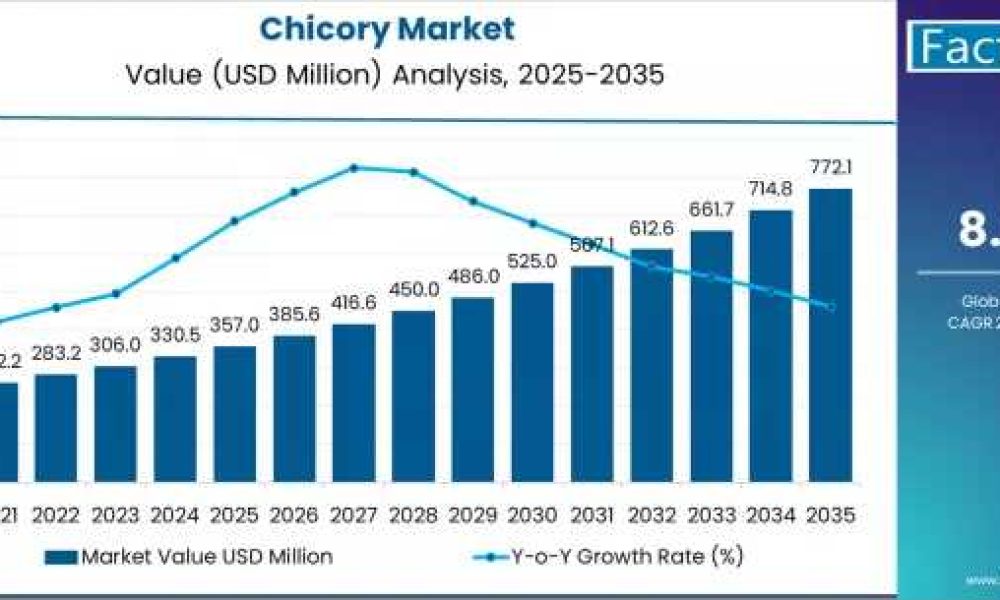
The global chicory market is projected to grow from about USD 357.0 million in 2025 to USD 772.1 million by 2035, implying a CAGR of ~8.0%. In the U.S., consumption volume is expected to reach ~1.1 K tons by 2035, up from ~1.0 K tons in 2024, with a wholesale value of around USD 1.3 million, reflecting a volume CAGR of ~0.4% and a value CAGR of ~0.6%.
The U.S. chicory ingredients market size is expected to grow from USD 422.0 million in 2025 to USD 697.9 million by 2035, reflecting a CAGR of ~5.16%. Different segments of the market show different growth patterns; while global chicory (all uses) may grow rapidly, the U.S. shows modest expansion in raw consumption volume but stronger growth in processed ingredients.
📦 Key Market Segments & Product Types
Root vs other plant parts: Root-derived chicory dominates the market, with roasted root pieces and root-derived inulin or fibers widely used for their functional properties, such as prebiotic fiber and caffeine-free coffee alternatives.
Application segments: The largest application is Food & Beverages, which accounts for approximately 62–69% of total chicory consumption, including roasted chicory coffee substitutes, fiber-fortified foods, snacks, and functional food products.
Functional ingredients & dietary supplements: Use of chicory-derived inulin, fiber, and prebiotic formulations is growing, especially in dietary supplements and fiber-enriched foods.
Product innovation and processing formats: Advanced extraction technologies, clean-label formulations, organic certification, and refined chicory derivatives, such as high-purity inulin and fiber-rich ingredients, are expected to drive growth.
To access the complete data tables and in-depth insights, request a Discount On The Report here: https://www.factmr.com/connectus/sample?flag=S&rep_id=12030
✅ Key Growth Drivers for U.S. Chicory Market
Health consciousness and clean-label demand: Consumers are increasingly seeking natural, plant-based, fiber-rich, caffeine-free food and beverage options.
Digestive health and prebiotics: Chicory root’s inulin content supports gut health, fueling demand in dietary supplements, functional foods, and beverages.
Shift toward caffeine-free beverages: Roasted chicory coffee and similar beverages are becoming more appealing to health-conscious consumers.
Expansion of distribution channels & innovation: Growth in supermarkets, specialty stores, online retail, and product innovation allows chicory to penetrate new consumer segments.
Sustainability and natural ingredients: Consumers prefer plant-based and naturally derived ingredients over synthetic alternatives.
⚠️ Key Challenges and Market Restraints
Dependence on imports and limited domestic production: Domestic production is negligible, making the U.S. heavily reliant on imports, which increases supply-chain risk and price volatility.
Modest volume growth in raw consumption: Raw chicory consumption is projected to grow slowly (~0.4% CAGR), indicating limited expansion in conventional uses.
Price fluctuations and raw material constraints: Seasonal cultivation cycles and global supply constraints may cause price variability.
Need for consumer education: Awareness of chicory’s benefits remains low in some segments, necessitating marketing and education efforts.
📈 Market Outlook: What to Expect by 2035 (U.S. Focus)
The U.S. chicory ingredients market could grow to approximately USD 700 million by 2035, up from USD 422 million in 2025, with a CAGR of ~5.1%.
Demand for chicory-based dietary supplements, fiber-enriched foods, and caffeine-free beverages is expected to increase, driven by consumer health trends.
Roasted chicory coffee and blended beverages may gain traction as healthier lifestyle alternatives.
Growth in retail distribution and e-commerce will make chicory products more accessible to mainstream consumers.
Most growth will come from processed forms rather than raw material demand.
Supply-chain and import dependencies may drive emphasis on vertical integration, contract farming, and supplier diversification
🎯 Key Strategic Implications for Stakeholders
Ingredient manufacturers / suppliers: Investment in extraction technologies, clean-label certification, and product innovation is critical to meet growing demand.
Beverage companies / food-service players: Opportunities exist to expand chicory-based beverages targeting health-conscious and caffeine-averse consumers.
Retailers and distributors: Offering a broad range of chicory products, from health-food aisles to mainstream shelves, will capture more consumers.
Importers / supply-chain managers: Long-term contracts, diversified sourcing, and quality assurance are essential to manage risk.
Marketing teams: Education on chicory’s prebiotic, fiber, and caffeine-free benefits can drive adoption among consumers.
The U.S. chicory market is poised for moderate but steady growth over the next decade, driven primarily by processed ingredients and functional applications, despite slow growth in raw consumption. Companies that innovate in product development, distribution, and consumer education are likely to capture the largest share of the expanding market.
Have a specific Requirements and Need Assistant on Report Pricing or Limited Budget please contact us – [email protected]
To View Related Report :
Chicory Root Fiber Market https://www.factmr.com/report/chicory-root-fiber-market
Chicory Extract Market https://www.factmr.com/report/2894/chicory-extract-market



