
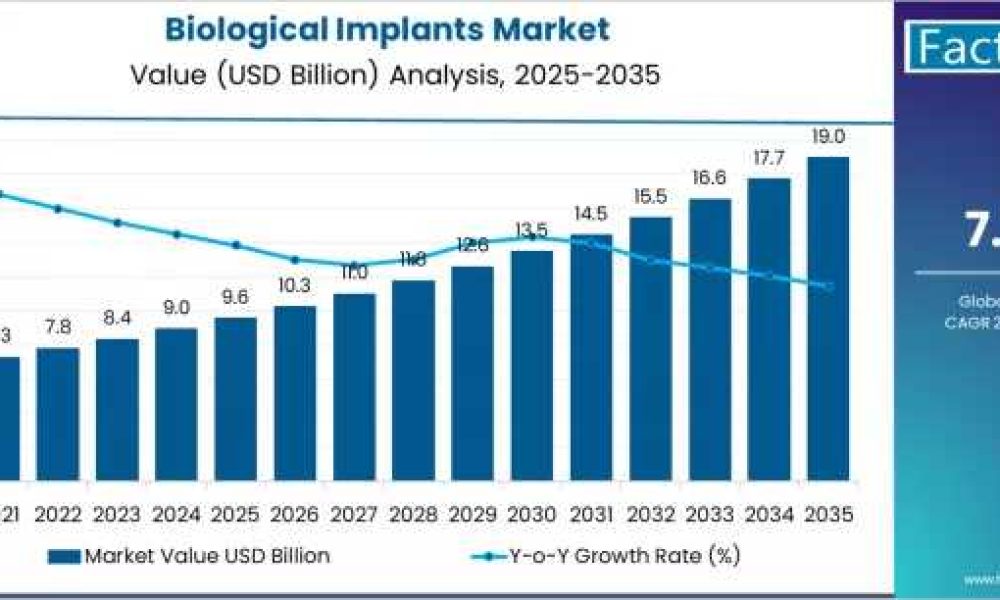
The U.S. biological implants market is entering a decade of accelerated transformation, driven by rising surgical volumes, demographic shifts, rapid innovation in regenerative technologies, and a broad shift toward biologically derived solutions that support faster healing and long-term integration. As the healthcare landscape continues to evolve, the period from 2025 to 2035 is expected to mark a pronounced growth phase across all major biological implant categories, including allografts, xenografts, bioengineered matrices, and advanced regenerative scaffolds.
Market Outlook (2025–2035)
The U.S. biological implants market has shown strong, steady expansion over the last several years, with revenue climbing in tandem with the recovery of elective procedures and increased surgeon preference for biologics over traditional synthetic implants. Between 2025 and 2035, analysts anticipate sustained mid-single-digit to high-single-digit annual growth as biologic solutions penetrate orthopedic, cardiovascular, dental, and wound-care applications more deeply. The shift in product mix toward bioactive and regenerative implants—many delivering higher clinical value—will also lift market value over the forecast period.
By 2035, biological implants are projected to represent a significantly larger share of the total surgical implant landscape in the U.S., supported by advancements in tissue engineering, better clinical outcomes data, and broader payor acceptance for proven regenerative modalities.
To access the complete data tables and in-depth insights, request a Discount On The Report here: https://www.factmr.com/connectus/sample?flag=S&rep_id=11906
Key Growth Drivers
1. Aging Population & Rising Disease Burden
The expanding older population is one of the strongest forces behind market expansion. As the incidence of musculoskeletal disorders, cardiovascular conditions, degenerative tissue damage, and dental bone loss increases, demand for biologic repair and replacement options rises in parallel. Surgical specialists in orthopedics, spine, cardiothoracic medicine, and maxillofacial surgery continue to report elevated case volumes, a trend expected to persist throughout the forecast window.
2. Increasing Clinician Adoption of Biologic Solutions
Across multiple surgical domains, clinicians are moving away from traditional synthetic implants in favor of biological materials that offer better integration, reduced rejection risk, and improved long-term functionality. Allografts and xenografts remain staples in bone, soft-tissue, and dental reconstruction, while advanced acellular matrices and engineered tissues are gaining traction for their consistency and regenerative potential. This shift reflects both improved patient outcomes and growing surgeon comfort with next-generation biologic technologies.
3. Regenerative Medicine Innovation
Tissue-engineered implants, cell-free scaffolds, decellularized matrices, and bioactive grafts represent the fastest-growing segment of the market. Innovations in manufacturing, sterility assurance, and biocompatibility have increased performance reliability, while ongoing R&D in regenerative healing continues to generate new applications. These advancements are expected to significantly expand the total addressable market over the next decade.
4. Technology Convergence: Smart, Connected Implants
A major transformation underway is the integration of sensing technologies into biological implants. Emerging “smart implant” platforms combine bioactive materials with micro-sensors and wireless communication capabilities, enabling remote monitoring of healing, load, pressure, temperature, and potential complications.
This convergence is opening a premium tier of biologic implants and complementary digital health services. Hospitals and manufacturers increasingly view data-enabled implants as the next frontier of long-term postoperative care.
5. Regulatory & Reimbursement Improvements
While biologics face higher development and validation requirements, recent years have brought clearer regulatory frameworks and improved reimbursement for well-validated biologic implants. Expanded clinical evidence, cost-effectiveness data, and standardized quality controls are accelerating product approvals and lowering barriers for providers.
Segment-by-Segment Insights
Orthopedics & Spine
Orthopedic reconstruction remains the largest and most mature biologic implant segment. Rising joint replacement volumes, greater use of biologic augmentation in ligament and tendon repair, and the expanding adoption of bone graft substitutes fuel continuous growth. Biological implants are increasingly used alongside synthetic devices to enhance stability, integration, and durability.
Dental & Oral Reconstruction
The dental implant ecosystem is undergoing a strong biologics-driven expansion. Bone grafts, membranes, sinus lift materials, and periodontal regeneration scaffolds are becoming standard in many restorative procedures. With growing demand for premium cosmetic and reconstructive dentistry, this segment will remain a high-growth corridor through 2035.
Cardiovascular & Soft-Tissue Repair
Though smaller in total volume, cardiovascular biologic implants—such as biologic heart valves, vascular patches, and tissue-engineered pericardial matrices—represent one of the most innovation-intensive categories. Regenerative scaffolds designed to remodel with native tissue hold long-term potential for disruptive growth.
Wound Healing & Surgical Reconstruction
Biologic meshes, acellular dermal matrices, and regenerative soft-tissue implants continue to expand in reconstructive surgery, hernia repair, and breast reconstruction. As clinical outcomes continue to favor biologics for complex cases, demand in this category is expected to rise steadily.
Competitive Landscape
The competitive environment is characterized by increasing consolidation as major device manufacturers expand their biologics portfolios through acquisitions and strategic collaborations. Companies are investing heavily in regenerative technologies, GMP-certified tissue processing facilities, and scalable biomanufacturing to meet rising demand.
Smaller innovators and startups focused on cell-derived scaffolds, customizable grafts, and digitally connected implants represent ongoing acquisition targets for larger enterprises.
Private equity and venture-backed investments remain strong, particularly in platforms that can demonstrate clear clinical differentiation, high scalability, and attractive gross margins relative to traditional hardware implants.
Challenges & Constraints
Despite strong momentum, several challenges may shape the market’s trajectory:
Reimbursement variability for emerging regenerative technologies
Manufacturing complexity, especially for high-purity or engineered biologic products
Pricing pressure in commoditized graft and membrane categories
Regulatory timelines that may extend as technologies push toward novel biologic-digital hybrids
Companies positioned with strong clinical evidence, high-quality processing capabilities, and diversified product portfolios will be best equipped to navigate these challenges.
Strategic Recommendations (2025–2035)
For Manufacturers:
Focus on evidence-based differentiation, scalable biologics production, and smart-implant R&D to build defensible product platforms.
For Providers:
Leverage biologic implants in value-based care pathways, emphasizing reduced complications and enhanced patient outcomes.
For Investors:
Balance near-term opportunities in high-volume graft markets with longer-term bets on regenerative and sensor-enabled implant technologies.
Have a specific Requirements and Need Assistant on Report Pricing or Limited Budget please contact us – [email protected]
To View Related Report :
Biological Indicator Incubator Market https://www.factmr.com/report/2844/biological-indicator-incubator-market
Biological Drug Market https://www.factmr.com/report/biological-drug-market



