
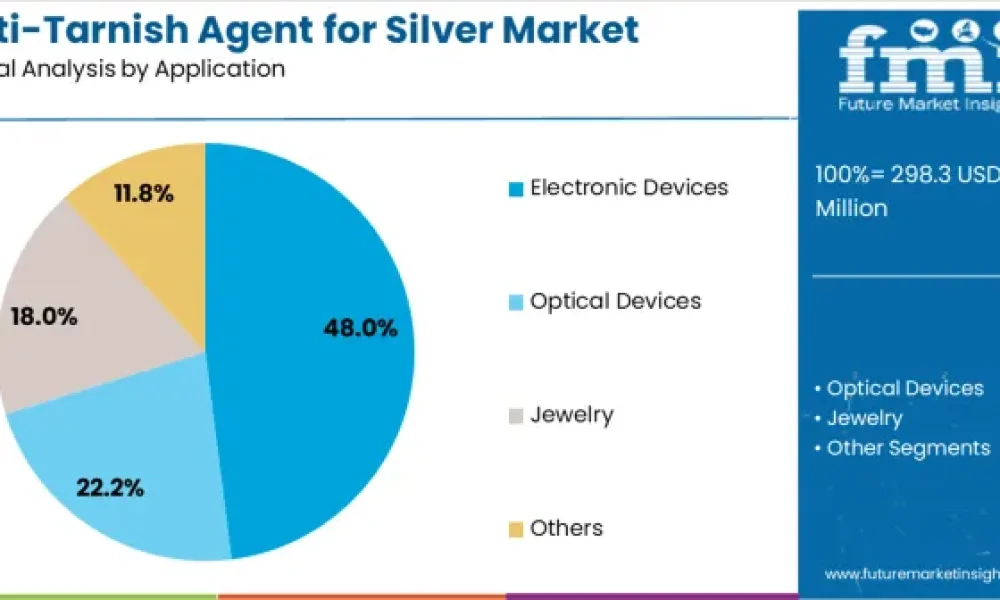
The global Anti-Tarnish Agent for Silver Market is entering a high-growth decade as manufacturers across electronics, optical components, and luxury goods accelerate their adoption of advanced silver protection technologies. Valued at USD 298.3 million in 2025, the market is forecast to reach USD 632.2 million by 2035, reflecting 111.9% total growth and a robust 7.8% CAGR.
Growth is fueled by increased demand for corrosion-resistant silver components, advancements in nanotechnology-enhanced coatings, and rising consumer preference for long-lasting, aesthetic preservation in silver-based products. The market is expected to grow 2.12X during the decade, supported by strong uptake across APAC, Europe, North America, and emerging Middle Eastern markets.
Demand Strengthens as Electronics Lead with 48% Market Share
Electronic devices represent the largest application segment, accounting for 48% of total market demand in 2025, as manufacturers prioritize performance stability, electrical conductivity preservation, and protection from environmental degradation. Rising production of wearables, smart jewelry, and miniaturized components is amplifying the need for sophisticated anti-tarnish solutions.
Subscribe for Year-Round Insights → Stay ahead with quarterly and annual data updates: https://www.futuremarketinsights.com/reports/sample/rep-gb-26455
Continuous investments by electronics manufacturers in high-reliability coating technologies are contributing significantly to the segment’s long-term growth.
Organic Anti-Tarnish Agents Hold a Dominant 58% Market Share
In 2025, organic anti-tarnish agents represent 58% of the total market, supported by their robust environmental stability, compatibility with precision applications, and operational ease. Electronics manufacturers rely heavily on organic formulations for their predictable performance, safety profile, and lower environmental impact.
Growing manufacturing modernization across East Asia and Europe is further strengthening the segment’s position, as demand for cost-efficient yet reliable coating technologies increases.
Why the Market Is Growing: Reliability, Sustainability & Longevity
Three key drivers are defining market momentum:
- Rising Need for Electronic Component Reliability
Manufacturers are demanding protective materials that ensure:
- Extended component lifespan
- Corrosion resistance
- Consistent conductivity
- Performance stability in harsh environments
Anti-tarnish agents are now essential in next-generation electronics manufacturing.
- Emphasis on Sustainable, High-Purity Coatings
Environmental awareness is pushing manufacturers toward eco-friendly formulations, particularly in Europe and the USA. The industry is witnessing increased adoption of low-toxicity, high-efficiency protective coatings without compromising operational performance.
- Growing Consumer Focus on Silver Care
Jewelry brands, retailers, and premium accessory makers are educating consumers about long-term preservation—leading to rising demand for sprays, wipes, and home-cleaning silver-protection kits.
Regional Outlook (2025–2035)
Asia-Pacific (APAC) Leads with China and India at Double-Digit CAGR
- China: 10.5% CAGR — incredibly strong growth driven by large electronics manufacturing clusters and government-backed innovation programs.
- India: 9.8% CAGR — supported by emerging precision coating hubs and rapid manufacturing expansion.
- Japan: 5.9% CAGR — maintaining leadership in precision electronics and advanced production technologies.
APAC remains the world’s fastest-growing region for anti-tarnish agent adoption.
Europe: Germany Dominates with Advanced Manufacturing Excellence
Europe’s market will grow from USD 72.6 million in 2025 to USD 143.7 million by 2035 at a 7.1% CAGR.
Key contributors include:
- Germany: Market share rising from 24.4% to 29.2% by 2035, backed by strong industrial and electronics production.
- France: Significant adoption in jewelry and specialty coatings.
- Italy: Rising demand from luxury goods and decorative silver applications.
BENELUX and the Nordics are emerging hotspots for sustainable coating technologies.
United States: 7.4% CAGR Driven by High-Performance Electronics
The USA maintains steady growth supported by:
- Mature electronics manufacturing
- Demand for premium coating technologies
- Rapid innovation in protective systems
Advancements in microelectronics and high-end industrial components are creating new opportunities for specialized anti-tarnish formulations.
Saudi Arabia & GCC: Growing Adoption in Industrial Modernization
As part of regional economic diversification and manufacturing expansion, Saudi Arabia is increasingly adopting advanced protective coatings in:
- Industrial electronics
- Infrastructure components
- High-value manufacturing
The GCC’s evolving manufacturing landscape positions the region as a steadily growing market participant through 2035.
Need tailored insights? Request report customization to match your specific business objectives: https://www.futuremarketinsights.com/customization-available/rep-gb-26455
Global Competitive Landscape
The market is characterized by active innovation, product diversification, and collaboration between chemical manufacturers and electronics component producers. Leading companies include:
- JX Advanced Metals Corporation
- Technic
- Daiwa Fine Chemicals
- Florida CirTech
- Shenzhen Yombo
- Guangzhou Yi Shun Chemical
- CoaTech
- DAZHI
- Umicore
- MacDermid Alpha Electronics Solutions
These companies focus on advanced formulation research, nanotechnology integration, sustainability compliance, and high-performance application techniques.
About Future Market Insights (FMI)
Future Market Insights, Inc. (FMI) is an ESOMAR-certified, ISO 9001:2015 market research and consulting organization, trusted by Fortune 500 clients and global enterprises. With operations in the U.S., UK, India, and Dubai, FMI provides data-backed insights and strategic intelligence across 30+ industries and 1200 markets worldwide.
Why Choose FMI: Empowering Decisions that Drive Real-World Outcomes: https://www.futuremarketinsights.com/why-fmi



