
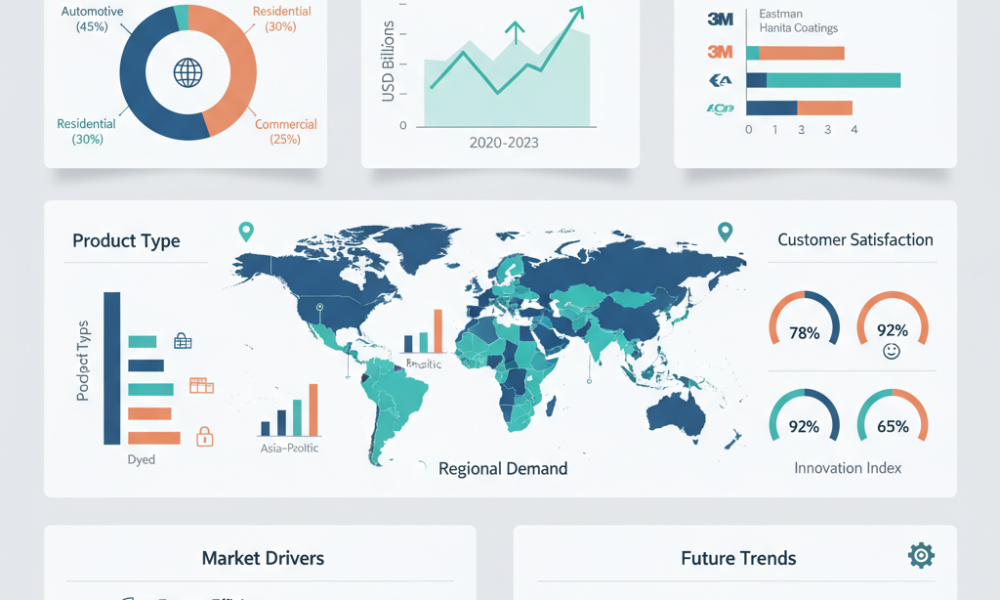
The global Sun Control Films Market is entering a decade of steady expansion, projected to surge from USD 7.3 billion in 2025 to USD 12.5 billion by 2035, reflecting a healthy CAGR of 5.6%. High-performance sun-control films currently command around 48.7% of total market share, while inorganic and ceramic absorber films dominate with approximately 54.2% share.
The top five industry leaders collectively hold just over 30% of global market revenue, indicating a moderately consolidated competitive environment. Key growth drivers include increasing demand for energy-efficient buildings, expanding automotive applications, and growing awareness of UV protection and heat reduction benefits among consumers worldwide.
Regional Value Overview
The market’s regional performance reveals a compelling story of both maturity and opportunity. North America and Western Europe continue to lead adoption, driven by stringent sustainability mandates, modern building codes, and heightened awareness of indoor energy efficiency. Meanwhile, Asia-Pacific is emerging as the fastest-growing region, propelled by rapid urbanization, surging vehicle ownership, and extensive commercial construction activity.
Together, these regions account for more than 80% of the global market share. Latin America and the Middle East & Africa are gaining momentum as infrastructure development and solar-intensive climates accelerate the need for efficient glazing and retrofit solutions.
Segment Overview
The Sun Control Films Market is segmented into film type, absorber type, and application:
- By Film Type: High-performance films dominate due to superior durability, UV rejection, and energy-saving capabilities.
- By Absorber Type: Inorganic and ceramic absorbers lead the category, offering advanced heat rejection and optical clarity for both residential and automotive uses.
- By Application: Automotive, commercial, and residential segments collectively fuel market expansion, supported by government incentives for energy efficiency and growing consumer preference for thermal comfort.
Continuous investment in smart-film technologies, self-healing coatings, and multi-layer reflective materials is expected to reshape market competitiveness in the coming years.
Competitive Landscape
The global landscape is moderately consolidated with a mix of multinational corporations and innovative regional players. Industry leaders are leveraging R&D investments, mergers, and strategic partnerships to strengthen market share and introduce advanced product lines.
Prominent companies include 3M, Eastman Chemical Company, Saint-Gobain, Avery Dennison, Garware Polyester, LLumar Films, Johnson Window Films, and Hanita Coatings. These firms are focusing on smart-window technologies, sustainable raw materials, and customized energy-control solutions to meet evolving building and automotive demands.
Market Outlook: Powering the Next Decade
The next decade will be defined by innovation and sustainability. The industry is expected to nearly double in value by 2035, driven by:
- Expanding adoption of green building initiatives and energy-efficiency regulations.
- Rising vehicle production and demand for enhanced thermal comfort and glare reduction.
- Rapid advancements in nanotechnology and ceramic-film engineering.
- Growing public and private investments in smart infrastructure.
These trends position sun-control films as a pivotal component of sustainable design and automotive innovation, driving measurable reductions in carbon footprint and energy consumption.
Key Players of the Sustainable Label Industry
- 3M: Leader in smart-tinting and energy-saving film solutions.
- Eastman Chemical Company: Innovator in UV-blocking and infrared-reflective coatings.
- Saint-Gobain: Pioneer in advanced multilayer solar-control systems.
- Avery Dennison Corporation: Specialist in decorative and functional energy-control films.
- Garware Polyester: Expanding global presence with cost-effective performance films.
- LLumar Films, Dexerials, Haverkamp, and others: Enhancing market diversity through specialized automotive and architectural solutions.
Recent Strategic Developments
- March 2024: 3M introduced a new smart, variable-tint window film for energy-efficient buildings.
- April 2024: Eastman launched advanced infrared-blocking films for automotive retrofits.
- May 2024: Saint-Gobain expanded its multi-layer solar film portfolio for residential applications.
- June 2024: Madico released a scratch-resistant, anti-glare technology for commercial windows.
- July 2024: Solar Gard enhanced its security-grade and sustainability-focused product line.
To access the complete data tables and in-depth insights, request a sample report here: https://www.futuremarketinsights.com/reports/sample/rep-gb-21434
Have a specific Requirements and Need Assistant on Report Pricing or Limited Budget please contact us – [email protected]
About Future Market Insights (FMI)
Future Market Insights, Inc. (ESOMAR certified, recipient of the Stevie Award, and a member of the Greater New York Chamber of Commerce) offers profound insights into the driving factors that are boosting demand in the market. With a vast team of over 400 analysts worldwide, FMI provides global, regional, and local expertise on diverse domains and industry trends across more than 110 countries.



