
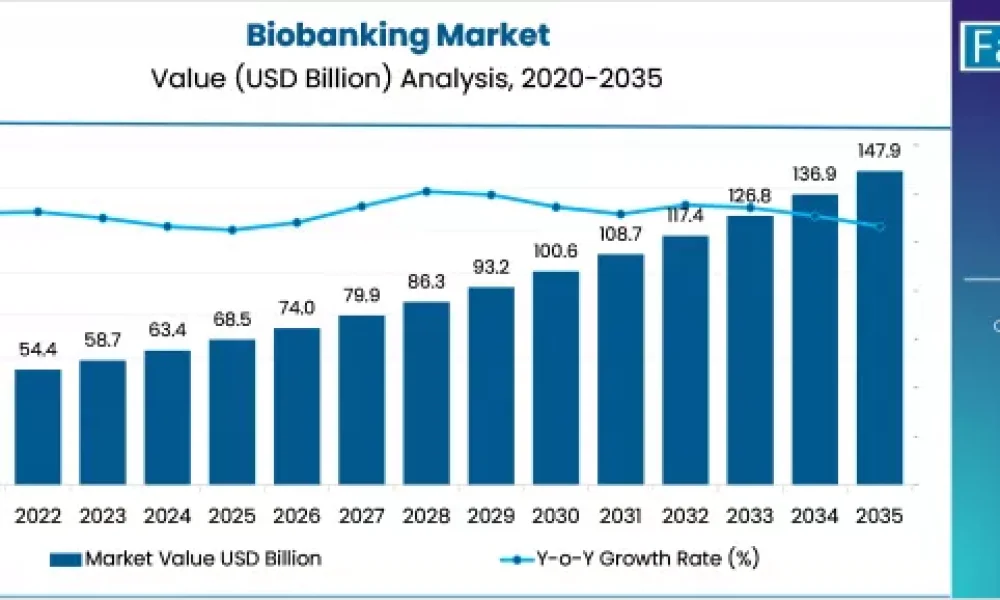
The global biobanking market is projected to grow from approximately USD 64.4 billion in 2025 to around USD 120 billion by 2035, registering a compound annual growth rate (CAGR) of about 6.5% during the forecast period. The expansion of the market is primarily driven by growing demand for precision medicine, rapid advancements in genomics research, and increasing investments in biobanking infrastructure by both public and private institutions.
Biobanks play a pivotal role in storing biological samples such as blood, tissues, DNA, and cells for clinical research, drug development, and disease diagnostics. As healthcare systems worldwide shift toward personalized medicine and genomics-driven therapies, the need for high-quality, traceable biospecimens has become critical. Enhanced digital tracking, cryopreservation techniques, and integration of artificial intelligence (AI) in data management are transforming biobanking operations globally.
Key Market Insights at a Glance
Market Value (2025): USD 64.4 billion
Forecast Value (2035): USD 120 billion
CAGR (2025–2035): ~6.5%
Leading Sample Type: Human tissue samples
Dominant Application: Therapeutic and research applications
Fastest-Growing Region: Asia Pacific
Key Players: Thermo Fisher Scientific, PHC Holdings, QIAGEN, Hamilton Company, Lonza Group, Biovault, and Merck KGaA
To Access the Complete Data Tables & in-depth Insights, Request a Discount on this report: https://www.factmr.com/connectus/sample?flag=S&rep_id=4438
Market Drivers / Growth Overview
Rising demand for precision and regenerative medicine: Increasing focus on personalized treatment drives the need for biospecimen repositories supporting genomic and molecular research.
Advances in cryopreservation and storage technologies: Improved freezing and thawing systems enable long-term stability and usability of biological materials.
Growing research on rare diseases and cancer genomics: Expanding biobank networks support large-scale population health studies and multi-omics research.
Government and institutional funding: Strategic investments in biobanking infrastructure and data-sharing platforms promote innovation and accessibility.
Integration of AI and digital management systems: Automation, sample tracking, and predictive analytics enhance efficiency and quality control in sample handling.
Despite its growth trajectory, the market faces challenges such as high setup and maintenance costs, ethical and privacy concerns, and the need for standardization in biobanking protocols across regions.
Segmentation & Key Drivers
By Type of Biobank:
Population-based biobanks dominate due to the scale of genomic and epidemiological studies.
Disease-oriented biobanks are expanding rapidly for oncology, cardiovascular, and infectious disease research.
By Sample Type:
Human tissue and blood samples account for a major share due to their wide utility in drug discovery and molecular diagnostics.
Stem cells and cell lines are growing in significance with the rise of regenerative medicine applications.
By Application:
Therapeutic applications lead, particularly in gene therapy and stem cell-based interventions.
Research applications continue to expand, supported by genomics, proteomics, and biomarker identification programs.
By End User:
Pharmaceutical and biotechnology companies are key consumers for drug development and clinical trials.
Academic and research institutions remain vital contributors to biospecimen collection and analysis.
Regional & Country Insights
North America: Holds the largest market share, driven by advanced healthcare infrastructure, strong funding for genomics, and presence of leading biobanks.
Europe: Shows steady growth, supported by regulatory frameworks promoting ethical biobanking and extensive collaborations across research networks.
Asia Pacific: Fastest-growing region with expanding biomedical research investments in China, Japan, South Korea, and India.
Latin America & Middle East: Emerging markets showing gradual adoption of biobanking technologies to support regional clinical research.
Competitive Landscape
The biobanking market is moderately consolidated, featuring both global leaders and specialized regional biorepositories. Prominent players include Thermo Fisher Scientific, PHC Holdings, QIAGEN, Hamilton Company, Lonza Group, Biovault, and Merck KGaA.
Strategic initiatives shaping the competitive landscape include:
Expansion of cryogenic storage capacities to meet growing biospecimen demand.
Partnerships between pharmaceutical companies and academic institutions to accelerate translational research.
Integration of AI-driven sample management systems for enhanced traceability and compliance.
Mergers and acquisitions to consolidate biobanking networks and improve geographic reach.
Focus on sustainability initiatives in cold storage and energy-efficient infrastructure.
Recent Developments
Leading industry players have expanded automated biobank facilities integrating robotic sample handling and real-time tracking systems.
Several organizations launched partnerships to develop standardized global frameworks for biospecimen sharing.
Innovations in dry-state preservation and low-energy cryogenic systems have reduced operational costs and carbon footprints.
Increased deployment of blockchain-based data management tools enhances transparency and consent tracking in biobanking operations.
Market Outlook & Strategic Insights
Over the next decade, the biobanking market is expected to play an even greater role in advancing precision medicine, rare disease research, and cell-based therapies. Integration of digital technologies, automation, and AI will further transform how biospecimens are stored, analyzed, and shared globally.
Strategic opportunities exist in:
Developing scalable, automated cryogenic storage solutions.
Establishing secure data-sharing networks linking biobanks and clinical research centers.
Expanding access to underrepresented populations in genomic databases.
Leveraging AI and cloud computing for real-time analytics and quality control.
With expanding healthcare digitization and personalized medicine initiatives, the global biobanking market is set to more than double by 2035, reinforcing its position as a cornerstone of next-generation biomedical innovation.
Purchase Full Report for Detailed Insights
For access to full forecasts, regional breakouts, company share analysis, and emerging trend assessments, you can purchase the complete report: https://www.factmr.com/checkout/4438
Have specific requirements or need assistance on report pricing or have a limited budget? Please contact [email protected]
Contact:
US Sales Office
11140 Rockville Pike
Suite 400
Rockville, MD 20852
United States
Tel: +1 (628) 251-1583, +353-1-4434-232
Email: [email protected]
About Fact.MR:
Fact.MR is a global market research and consulting firm, trusted by Fortune 500 companies and emerging businesses for reliable insights and strategic intelligence. With a presence across the U.S., UK, India, and Dubai, we deliver data-driven research and tailored consulting solutions across 30+ industries and 1,000+ markets. Backed by deep expertise and advanced analytics, Fact.MR helps organizations uncover opportunities, reduce risks, and make informed decisions for sustainable growth.



