
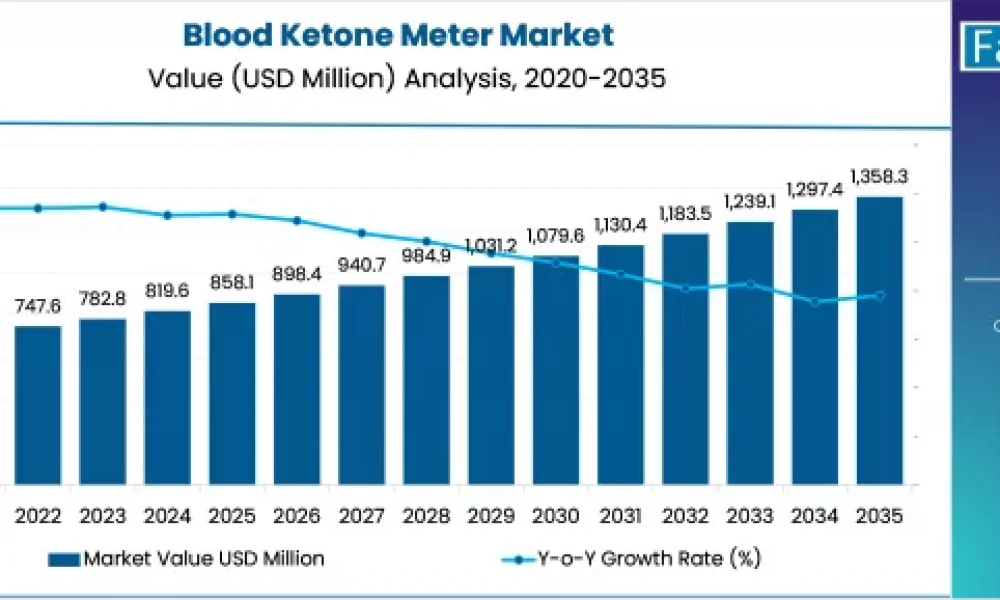
The global blood ketone meter market is estimated at USD 480 million in 2025 and is projected to reach USD 850 million by 2035, expanding at a CAGR of 5.8% during the forecast period. Increasing awareness of diabetes management, the rising number of ketogenic diet followers, and advancements in point-of-care testing technologies are expected to drive steady market growth in the coming decade.
Blood ketone meters are portable diagnostic devices that measure the concentration of ketones in blood, providing critical information for managing diabetes, metabolic disorders, and ketogenic diets. These devices have become increasingly popular among individuals with Type 1 diabetes, as monitoring ketone levels helps prevent life-threatening complications such as diabetic ketoacidosis (DKA).
Key Market Insights at a Glance
Market Value (2025): USD 480 million
Forecast Value (2035): USD 850 million
CAGR (2025–2035): 5.8%
Leading Product Type: Handheld ketone meters
Top End User: Homecare settings
Fastest-Growing Region: Asia Pacific
Prominent Players: Abbott Laboratories, Nova Biomedical, EKF Diagnostics, APEX Biotechnology Corp., TaiDoc Technology, and KETO-MOJO
To Access the Complete Data Tables & in-depth Insights, Request a Discount on this report: https://www.factmr.com/connectus/sample?flag=S&rep_id=7175
Market Dynamics
Key Growth Drivers
Rising prevalence of diabetes worldwide: The growing global diabetic population—projected to exceed 780 million by 2040—significantly increases the demand for continuous ketone monitoring devices.
Increasing awareness of diabetic ketoacidosis (DKA): Early ketone detection helps prevent severe complications, fueling adoption among both patients and healthcare professionals.
Growth in home-based health monitoring: The surge in demand for compact, easy-to-use meters supports homecare diagnostics and self-management of chronic conditions.
Expanding ketogenic and low-carb diet trends: Consumers adopting ketogenic diets for weight loss and cognitive health are contributing to increased usage of blood ketone meters for nutritional monitoring.
Technological innovations: Integration of Bluetooth-enabled devices, smartphone apps, and real-time cloud-based data analytics is improving patient engagement and remote monitoring capabilities.
Challenges
Despite strong demand, challenges such as high device cost, limited insurance reimbursement, and consumer preference for urine-based ketone strips in some regions hinder market penetration. Additionally, varying accuracy standards across manufacturers can affect user trust and compliance.
Market Segmentation
By Product Type
Handheld Blood Ketone Meters: Dominate the market due to portability, accuracy, and affordability.
Wearable Ketone Monitors: Emerging as a promising segment with growing R&D in non-invasive biosensor technology.
By Application
Diabetes Management: Primary application, accounting for the majority of device usage.
Ketogenic Diet Monitoring: Rapidly expanding segment among health-conscious consumers and athletes.
Clinical & Research Use: Growing in hospitals and metabolic research centers for advanced metabolic monitoring.
By End User
Homecare Settings: Lead the market, driven by increased patient preference for self-monitoring and telehealth integration.
Hospitals & Clinics: Continue to adopt ketone meters for rapid screening in diabetic emergencies.
Diagnostic Laboratories: Use devices for research and validation purposes in metabolic studies.
Regional Outlook
North America: Dominates the global market, supported by a high prevalence of diabetes, strong awareness programs, and advanced healthcare infrastructure. The U.S. remains a key market, with rising adoption of digital health technologies.
Europe: Expected to register stable growth due to established diabetic care programs and supportive government initiatives promoting early diagnosis.
Asia Pacific: Anticipated to exhibit the fastest growth, driven by the increasing incidence of diabetes in India and China, expanding access to home-based diagnostics, and improving healthcare affordability.
Latin America and Middle East & Africa: Emerging markets witnessing gradual adoption, propelled by expanding distribution networks and awareness of DKA management.
Competitive Landscape
The blood ketone meter market features a mix of global and regional players focusing on product innovation, affordability, and enhanced accuracy. Key market participants include Abbott Laboratories, Nova Biomedical, EKF Diagnostics, TaiDoc Technology, Apex Biotechnology Corp., KETO-MOJO, Beurer GmbH, and Bioptik Technology.
Strategic initiatives include:
Development of dual-function devices that measure both blood glucose and ketones.
Integration of smartphone connectivity for data logging and sharing with healthcare providers.
Expansion into emerging markets through partnerships with local distributors.
Continuous investment in miniaturized biosensor technologies for non-invasive detection.
Recent Developments
Several leading manufacturers have introduced Bluetooth-enabled ketone meters with mobile app integration for continuous data monitoring and alerts.
Research initiatives are exploring optical and breath-based ketone sensors, which could disrupt traditional invasive testing methods.
Manufacturers are focusing on low-cost test strips and subscription-based supply models to improve affordability for long-term users.
Collaboration between digital health platforms and device manufacturers is promoting data-driven diabetes management ecosystems.
Market Outlook
The increasing prevalence of diabetes, coupled with rising demand for personalized healthcare, will continue to shape the global blood ketone meter market. Technological convergence—combining biosensors, cloud computing, and AI-driven analytics—will make real-time metabolic monitoring more accessible and precise.
Emerging opportunities include:
Integration of ketone monitoring into multi-analyte wearable sensors.
AI-based predictive analytics to anticipate DKA risk.
Expansion of telehealth-compatible diagnostic ecosystems.
Rising consumer use beyond diabetes management, particularly in fitness and nutrition monitoring.
By 2035, the global blood ketone meter market will play a crucial role in preventive healthcare and digital metabolic management, bridging the gap between clinical diagnostics and personalized wellness.
Purchase Full Report for Detailed Insights
For access to full forecasts, regional breakouts, company share analysis, and emerging trend assessments, you can purchase the complete report: https://www.factmr.com/checkout/7175
Have specific requirements or need assistance on report pricing or have a limited budget? Please contact [email protected]
Contact:
US Sales Office
11140 Rockville Pike
Suite 400
Rockville, MD 20852
United States
Tel: +1 (628) 251-1583, +353-1-4434-232
Email: [email protected]
About Fact.MR:
Fact.MR is a global market research and consulting firm, trusted by Fortune 500 companies and emerging businesses for reliable insights and strategic intelligence. With a presence across the U.S., UK, India, and Dubai, we deliver data-driven research and tailored consulting solutions across 30+ industries and 1,000+ markets. Backed by deep expertise and advanced analytics, Fact.MR helps organizations uncover opportunities, reduce risks, and make informed decisions for sustainable growth.



