
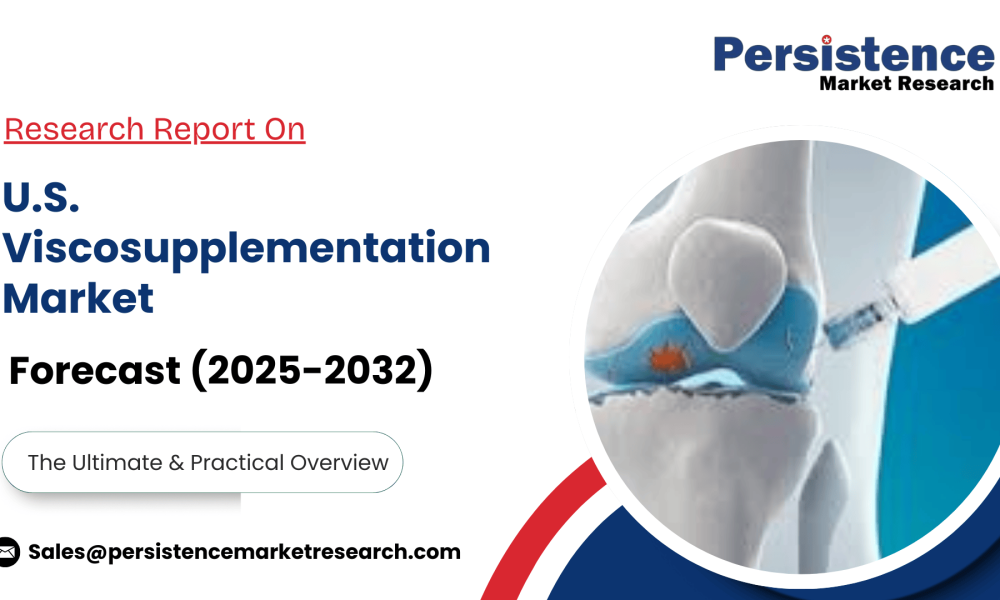
The U.S. viscosupplementation market is poised for sustained growth, with its valuation projected to reach US$1,127.6 million in 2025 and expand to US$1,611.7 million by 2032, reflecting a compound annual growth rate (CAGR) of 5.2% over the forecast period. This growth is largely driven by the increasing burden of osteoarthritis (OA), demographic trends favoring minimally invasive treatments, and continuous advancements in hyaluronic acid (HA) formulations.
Market Size and Trends Analysis
The U.S. viscosupplementation market has demonstrated steady growth over the past five years, with a historical CAGR of 4.4% from 2019 to 2024. This trajectory is expected to strengthen between 2025 and 2032, as more patients and providers embrace viscosupplementation as a clinically effective and cost-efficient alternative to surgical procedures. Notably, single-injection viscosupplementation therapies are gaining dominance due to their simplicity, convenience, and compliance advantages over multi-injection protocols.
Knee osteoarthritis continues to be the most common indication for viscosupplementation, and the number of procedures for knee OA is expected to grow significantly as the U.S. population ages and obesity rates climb. Additionally, a strong pipeline of HA innovations and combination therapies offers potential for expanded clinical use and improved long-term outcomes.
Key Industry Highlights
Single-injection viscosupplementation products lead the U.S. market owing to greater patient adherence, fewer clinic visits, and a reduced risk of complications. Knee osteoarthritis remains the primary application, accounting for the vast majority of viscosupplementation procedures. An emerging area of innovation is combination therapies, integrating HA with platelet-rich plasma (PRP), anti-inflammatory drugs, or regenerative medicine technologies, aimed at enhancing efficacy and durability of symptom relief.
Technological advancements in crosslinked and longer-acting HA products have further improved therapeutic outcomes, boosting adoption among physicians and patient populations alike.
Get a Sample Copy of Research Report (Use Corporate Mail id for Quick Response): https://www.persistencemarketresearch.com/samples/35654
Market Dynamics
Driver
The primary driver of market growth is the increasing prevalence of osteoarthritis. An estimated 32.5 million U.S. adults are affected by OA annually, with more than 1 million knee and hip replacements performed due to OA-related complications. An aging population and rising obesity levels are compounding the incidence of OA, creating sustained demand for non-surgical interventions. Viscosupplementation, with its proven safety profile, cost-effectiveness, and convenience, is emerging as a frontline therapy, particularly in outpatient care settings.
Restraint
Despite these advantages, viscosupplementation faces strong competition from alternative therapies, including corticosteroid injections, physical therapy, and newer techniques such as genicular artery embolization (GAE). These treatments are often more familiar to clinicians, more widely reimbursed, and offer perceived or real cost advantages in certain clinical scenarios. Reimbursement variability across insurers and regions also contributes to inconsistent uptake of viscosupplementation.
Opportunity
A significant opportunity lies in the development of combination therapies that pair hyaluronic acid with anti-inflammatory or regenerative agents. Such therapies not only offer symptomatic relief but also aim to address underlying joint pathology. Additionally, the rise of outpatient and ambulatory care centers as primary settings for OA treatment creates new channels for distribution and partnerships, enhancing market accessibility and scalability.
Category-wise Analysis
Product Insights
Single-injection products are outperforming multi-injection options due to ease of administration, reduced treatment burden, and improved adherence. These formulations are being enhanced with crosslinking technology to extend the duration of therapeutic action, minimize pain episodes, and delay surgical interventions.
Application Insights
Knee OA dominates the application landscape due to its high prevalence and functional impact on patients’ mobility. Studies indicate that more than 25% of arthritis patients experience severe knee pain, while 43% of individuals aged 65 and older have some form of OA. Viscosupplementation, in this context, offers targeted relief with a strong safety and tolerability profile, driving repeat usage and continued physician recommendation.
Regional Insights
The U.S. presents a favorable environment for viscosupplementation adoption due to its advanced healthcare infrastructure, broad insurance coverage (including Medicare), and high awareness of treatment alternatives. Clinical research in the U.S. is increasingly focusing on next-generation HA formulations, combination products, and advanced drug delivery platforms. For example, integrating HA with natural and synthetic polymers—such as chitosan, polylactic acid, and polycaprolactone—is being explored to enhance joint protection and stimulate cartilage regeneration.
Geographically, higher adoption is observed in urban and suburban ambulatory centers, where access to orthopedic specialists and outpatient clinics is robust. These settings are also benefitting from increased investment in OA management, as payers and providers prioritize value-based care models and minimally invasive treatment pathways.
Request for Customization of the Research Report: https://www.persistencemarketresearch.com/request-customization/35654
Competitive Landscape
The U.S. viscosupplementation market is moderately consolidated, with key players leveraging strategic alliances, product innovation, and geographic expansion to strengthen their market positions. Major companies include:
Sanofi S.A.
Zimmer Biomet Holdings Inc.
Bioventus LLC
Anika Therapeutics Inc.
Fidia Pharma USA Inc.
Ferring B.V.
Seikagaku Corporation
Teva Pharmaceutical Industries Ltd.
OrthogenRx Inc.
Searchlight Pharma Inc.
TRB Chemedica International SA
IBSA Institut Biochimique SA
These companies are investing in clinical research, enhancing their HA product portfolios, and engaging in strategic partnerships with healthcare networks and outpatient centers. For example, Seikagaku Corporation’s partnership with Ono Pharmaceutical and the clinical progress of BioSenic’s JTA-004 injection exemplify ongoing R&D initiatives shaping future treatment paradigms.
Market Segmentation
The U.S. viscosupplementation market can be segmented based on:
Product Type: Single-injection, three-injection, five-injection viscosupplementation
Application: Knee osteoarthritis, hip osteoarthritis, shoulder osteoarthritis, and others
End User: Hospitals, ambulatory surgical centers, and specialty clinics
Among these, single-injection treatments for knee OA administered in outpatient and specialty clinic settings account for the largest market share, driven by convenience, cost-efficiency, and high therapeutic value.
Recent Developments
April 2025: Seikagaku Corporation announced a co-development and commercialization agreement with Ono Pharmaceutical Co., Ltd. for Gel-One, a crosslinked HA product aimed at improving viscosupplementation efficacy.
April 2024: BioSenic reported favorable Phase 3 data for JTA-004, a single-injection HA-based therapy for knee OA, at the Osteoarthritis Research Society International conference. The product demonstrated both safety and efficacy, reinforcing its potential for regulatory approval and commercial launch.
These developments signal a trend toward enhanced clinical validation, innovation in HA formulation, and strategic collaborations that accelerate time-to-market and widen therapeutic reach.
Future Outlook
Looking ahead to 2032, the U.S. viscosupplementation market is expected to continue expanding at a steady CAGR of 5.2%, reaching US$1,611.7 million. Growth will be underpinned by the increasing prevalence of osteoarthritis, an aging and mobility-challenged population, and the shift toward non-invasive, outpatient-based care.
Product innovation will remain a central theme, with combination therapies, biodegradable carriers, and targeted drug delivery platforms opening new therapeutic frontiers. Moreover, increased alignment with payer priorities—focusing on outcomes-based care and cost-efficiency—will support broader adoption of viscosupplementation in the U.S. healthcare system.
In summary, the U.S. viscosupplementation market stands at a pivotal juncture, offering strong prospects for manufacturers, providers, and patients alike. With a clear demand for minimally invasive, effective OA treatments and an expanding innovation pipeline, the market is well-positioned for sustained growth over the coming decade.




