
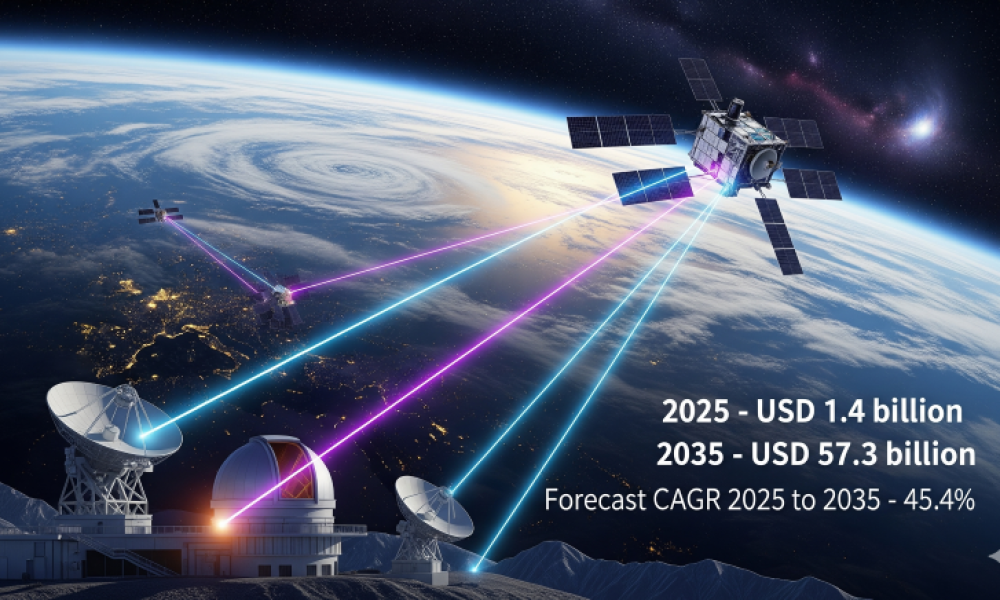
The satellite laser communication market is set to experience an extraordinary expansion over the next decade, with projections indicating a surge from an estimated value of USD 1.4 billion in 2025 to USD 57.3 billion by 2035. This impressive growth represents a remarkable compound annual growth rate (CAGR) of 45.4%, underscoring the increasing demand for high-capacity, secure, and low-latency communication solutions in the satellite industry.
Unlock detailed analytics – Request your personalized report now! https://www.futuremarketinsights.com/reports/sample/rep-gb-24873
Market Drivers and Adoption of Optical Technology
The rapid adoption of satellite laser communication is being driven by the need for faster, more secure, and efficient data transfer methods. The limitations of traditional radio frequency (RF) systems, such as bandwidth constraints and spectrum congestion, are pushing satellite operators, defense agencies, and commercial entities to turn to optical communication technologies. This shift is not merely technological—it’s an industry-wide transformation as more sectors, including broadband connectivity, Earth observation, and space exploration, prioritize high-speed satellite links.
Key Segments and Regional Insights
The satellite laser communication market is segmented into several key solutions, including space-to-ground, space-to-space, and space-to-other applications. Among these, space-to-ground stations dominate, accounting for 42.7% of the market share. This dominance is attributed to the critical role ground stations play in enabling secure, high-speed communication between orbital platforms and terrestrial infrastructure.
Geographically, the market is experiencing rapid growth across North America, Asia-Pacific, and Europe. Leading players such as Airbus SE, Axelspace Corporation, and Ball Aerospace & Technologies Corp. are strategically positioning themselves in these regions to capture the growing demand for optical communication systems. Notably, China and India are leading the charge in terms of market growth, with respective CAGRs of 61.3% and 56.8%, driven by aggressive space programs and government investments in satellite communication technologies.
Technological Advancements and Strategic Investments
Technological innovation is central to the market’s expansion. Key advancements include improvements in optical payload miniaturization, enhanced beam-tracking capabilities, and energy-efficient transmission systems. These innovations are expected to make satellite laser communication systems more scalable and cost-effective, thereby accelerating the transition from traditional RF systems to optical solutions.
The market is also witnessing strategic partnerships between space agencies, such as NASA and the European Space Agency (ESA), and private players like SpaceX and OneWeb, further driving investment in optical inter-satellite links. These collaborations are vital for advancing satellite networks and boosting the adoption of laser communication systems across multiple applications, from military to commercial sectors.
Competitive Landscape and Leading Players
The satellite laser communication market is becoming increasingly competitive, with key players vying for market share by focusing on research and development, product innovation, and strategic collaborations. Leading industry players include:
- Airbus SE: Known for its advanced optical communication terminals designed to support inter-satellite links and satellite-to-ground communication, Airbus is a key player in providing high-capacity solutions for applications such as Earth observation and military missions.
- Axelspace Corporation: This Japanese company specializes in compact, efficient optical communication modules that are integrated into small satellite constellations, enhancing real-time Earth observation capabilities.
- Ball Aerospace & Technologies Corp.: A leader in high-precision optical payloads, Ball Aerospace focuses on developing secure, low-latency, and high-bandwidth communication systems, tailored for both defense and commercial applications.
Download Brochure for Full Insights: https://www.futuremarketinsights.com/reports/brochure/rep-gb-24873
Market Challenges and Future Outlook
Despite its promising growth, the satellite laser communication market faces challenges such as atmospheric interference and high initial costs. Weather-related disruptions, including clouds and fog, can affect laser beam performance, while the need for precise satellite alignment adds complexity to system deployment.
Nonetheless, the market’s long-term outlook remains robust, as the benefits of satellite laser communication—such as higher data rates, reduced spectrum congestion, and enhanced security—continue to outweigh these challenges. As technology advances and scalable deployment models become more accessible, satellite laser communication is poised to become the cornerstone of next-generation global connectivity, empowering everything from space exploration to commercial broadband services.
About Future Market Insights (FMI)
Future Market Insights, Inc. (ESOMAR certified, recipient of the Stevie Award, and a member of the Greater New York Chamber of Commerce) offers profound insights into the driving factors that are boosting demand in the market. FMI stands as the leading global provider of market intelligence, advisory services, consulting, and events for the Packaging, Food and Beverage, Consumer Technology, Healthcare, Industrial, and Chemicals markets. With a vast team of over 400 analysts worldwide, FMI provides global, regional, and local expertise on diverse domains and industry trends across more than 110 countries.



