Definition
Chromatographic packing refers to porous microsphere materials used as stationary phases in chromatography columns, with particle sizes ranging from micrometers to nanometers. These materials enable high-resolution separation of complex mixtures across industries, from pharmaceuticals to environmental analysis. Pore sizes typically fall between 5–200 nanometers, allowing precise molecular discrimination and efficient purification.
Chromatographic packing materials can be classified into silica-based, polymer-based, and hybrid compositions, each tailored for specific separation techniques like HPLC, GC, ion exchange, and affinity chromatography. These packings are critical for applications requiring high purity and reproducibility, particularly in pharmaceutical manufacturing, where impurities must often be monitored at 0.1% levels or lower.
Key characteristics of chromatographic packings include:
- High surface area for better molecular interaction
- Controlled pore size distribution for selective separation
- Mechanical stability to withstand high-pressure systems
- Chemical resistance for compatibility with various solvents and buffers
Industries relying on chromatographic packing materials include:
- Pharmaceuticals and biopharmaceuticals for drug purification
- Food and beverage analysis for quality control
- Environmental testing for trace contaminant detection
- Academic and industrial research requiring high-resolution separation
Market Size
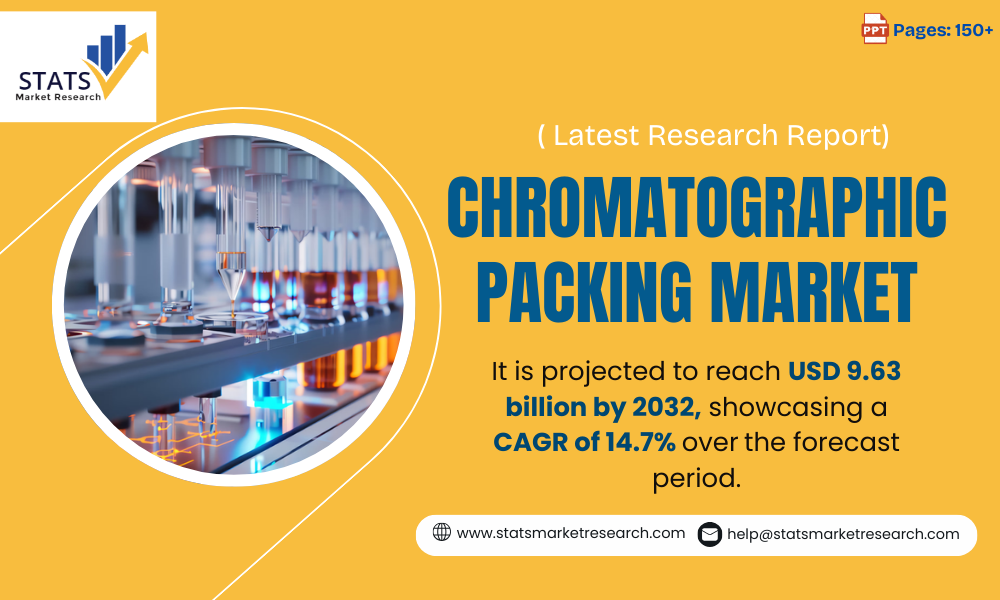
Global chromatographic packing market was valued at USD 3.77 billion in 2023 and is projected to reach USD 9.63 billion by 2030, exhibiting a CAGR of 14.7% during the forecast period.
Download FREE Sample of this Report @ https://www.statsmarketresearch.com/download-free-sample/8059594/global-chromatographic-packing-forecast-market
Market growth is propelled by:
- Increasing global biopharmaceutical R&D spending, which reached USD 238 billion in 2023
- Rising regulatory stringency for drug purity and reproducibility
- Expansion of the Asia-Pacific pharmaceutical sector, growing at 18.2% CAGR, led by China
Pharmaceutical and biopharmaceutical applications dominate, accounting for approximately 80% of total demand, driven by strict impurity profiling requirements and large-scale production of biologics such as monoclonal antibodies, mRNA vaccines, and gene therapies.
Technological innovations, including polymer-based packings and surface-modified silica gels, are improving separation efficiency for complex biomolecules. Leading players like GE Healthcare and Tosoh Corporation are continually introducing novel silica and polymer matrices to meet evolving industry needs.
Emerging applications in environmental monitoring and industrial purification further contribute to market expansion. For instance, preparative-scale chromatography for PFAS monitoring and metal ion recovery is growing rapidly, creating new revenue streams outside traditional pharmaceutical applications.
Recent Developments in the Chromatographic Packing Market
The chromatographic packing market is seeing significant innovation, largely driven by the pharmaceutical and biopharmaceutical industries where efficient separation is critical for drug development and manufacturing. One major trend is the shift towards high-efficiency packing materials like sub-2-micron particles and core-shell particles, which allow for faster analysis and better resolution. Manufacturers are also developing more specialized, multi-layered packing materials tailored for complex biomolecules such as monoclonal antibodies. Another key development is the emergence of 3D printing to create customized stationary phases with unique geometries that can improve separation efficiency and reduce material waste. These innovations aim to make chromatography more precise, faster, and more cost-effective.
Major Distribution Channels for Chromatographic Packing
The distribution of chromatographic packing materials is a highly specialized business-to-business (B2B) model. The primary customers are pharmaceutical and biotechnology companies, as well as academic and research institutes, which rely heavily on these products for their R&D and quality control processes. Consequently, the main distribution channels are direct sales from major manufacturers like Agilent Technologies, Waters Corporation, and Thermo Fisher Scientific. These companies often have extensive global sales networks and provide technical support and custom solutions. Additionally, third-party distributors and scientific supply companies play a crucial role, providing a broad range of products from various manufacturers to a wider customer base. This multi-channel approach ensures that a variety of labs, from large-scale manufacturers to small research facilities, can access the specific packing materials they need.
Market Dynamics (Drivers, Restraints, Opportunities, and Challenges)
Drivers
Rising Biopharmaceutical Investments
- The global biopharmaceutical industry is projected to exceed USD 650 billion by 2030, driving demand for advanced purification technologies.
- Chromatographic packing is critical in downstream processing, with ion exchange and affinity resins representing nearly 45% of purification costs for monoclonal antibodies.
- New biologics approvals, including bispecific antibodies and gene therapies, increase adoption of high-performance packing materials.
- Scaling up production for vaccines further boosts market demand.
Stringent Pharmaceutical Regulatory Requirements
- Regulatory agencies now require impurity profiling down to 0.1%, creating additional chromatographic tests per NDA submission.
- Adoption of QbD (Quality by Design) and updated USP <621> and ICH Q14 guidelines emphasize robust and reproducible stationary phases.
- Emerging markets are upgrading facilities to meet WHO Prequalification and EU GMP standards for export.
Emerging Environmental Applications
- Environmental labs are adopting preparative chromatography to monitor PFAS, growing at 12% annually.
- Industrial wastewater facilities implement continuous chromatography with zirconia-based packings, achieving 99.9% metal ion recovery.
- These environmental applications represent the fastest-growing preparative packing segment outside pharma.
Restraints
High Costs and Limited Availability of Specialty Ligands
- Affinity media incorporating protein A/G ligands face 6-month+ lead times during peak demand.
- Costs range from USD 15,000–20,000 per liter, creating barriers for smaller firms.
- Intellectual property restrictions and royalty payments increase procurement costs by 20–25%.
Column Packing Consistency Challenges
- 35–40% of separation issues originate from inconsistent column packing, especially for sub-3μm particles in UHPLC.
- Specialized skills are required for slurry preparation and high-pressure packing stations.
- Continuous chromatography systems face additional engineering challenges maintaining bed stability.
Opportunities
Continuous Bioprocessing Revolution
- Shift from batch to continuous biomanufacturing creates demand for packings capable of dynamic flow operation.
- Multimodal resins now demonstrate 300–400 cycle lifetimes in perfusion bioreactors.
- Radial flow columns packed with gigaporous media achieve 5–7x higher productivity than traditional designs.
- Estimated $900 million opportunity for continuous chromatography packings by 2027.
ADC and Oligonucleotide Therapeutics Expansion
- Growth of antibody-drug conjugates and mRNA therapeutics drives demand for specialized packings.
- Phenyl-based resins with controlled hydrophobicity enable precise separation of ADC variants.
- High-capacity anion exchangers with 1000Å+ pores enable advanced nucleic acid purification with >65% gross margins.
Challenges
Regulatory Uncertainty for Novel Materials
- FDA scrutiny on polymeric and hybrid silica packings delays commercialization.
- Biocompatibility and extractables/leachables studies add 18–24 months to lead times.
- Lack of harmonized global standards complicates material qualification.
Supply Chain Vulnerabilities
- High-purity spherical silica production is concentrated in a few facilities, creating supply risks.
- Energy crises and geopolitical tensions have disrupted production and pricing.
- Dual sourcing strategies are now common to mitigate risks.
Regional Analysis
North America
- Largest market due to established biopharma infrastructure and regulatory compliance.
- U.S. leads in both R&D investment and downstream purification adoption.
Europe
- Steady growth with aging population and high biopharma production capacity.
- Germany, France, and U.K. are key contributors.
Asia-Pacific
- Fastest-growing region (18.2% CAGR) due to China’s expanding pharma sector.
- Investments in local production and regulatory alignment drive adoption.
Latin America
- Moderate growth fueled by academic research and pharmaceutical production upgrades.
Middle East & Africa
- Limited adoption due to high CAPEX and infrastructure constraints, though urban centers show incremental uptake.
Get the Complete Report & TOC @ https://www.statsmarketresearch.com/global-chromatographic-packing-forecast-market-8059594
Competitor Analysis
Key Players:
- GE Healthcare – ~22% global share, extensive portfolio in biopharmaceutical applications
- Tosoh Corporation – Innovative silica and polymer packings, focus on HPLC efficiency
- Bio-Rad Laboratories – Strong presence in protein purification resins
- Agilent Technologies – Specialized in analytical packing, food safety, environmental testing
- Osaka Soda – Expanding global footprint through partnerships and cost-efficient silica production
- Fuji Silysia Chemical – High-quality silica-based packing solutions
- Kromasil (Sweden), Nanotech (China), Lanxiao Technology (China), Sepax Technologies (U.S.)
Competitive strategies include:
- R&D for novel polymeric and hybrid materials
- Geographic expansion, especially in Asia
- Product diversification across chromatography techniques
- Technological differentiation with superficially porous particles and multimodal resins
Global Chromatographic Packing: Market Segmentation Analysis
This report provides a deep insight into the global Chromatographic Packing market, covering all its essential aspects. This ranges from a macro overview of the market to micro details of the market size, competitive landscape, development trend, niche market, key market drivers and challenges, SWOT analysis, value chain analysis, etc.
The analysis helps readers shape competition strategies and enhance potential profits. It provides a framework for evaluating business positions and focuses on the competitive landscape of the Global Chromatographic Packing market. It details market share, product situation, operations, and performance of key players, helping readers identify main competitors and understand market dynamics.
In a word, this report is a must-read for industry players, investors, researchers, consultants, and business strategists looking to enter the Chromatographic Packing market.
Market Segmentation (by Application)
- Biopharmaceuticals
- Food & beverage analysis
- Environmental testing
- Academic research
- Others
Market Segmentation (by Type)
- Silicone Filler
- Porous silica
- Surface-modified silica
- Others
- Polymer Filler
- Polystyrene-divinylbenzene
- Methacrylate-based
- Others
- Others
Key Company
- GE Healthcare (U.S.)
- Tosoh Corporation (Japan)
- Bio-Rad Laboratories (U.S.)
- Agilent Technologies (U.S.)
- Osaka Soda Co., Ltd. (Japan)
- Fuji Silysia Chemical Ltd. (Japan)
- Kromasil (Sweden)
- Nanotech (China)
- Lanxiao Technology (China)
- Sepax Technologies (U.S.)
Geographic Segmentation
- North America
- Europe
- Asia-Pacific
- Latin America
- Middle East & Africa
FAQ
Q1: What is the current market size of the Chromatographic Packing market?
A1: The market was valued at USD 3.77 billion in 2023 and is projected to reach USD 9.63 billion by 2030, with a CAGR of 14.7%.
Q2: Which are the key companies operating in the Chromatographic Packing market?
A2: Key players include GE Healthcare, Tosoh Corporation, Bio-Rad Laboratories, Agilent Technologies, Osaka Soda, Fuji Silysia Chemical, among others.
Q3: What are the key growth drivers in the Chromatographic Packing market?
A3: Growth is driven by rising biopharmaceutical R&D, stringent drug purity regulations, continuous bioprocessing adoption, and expansion of ADC and oligonucleotide therapeutics.
Q4: Which regions dominate the Chromatographic Packing market?
A4: North America leads due to established biopharma infrastructure, followed by Europe and Asia-Pacific, with Asia-Pacific exhibiting the fastest growth.
Q5: What are the emerging trends in the Chromatographic Packing market?
A5: Emerging trends include polymer-based high-performance packings, multimodal resins for continuous processing, superficially porous particles for UHPLC, and environmental monitoring applications.
About Us
☎️ International: +1 (332) 2424 294
📄 Website: www.statsmarketresearch.com
Join us on LinkedIn:- https://www.linkedin.com/company/statsmarketresearch




