
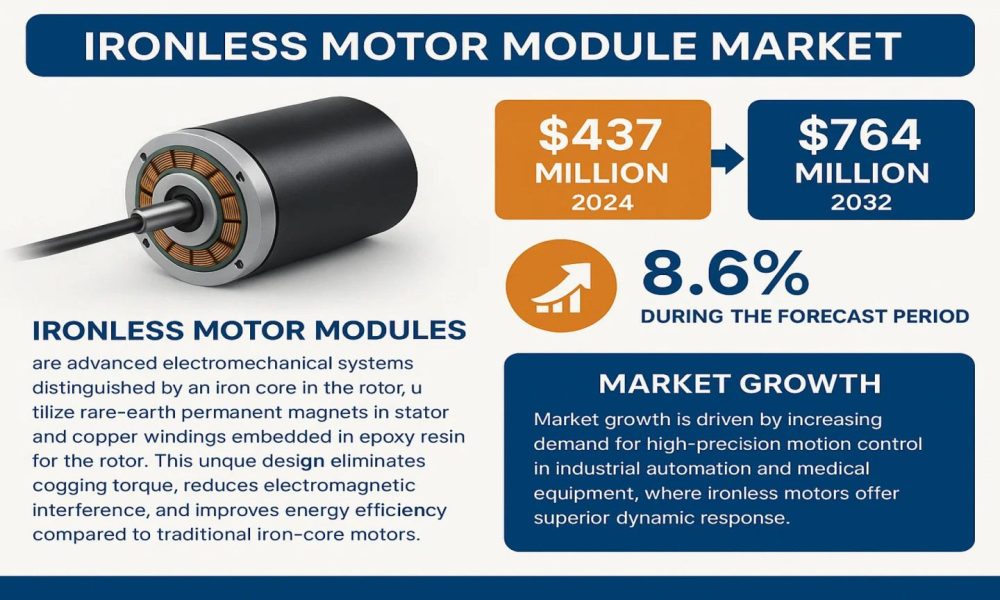
Ironless Motor Module Market was valued at 437 million in 2024 and is projected to reach US$ 764 million by 2032, at a CAGR of 8.6% during the forecast period.
Ironless motor modules are advanced electromechanical systems distinguished by their lack of an iron core in the rotor. Instead, these modules utilize rare-earth permanent magnets (such as neodymium or samarium cobalt) in the stator and copper windings embedded in epoxy resin for the rotor. This unique design eliminates cogging torque, reduces electromagnetic interference, and improves energy efficiency compared to traditional iron-core motors.
The market growth is driven by increasing demand for high-precision motion control in industrial automation and medical equipment, where ironless motors offer superior dynamic response. While North America currently leads in technological adoption, Asia-Pacific is emerging as the fastest-growing region due to expanding manufacturing sectors. Major players like Siemens, ABB, and Yaskawa Electric are investing in R&D to enhance torque density and thermal performance, further accelerating market expansion.
Receive Your Sample Report at No Cost- https://semiconductorinsight.com/download-sample-report/?product_id=117896
MARKET DYNAMICS
MARKET DRIVERS
Expanding Industrial Automation to Accelerate Adoption of Ironless Motor Modules
The rapid expansion of industrial automation across manufacturing, robotics, and logistics is a key driver for ironless motor modules. These motors offer superior precision and responsiveness compared to traditional core motors, making them ideal for applications requiring high-speed and high-accuracy motion control. The global industrial automation market is projected to grow considerably, with heavy investments in smart factories and Industry 4.0 technologies. Ironless motors, with their reduced cogging and enhanced torque-to-weight ratio, are increasingly favored in pick-and-place robots, CNC machines, and semiconductor manufacturing equipment where micron-level precision is critical.
Growing Demand for Miniaturization in Medical Equipment to Fuel Market Prospects
Medical device manufacturers are increasingly adopting ironless motor modules to meet the demand for compact, lightweight, and energy-efficient components. Unlike conventional motors, ironless designs eliminate magnetic saturation and eddy current losses, making them perfect for portable medical equipment like surgical robots, MRI systems, and catheter navigation devices. The medical equipment sector is witnessing significant growth due to aging populations and rising healthcare spending, with projections indicating strong expansion in diagnostic imaging and robotic-assisted surgery segments where ironless motors excel.
The superior thermal management of ironless motors also allows for longer operational periods without overheating – a critical requirement for medical applications where equipment reliability directly impacts patient outcomes. This combination of technical advantages and market demand positions ironless motor modules for sustained adoption in the healthcare sector.
Recent Developments in the Ironless Motor Module Market:
- Rising Adoption in Robotics and Automation:
Companies are increasingly integrating ironless motor modules in precision robotics and industrial automation due to their low cogging, high efficiency, and quiet operation. This trend is driving demand in sectors like manufacturing, logistics, and healthcare robotics. - Technological Innovations:
Recent advancements include the development of compact, high-torque ironless motors suitable for applications in drones, electric vehicles (EVs), and medical devices. Enhanced thermal management and lightweight designs are improving performance and durability. - Expansion by Key Players:
Leading manufacturers are expanding their production facilities to meet growing demand. Collaborations and partnerships for R&D in custom motor solutions have intensified, focusing on miniaturization and energy-efficient designs. - Automotive Sector Integration:
Ironless motors are increasingly being used in EVs and hybrid vehicles for functions such as steering, braking, and seat adjustment due to their precision and energy efficiency. OEMs are actively collaborating with motor module suppliers to integrate these solutions into next-generation vehicles. - Sustainability Focus:
Companies are emphasizing eco-friendly production processes and recyclable materials for ironless motors to reduce environmental impact, aligning with global sustainability initiatives. - Market Expansion in Asia-Pacific:
Rapid industrialization in countries like China, Japan, and South Korea is fueling regional demand. The Asia-Pacific market is expected to witness the highest growth due to strong manufacturing infrastructure and technological adoption.
MARKET OPPORTUNITIES
Emerging Electric Vehicle Applications to Create New Growth Potential
The electric vehicle industry presents significant opportunities for ironless motor modules, particularly in high-performance applications. Their power density and efficiency advantages make them ideal candidates for electric power steering systems, brake-by-wire actuators, and other precision motion control applications in EVs. As automakers push for greater energy efficiency and responsive vehicle dynamics, ironless motors are gaining attention for their ability to deliver precise torque control without cogging artifacts.
Major automotive suppliers are actively developing next-generation ironless motor solutions tailored for the unique requirements of electric and autonomous vehicles. The transition to electric powertrains across all vehicle segments is expected to drive considerable demand for advanced motor technologies that can operate efficiently across wide speed ranges while meeting stringent automotive reliability standards.
Furthermore, the aerospace industry’s shift toward more-electric aircraft creates parallel opportunities for ironless motors in flight control systems and auxiliary power units where weight savings and reliability are paramount. These emerging high-value applications could significantly expand the addressable market beyond traditional industrial uses.
List of Key Ironless Motor Module Manufacturers
- Siemens AG (Germany)
- ABB Ltd. (Switzerland)
- Yaskawa Electric Corporation (Japan)
- Bosch Rexroth AG (Germany)
- Schneider Electric SE (France)
- Parker Hannifin Corp (U.S.)
- Mitsubishi Electric Corporation (Japan)
- Fanuc Corporation (Japan)
- Moog Inc. (U.S.)
- Delta Electronics (Taiwan)
- Aimega (China)
- Shenzhen FGS Mechanical Electrical Equipment (China)
Receive Your Sample Report at No Cost- https://semiconductorinsight.com/download-sample-report/?product_id=117896
Segment Analysis:
By Type
Brushless Motor Module Segment Leads Due to High Efficiency and Low Maintenance Requirements
The market is segmented based on type into:
- Brushed Motor Module
- Brushless Motor Module
By Application
Industrial Automation Represents the Largest Application Segment Due to Growing Manufacturing Automation Trends
The market is segmented based on application into:
- Industrial Automation
- Medical Equipment
- Transportation
- Aerospace
- Others
By Power Rating
Medium Power Segment Holds Significant Share Due to Diverse Industrial Applications
The market is segmented based on power rating into:
- Low Power (Below 1 kW)
- Medium Power (1-10 kW)
- High Power (Above 10 kW)
By Cooling Method
Air-Cooled Modules Dominate Market Share Owing to Simplicity and Cost-Effectiveness
The market is segmented based on cooling method into:
- Air-Cooled
- Liquid-Cooled
Other Topic- 172 nm Excimer Lamp Market
CONTACT US:
City vista, 203A, Fountain Road, Ashoka Nagar, Kharadi, Pune, Maharashtra 411014
[+91 8087992013]




