
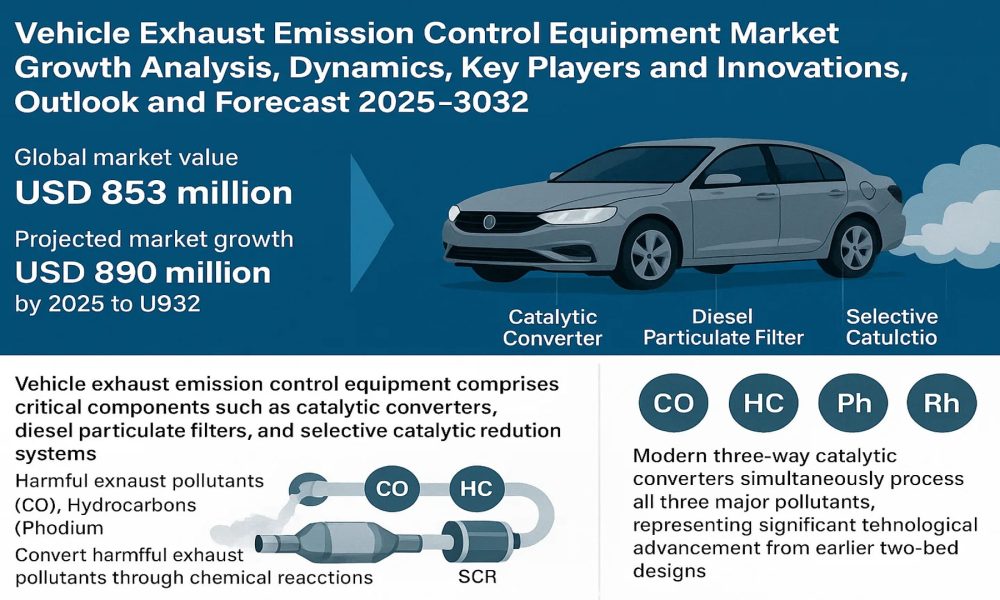
The global vehicle exhaust emission control equipment market was valued at USD 853 million in 2024. The market is projected to grow from USD 890 million in 2025 to USD 1,164 million by 2032, exhibiting a CAGR of 4.7% during the forecast period.
Vehicle exhaust emission control equipment comprises critical components such as catalytic converters, diesel particulate filters, and selective catalytic reduction systems. These systems utilize precious metals like platinum, palladium, and rhodium to convert harmful exhaust pollutants (CO, HC, NOx) into less toxic substances through chemical reactions. Modern three-way catalytic converters simultaneously process all three major pollutants, representing significant technological advancement from earlier two-bed designs.
The market growth is driven by tightening global emission standards and increasing vehicle production, particularly in Asia which accounted for 56% of 2022’s 81.6 million global vehicle production. However, the transition to electric vehicles presents a long-term challenge. Key players like Johnson Matthey, Faurecia, and Tenneco continue to innovate, with recent developments focusing on improved catalyst formulations and modular exhaust systems to meet Euro 7 and China 6B regulations.
Download Your Free Copy of the Sample Report-https://www.intelmarketresearch.com/download-free-sample/8019/vehicle-exhaust-emission-control-equipment-market
MARKET DYNAMICS
MARKET DRIVERS
Stringent Emission Regulations Globally Accelerate Adoption of Control Equipment
With climate change concerns escalating, governments worldwide are implementing progressively stricter vehicular emission standards. The Euro 6 standards in Europe, China VI norms, and Bharat Stage VI in India mandate significant reductions in NOx, particulates, and other harmful emissions. These regulations are compelling automakers to integrate advanced exhaust treatment systems like selective catalytic reduction (SCR) and diesel particulate filters (DPF). As enforcement tightens, the market for emission control technologies is expected to grow substantially. Notably, heavy-duty diesel vehicles now require multiple integrated systems to meet these standards, driving demand across commercial vehicle segments.
Expanding Electric Vehicle Adoption Creates Ancillary Demand for Hybrid Solutions
While pure electric vehicles continue gaining market share, hybrid powertrains incorporating internal combustion engines remain crucial transitional technologies. Hybrid vehicles still require sophisticated emission control systems since their engines operate intermittently under varying conditions. This creates unique challenges for catalytic converters and particulate filters, requiring temperature management solutions and advanced catalyst formulations. With hybrid vehicle production projected to grow at nearly 12% annually through 2030, the demand for specialized emission control equipment in this segment presents significant growth opportunities.
➤ The growing popularity of plug-in hybrids in Europe and North America, which accounted for over 1.2 million unit sales in 2023, is creating demand for next-generation catalytic converters optimized for intermittent operation cycles.
Urbanization and Air Quality Concerns Drive Aftermarket Replacement Demand
Rapid urbanization in developing nations is exacerbating air pollution, with vehicles contributing significantly to poor air quality in major cities. This has led to increased vehicle scrappage policies and more rigorous inspection/maintenance programs that mandate emission system replacements. The global automotive aftermarket for emission control components is consequently experiencing strong growth, particularly in Asia where vehicle parc ages have increased. Major cities now require periodic emissions testing, creating a substantial replacement market for catalytic converters and particulate filters in older vehicles.
MARKET OPPORTUNITIES
Development of PGM-Free Catalysts Presents Breakthrough Potential
Research into platinum group metal (PGM)-free catalytic converter technologies represents a significant opportunity in the industry. As precious metal costs remain high, alternative catalyst materials using copper, iron, or novel nanomaterials could reduce dependence on expensive inputs. Several manufacturers have already introduced prototype systems demonstrating promising performance, with commercialization expected within the next five years. Success in this area could reshape the competitive landscape while addressing cost pressures that currently limit market expansion.
Expansion in Commercial Vehicle Segment Offers Resilient Growth Prospects
The commercial vehicle sector continues to heavily rely on diesel engines due to their durability and efficiency advantages, ensuring sustained demand for advanced emission control systems. With global freight volumes projected to triple by 2050, truck and bus manufacturers will require increasingly sophisticated SCR and DPF solutions to meet stricter regulations. This segment is less susceptible to electrification disruption in the near-to-medium term, providing a more stable growth environment for emission control suppliers.
Circular Economy Initiatives Create New Value Recovery Channels
Growing focus on sustainability is driving opportunities in the recycling and remanufacturing of emission control components. Precious metal recovery from spent catalytic converters has become a substantial business, with recovery rates for platinum group metals exceeding 95% in advanced processes. Additionally, remanufacturing programs for OEM-approved replacement components are gaining traction in the aftermarket, offering cost-effective and environmentally sustainable alternatives to brand-new parts.
Segment Analysis:
Segment Category
By Type
- Three-Way Catalytic Converters
- Selective Catalytic Reduction (SCR) Systems
- Diesel Particulate Filters (DPF)
- Exhaust Gas Recirculation (EGR) Systems
Three-Way Catalytic Converters dominate the market due to stringent emission regulations for gasoline engines, with growing adoption in passenger vehicles.
By Vehicle Type
- Passenger Vehicles
- Commercial Vehicles
- Heavy-Duty Vehicles
- Off-Road Equipment
Passenger Vehicles are the largest segment, driven by high production volumes and stringent emission norms in key markets like Europe and North America.
By Fuel Type
- Gasoline
- Diesel
- Hybrid/Electric
- Alternative Fuels
Gasoline-powered vehicles require extensive emission control systems, especially three-way catalytic converters, to meet emission standards like Euro 6 and Tier 3.
By Sales Channel
- OEM
- Aftermarket
OEM installations are dominant as emission control systems are integrated during vehicle manufacturing to comply with regulatory standards.
VEHICLE EXHAUST EMISSION CONTROL EQUIPMENT MARKET TRENDS
Stringent Emission Regulations Driving Adoption of Advanced Catalytic Converters
The global vehicle exhaust emission control equipment market is undergoing significant transformation due to tightening environmental regulations across major economies. With emission standards like Euro 7, China 6, and Bharat Stage VI mandating drastic reductions in NOx, CO, and particulate matter, automakers are compelled to adopt sophisticated catalytic converter technologies. Three-way catalytic converters, which simultaneously reduce NOx while oxidizing CO and HC, now account for over 68% of gasoline vehicle applications. For diesel engines, selective catalytic reduction (SCR) systems using urea injection have seen adoption rates surge by 42% since 2020, as they can reduce NOx emissions by up to 90%. The market is witnessing accelerated R&D in precious metal catalysts, with palladium-rhodium formulations showing particular promise in meeting future ultra-low emission thresholds.
Other Trends
Electrification Challenges and Hybrid Solutions
While electric vehicles gain market share, traditional emission control systems remain critical for hybrid vehicles and conventional ICE fleets that will dominate roads for the next decade. Manufacturers are developing dual-mode exhaust systems that optimize performance across different drive cycles, with some hybrid-specific catalysts demonstrating 15-20% better thermal efficiency than conventional designs. This hybrid transition period creates unique opportunities for modular emission control solutions that can integrate with evolving powertrain architectures.
Recent Developments in the Vehicle Exhaust Emission Control Equipment Market:
- Stricter Global Regulations – Governments across Europe, North America, and Asia-Pacific have tightened vehicle emission standards (such as Euro 7, China VI, and US EPA norms), pushing automakers to adopt advanced catalytic converters, diesel particulate filters (DPF), and selective catalytic reduction (SCR) systems.
- Integration of Advanced Aftertreatment Systems – Leading manufacturers are introducing combined systems such as SCR + DPF + DOC (Diesel Oxidation Catalyst) to meet stricter NOx and particulate matter (PM) limits.
- Shift Toward Electrification-Compatible Components – With the rise of hybrid vehicles, companies are developing emission control equipment optimized for hybrid powertrains, which operate under varying load cycles.
- Expansion of Hydrogen and Alternative Fuel Vehicles – Innovations in emission control systems are being tailored for hydrogen-powered ICEs and vehicles running on biofuels and CNG/LNG, requiring modified catalytic technologies.
- R&D in Lightweight Materials – To improve fuel efficiency and reduce vehicle weight, exhaust system manufacturers are using advanced alloys, ceramics, and coated substrates for catalysts and filters.
- Collaborations and Partnerships – Companies like Tenneco, Faurecia, and Continental have expanded partnerships with automakers to co-develop integrated emission and thermal management solutions.
- Adoption of Smart Monitoring Systems – Integration of IoT-based exhaust monitoring and onboard diagnostics (OBD) ensures compliance and real-time emission tracking, particularly for fleet operators.
Download Your Free Copy of the Sample Report-https://www.intelmarketresearch.com/download-free-sample/8019/vehicle-exhaust-emission-control-equipment-market
About Intel Market Research
Intel Market Research delivers actionable insights in technology and infrastructure markets. Our data-driven analysis leverages:
- Real-time infrastructure monitoring
- Techno-economic feasibility studies
Competitive intelligence across 100+ countries
Trusted by Fortune 500 firms, we empower strategic decisions with precision.
International: +1(332) 2424 294 | Asia: +91 9169164321
Website: https://www.intelmarketresearch.com
Follow us on LinkedIn: https://www.linkedin.com/company/intel-market-research
Market Research Reports | Market Trends | SWOT Analysis | Industrial Survey – Intelmarketresearch
Intel market research provides market research reports and company research reports across worldwide industries. We also offers customized market research solutions



