
Definition
Border security refers to the integrated use of technologies, systems, and strategies designed to prevent unauthorized cross-border activities, protect national sovereignty, and ensure safe and legal movement of people and goods. The market encompasses a wide range of solutions including surveillance systems (radar, thermal cameras, ground sensors), biometric identification technologies, unmanned aerial vehicles (UAVs), automated entry/exit systems, and advanced command and control infrastructures. These systems are deployed across land, air, and maritime borders to detect, monitor, and mitigate threats such as illegal immigration, human trafficking, smuggling, and cross-border terrorism. The border security industry has evolved significantly over the last decade, shifting from traditional manpower-driven models to high-tech, AI-powered, and automated surveillance ecosystems that deliver higher efficiency and real-time threat detection capabilities.
Recent Developments
Recent developments in the border security market are heavily concentrated on the integration of advanced technologies to create more intelligent and automated systems. A key trend is the shift from a reliance on human-intensive patrols and physical barriers toward sophisticated, technology-driven solutions. This includes the widespread adoption of Unmanned Aerial Vehicles (UAVs) and autonomous surveillance towers, which are often equipped with AI-powered analytics to detect and track potential threats in real time. The market is also seeing rapid growth in biometrics, with the use of facial recognition and other biometric identification tools to streamline the process at legal ports of entry while enhancing security. Furthermore, there’s a strong focus on “smart border” solutions that connect various sensors and data points to provide a comprehensive, real-time situational picture for border control agencies.
Major Distribution
The distribution of border security products and services is a B2B model primarily directed toward government agencies and defense ministries worldwide. This market is dominated by a few large multinational corporations that specialize in defense, aerospace, and security technologies. These companies often win large, multi-year government contracts to design, develop, and implement integrated border security systems. The major distribution channels are therefore direct sales and service agreements between these companies and government entities, rather than a traditional retail or wholesale model. Key end-users include homeland security and military organizations responsible for managing a nation’s land, maritime, and airborne borders. Geographically, North America and the Asia-Pacific regions are major hubs for both the demand and supply of these technologies due to substantial defense budgets and ongoing security concerns.
Market Size
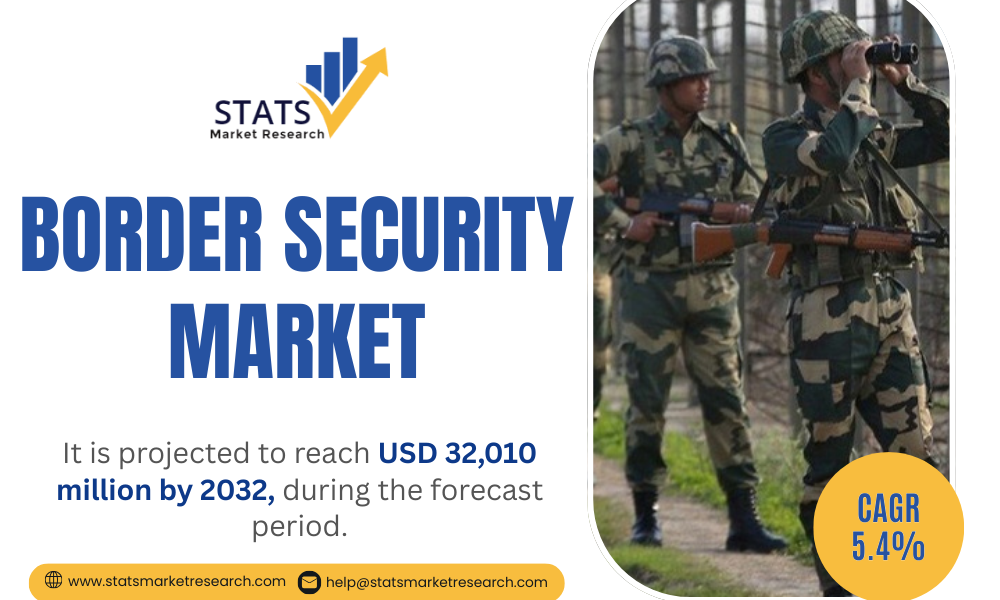
Global border security market was valued at USD 22,320 million in 2024 and is projected to grow from USD 23,480 million in 2025 to USD 32,010 million by 2032, exhibiting a CAGR of 5.4% during the forecast period. Historical analysis indicates consistent growth driven by rising geopolitical tensions and technological advancements. In 2020, the market stood at approximately USD 18 billion, demonstrating an average annual growth rate of 5-6% over the past five years.
Detection systems currently dominate the industry with a 63% market share, driven by increased deployment of AI-powered surveillance towers, thermal imaging solutions, and UAV patrols. Land border security solutions represent 67% of global deployments, reflecting government prioritization of terrestrial infrastructure, particularly in regions experiencing migration surges and territorial disputes.
Regionally, Europe leads with 41% market share, followed by North America and Asia-Pacific. Notable investments include the U.S. Customs and Border Protection’s USD 415 million investment in AI-powered surveillance towers and the EU’s Smart Borders initiative, which incorporates automated entry/exit systems across Schengen zones.
Download FREE Sample of this Report @ https://www.statsmarketresearch.com/download-free-sample/8057043/global-border-security-forecast-market
Market Dynamics (Drivers, Restraints, Opportunities, and Challenges)
Drivers
- Rising Geopolitical Tensions and Conflicts
Over 350 active border disputes worldwide in 2024 are pushing governments to allocate higher defense budgets toward securing borders. For example, the European Union allocated approximately USD 15 billion for border modernization, focusing on smart surveillance and data-driven monitoring. - Technological Advancements
AI-enabled detection systems now provide 98.7% accuracy in threat identification, a 40% improvement compared to five years ago. Innovations such as drone-based monitoring, automated license plate recognition, and IoT-based ground sensors are driving widespread adoption. - Data Sharing and Allied Cooperation
The standardization of cross-border intelligence sharing protocols enables real-time threat response. This has significantly improved joint monitoring efforts across regions such as the EU and NATO members.
Restraints
- Privacy Concerns
Biometric and facial recognition technologies face heavy regulatory restrictions, especially in Europe under GDPR. Civil liberty debates slow down adoption in democratic regions. - High Costs
Implementing large-scale border security systems requires an average USD 50-200 million in capital expenditure, with 15-20% annual maintenance costs, limiting penetration in developing economies.
Opportunities
- Emerging Economies
Countries in Asia, Africa, and South America plan USD 12 billion investments by 2030. For instance, India’s USD 1.2 billion Border Security Modernization Program integrates underground sensors, AI analytics, and thermal imaging towers. - Quantum Technologies
Quantum radar and quantum key distribution systems are being tested for border surveillance, offering 300% improved detection ranges and spoof-proof communication networks.
Challenges
- Technical Complexity
Shortage of skilled personnel results in delays averaging 18 months in nearly 30% of border security projects. - Interoperability Issues
Legacy and next-gen systems often lack compatibility, creating exploitable vulnerabilities.
Regional Analysis
- Europe (41% market share): Focus on Schengen-wide smart border initiatives, automated entry/exit systems, and counter-migration technologies. The EU is the largest spender globally.
- North America: The U.S. remains a leader with investments exceeding USD 3 billion annually in detection and AI-driven monitoring. Mexico and Canada are also upgrading infrastructure under joint security programs.
- Asia-Pacific: Territorial disputes in the South China Sea, India-China border tensions, and maritime monitoring drive regional demand. India and China are key spenders.
- Middle East & Africa: Adoption remains slow due to financial constraints, but conflict-prone zones such as Libya and the Sahel are prioritizing modular solutions.
- South America: Investments are growing in Brazil, Argentina, and Colombia to combat smuggling and illegal trafficking, with emphasis on UAV surveillance.
Competitor Analysis (in brief)
The global border security market is semi-consolidated, dominated by defense giants and technology-driven firms. BAE Systems and Lockheed Martin account for nearly 28% of market share. Chinese firms such as CETC SPACEON and CETC54 are gaining ground, particularly through regional partnerships. Mid-sized players like Dahua Technology and Uniview are targeting modular solutions for emerging markets.
Key strategies include public-private partnerships, AI-based R&D, and dual-use military technology adaptation.
Get the Complete Report & TOC @ https://www.statsmarketresearch.com/global-border-security-forecast-market-8057043
Global Border Security Market: Segmentation Analysis
This report provides a deep insight into the global border security market, covering all its essential aspects. This ranges from a macro overview of the market to micro details of the market size, competitive landscape, development trend, niche market, key market drivers and challenges, SWOT analysis, value chain analysis, etc.
The analysis helps the reader to shape the competition within the industries and strategies for the competitive environment to enhance the potential profit. Furthermore, it provides a simple framework for evaluating and assessing the position of the business organization. The report structure also focuses on the competitive landscape of the Global Border Security Market. This report introduces in detail the market share, market performance, product situation, operation situation, etc., of the main players, which helps the readers in the industry to identify the main competitors and deeply understand the competition pattern of the market.
In a word, this report is a must-read for industry players, investors, researchers, consultants, business strategists, and all those who have any kind of stake or are planning to foray into the border security industry in any manner.
Market Segmentation (by Application)
- Water Border Security
- Air Border Security
- Land Border Security (67% share)
Market Segmentation (by Type)
- Detection Systems
- Radar
- Infrared Sensors
- Biometric Scanners
- Others
- Communication Systems
- Command and Control Systems
- Others
Key Company
- BAE Systems (UK)
- Lockheed Martin (U.S.)
- CETC SPACEON CO., LTD (China)
- CETC54 (China)
- Hikvision (China)
- Dahua Technology (China)
- Uniview (China)
- Shanghai Eagle Sense Technology Co., Ltd. (China)
- Beijing Sinoits Tech Co., Ltd. (China)
- Guangzhou Sunscience Electronic Technology Company (China)
Geographic Segmentation
- North America
- Europe
- Asia-Pacific
- Middle East & Africa
- South America
FAQ Section
- What is the current market size of the Border Security Market?
The global border security market is valued at USD 22,320 million in 2024 and is projected to reach USD 32,010 million by 2032. - Which are the key companies operating in the Border Security Market?
Major players include BAE Systems, Lockheed Martin, CETC SPACEON, CETC54, Hikvision, Dahua Technology, Uniview, and others. - What are the key growth drivers in the Border Security Market?
Key drivers include geopolitical tensions, migration challenges, AI-powered surveillance systems, and quantum technology advancements. - Which regions dominate the Border Security Market?
Europe leads with 41% market share, followed by North America and Asia-Pacific. - What are the emerging trends in the Border Security Market?
Emerging trends include AI-enabled detection systems, biometric adoption, UAV-based patrols, data-sharing protocols, and quantum radar technologies.
About Us
☎️ International: +1 (332) 2424 294
📄 Website: www.statsmarketresearch.com
Join us on LinkedIn:- https://www.linkedin.com/company/statsmarketresearch




